
Lesotho Motorcycle Travel Challenges and Safety Tips
Explore Lesotho motorcycle travel challenges, safety tips, and planning advice for remote routes and budgets in Africa's highlands.
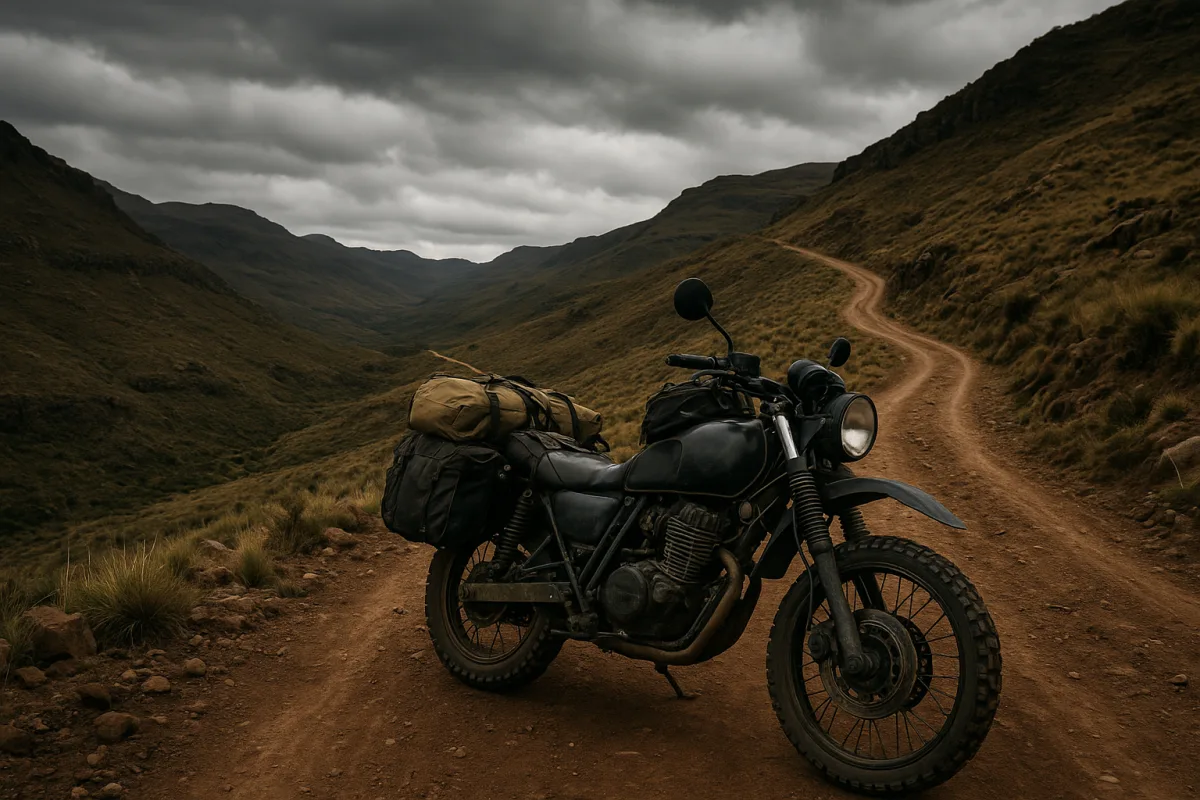
The travel decision that matters: when a route stops being reversible
The useful connection between a difficult mountain ride in Lesotho and a bowl of Burmese noodles in Bangkok is not adventure versus comfort. It is access. In both cases, the central question is how much local infrastructure sits between you and the thing you came to find.
On a mountain route, access means a passable surface, fuel, phone signal, daylight, physical energy and somebody capable of helping if the plan fails. In a city food district, it means vendors who can still afford ingredients, a legal place to trade and enough customers to keep specialised dishes available.
The difference is consequence. Missing a particular noodle stall means lunch elsewhere. Taking the wrong descent in Lesotho can mean being committed to a valley where even lifting a loaded bike becomes the day’s main task.
That distinction is clear in Lost LeBlanc’s account of a ride from Semonkong towards Sani Pass. The travellers were given three possible routes: a predictable highway taking five to six hours, a rough older road, and a valley track their lodge contact explicitly advised them to avoid.
A navigation mistake reportedly loaded the forbidden third option. The route began with villages and rough ground, then deteriorated into a steep, rock-filled descent with no useful tyre tracks, only donkey paths, repeated drops and eventually damaged brakes.
The important lesson is not that travellers should never seek rough roads. It is that route difficulty compounds. A single steep section becomes more dangerous after a fall, then more dangerous again when the bike is damaged, the rider is tired, water is low and the sun is down.
Why a wrong turn becomes an emergency
Road classification is usually the practical measure travellers miss. A highway is designed for regular traffic. A former forestry or mining road may be rough but still have a through-route. A village path may be maintained for walkers, horses and donkeys, not a loaded motorcycle.
Lost LeBlanc’s Lesotho ride demonstrates the gap. The riders could not simply reverse their mistake because uphill retreat over the terrain they had descended was no longer realistic. Local boys from a nearby village helped push, steady and lift the bikes over obstacles.
That local help was generous, but it should not be treated as a rescue plan. The research brief finds no detailed emergency-support network for motorcyclists in Lesotho’s remote mountains, and medical capacity outside urban areas is limited. Serious cases may require transfer to South Africa. [3]
Lesotho does have an emergency number, 112, while police contacts include +266 5888 1024 and +266 2232 2099. [7] Those are important numbers to save, but they do not solve the physical problem of reaching a rider on an impassable slope.
In the film, the travellers had no signal and used a villager’s phone to contact the lodge owner. They were told to aim for a green footbridge, around 20 kilometres away, and a lodge beyond the next settlement. That is navigation by landmarks, not a service network.
It also shows why phone signal alone is not the full contingency plan. A location pin is only useful if somebody can travel to it, knows the terrain and has the equipment to move an injured person or recover a motorcycle.
Lesotho’s published safety guidance describes steep, unpaved mountain roads, rockfall risks and sparse service stations in rural areas. It advises that a four-wheel-drive vehicle is needed in some areas. [4][8] That does not ban motorbikes, but it should reset expectations for what “road” means.
A motorbike also adds a mechanical vulnerability that is easy to overlook when planning from a map. A fall can bend a lever, damage luggage, drain fuel, injure an ankle or leave the rear brake ineffective. Each fault reduces the rider’s margin for the next obstacle.
Plan the exit before taking the scenic route
For independent riders, the workable planning unit is not kilometres per day. It is the last safe exit point. Before leaving pavement, decide at what time, fuel level, weather change or surface condition you will turn back.
That rule would have particular force in Lesotho’s winter. June through August can bring sub-zero temperatures, snow and blizzards that close roads. [3] The most sensible riding season is therefore outside that period, while still checking short-term rain forecasts because mud can immobilise traffic quickly.
Lost LeBlanc’s companion film from Semonkong gives useful context for why walking and riding animals remain practical transport. Residents described mud roads where cars cannot reliably travel, making horse riding or walking necessary in some places rather than a staged visitor activity.
The same film shows a donkey pub crawl and local bars, which makes entertaining viewing but should not obscure the transport point. Animals and local knowledge fit the terrain in ways a heavily laden visitor motorcycle may not, especially after rain.
Travel budgets also need separating from expedition budgets. TravelDojo estimates a budget Lesotho trip at roughly US$25 to US$40 a day, and a more comfortable trip at US$100 or more. [2] Those figures cover ordinary travel, not breakdowns, guides, recovery or medical evacuation.
There is no dependable 2026 evidence for visitor motorcycle rental prices or availability in Lesotho. Do not fill that gap with global bike prices, which place new entry-level 300 to 500cc motorcycles around US$4,500 to US$7,000 but do not describe the local rental market.
Practical preparation is less glamorous than selecting a dramatic route: offline mapping, a paper backup, water carried on the body, food, warm and waterproof layers, a charged power bank, basic first aid and a decision to avoid unknown tracks late in the day.
Helmet use is mandatory, and international driving permits are recognised in Lesotho. [1] Those legal basics matter, though they are only the start. A valid licence and helmet do not turn a livestock track into a motorcycle route.
There is some reason to expect gradual improvement rather than instant transformation. Lesotho’s Roads Directorate has allocated M1.86 billion, about US$115 million, to 2026/27 works including road upgrades, drainage and footbridges. [4] A route still needs checking locally before departure.
Bangkok’s Myanmar food scene: access without the border crossing
Bangkok offers the opposite kind of access. It lets travellers encounter Burmese dishes without depending on Yangon breakfast hours, local-language ordering or a particular market’s morning sell-out. That convenience matters, but it is supported by fragile small-business economics.
Luke Martin’s Yangon breakfast report for the Chopstick Travel channel shows why timing matters at source. A mohinga stall cooking over charcoal was reportedly selling out by 8:30 a.m., while its coconut-based ono khao swe was available only on Saturdays and Sundays.
Mohinga works as a useful entry point because the name hides a system of preparation. It is rice noodles in a broth made with river fish, garlic, chilli and onion, thickened with chickpea flour. Fish bones may be pounded and returned to the broth.
That thickness is not incidental. Chickpea flour gives body to a broth that could otherwise be thin, while toppings such as boiled egg, fried bottle gourd, banana stem, coriander, chilli and lime allow each bowl to be adjusted at the stall.
For travellers, that explains why “Burmese noodle soup” is too vague an order. Mohinga is fish-led and savoury. Ono khao swe is a richer chicken and coconut-milk noodle dish, also thickened with chickpea flour, and can feel more substantial at breakfast.
In Bangkok, Luke Martin’s Chopstick Travel report finds another expression of the same chickpea technique at a small shop called Burmese Noodle in Little India. Its tofu nway is not soybean tofu: it is a turmeric-tinted chickpea preparation poured over rice noodles.
That distinction matters for diners with allergies or simple expectations. The dish may be called tofu, but its basic ingredient is chickpea flour, not soy. It can be served soft and sauce-like, or allowed to set, sliced and dressed with peanuts, garlic water and pickles.
The report also identifies Rangoon Tea House in Bangkok as a more formal Myanmar-focused restaurant, serving dishes including mohinga, biryani and prawn curry. It is a useful option for a sit-down meal, rather than evidence that one venue represents all Burmese cooking.
For clear current price expectations, Mo.Na lists Burmese meals such as mohinga and tea-leaf salad at 50 to 120 THB. [6] Aung Thukha Myanmar Foods lists traditional Burmese dishes at 101 to 250 THB. [6] Those prices cover food, not drinks, transport or service charges.
Laxmi Celebrating of Myanmar Food is another named Bangkok option identified for Burmese flavours and service, but the available research does not provide a dependable price range. That is worth saying plainly rather than inventing a budget based on nearby restaurants.
The pressure behind the cheap bowl
A low-cost bowl exists because a vendor can buy ingredients, travel to work and trade from a viable location. Bangkok’s food economy has become less forgiving on all three points. Rising fuel, transport and ingredient costs have led to increases of roughly 5 THB per dish. [6]
That may sound minor, but it is material at a shop where a whole meal costs 50 to 120 THB. [6] For a traveller, it is a small change. For a vendor, it is the difficult decision between absorbing costs, shrinking portions or charging regular customers more.
Location is changing too. Bangkok has tightened street-vendor rules since 2022, with roughly 10,000 mobile vendors reduced and relocation to hawker centres encouraged. [6] The practical consequence is that a food search based on old videos may lead to a closed pavement pitch.
That does not make Bangkok’s Burmese food scene less worthwhile. It makes it more important to use a specific restaurant name, check current opening details, and be ready to eat in a small shop or food court rather than chase a romantic idea of permanent street stalls.
The contrast with Lesotho is useful. In the mountains, self-reliance means carrying what you need because help may be distant. In Bangkok, it means recognising that the affordable, specialised meal you want depends on vendors navigating costs and regulation every day.
Frequently Asked Questions
What are the main challenges of motorcycle travel in Lesotho?
Motorcycle travel in Lesotho faces steep, unpaved mountain roads, rockfall risks, and sparse service stations in rural areas. Remote routes can become impassable, with limited rescue capacity and no detailed emergency support network outside urban centers. Mechanical failures or injuries can quickly escalate due to the terrain and lack of nearby help.
How to prepare for remote motorcycle routes in Lesotho?
Before leaving paved roads, riders should identify the last safe exit point and set clear turnaround criteria based on time, fuel, weather, or road conditions. Carrying water, offline navigation tools, and wearing a helmet are essential. Riders must expect limited phone signal and plan for navigation by landmarks rather than relying solely on digital aids.
What safety precautions should motorcyclists take in Lesotho?
Motorcyclists should wear helmets and be prepared for serious injuries that may require evacuation to South Africa due to limited local medical capacity. It is important to avoid riding during winter months (June to August) when sub-zero temperatures, snow, and blizzards can close roads. Saving emergency numbers such as 112 and local police contacts is advised, though physical rescue may be difficult.
When is the best season to ride motorcycles in Lesotho?
The best time to ride is outside the winter months of June through August. During winter, sub-zero temperatures, snow, and blizzards pose significant hazards and can close roads, making travel unsafe and potentially impossible.
How to plan a motorcycle trip budget in Lesotho?
Reliable 2026 rental pricing and availability data for motorcycles in Lesotho is not available, so budgeting should not rely on sticker prices or assumed rental rates. General travel budgets for Lesotho range from $25–40 per day for budget travelers to over $100 for more comfortable travel, but motorcycle-specific costs require local inquiry and caution.
How we researched this
This article was assembled from 4 video sources across 2 channels, 8 cited references.
Nothing here is based on hands-on testing. Where a figure or finding appears, it belongs to the source cited beside it, and the writing says so rather than implying otherwise. Every source is listed below so you can check it.
Sources
Myanmar has DANGEROUSLY Good Breakfast! 🇲🇲 — Luke Martin
Trapped 2 Days on Lesotho’s Worst Motorbike Trail — Lost LeBlanc
I Found Myanmar's BEST Food in Bangkok! 🇲🇲🇹🇭 — Luke Martin
We Took the Wrong Road and It Led to Disaster — Lost LeBlanc
Safety in Lesotho 2026: rating, scams, laws — Backpack.travel
Is Lesotho Safe to Visit? 2026 Travel Safety Advisory | travelsafetybrief.com
Lesotho travel advisory today: is it safe right now? US, UK & Canada | Voyaggora
Watch Travel Experiences and Challenges in Africa on Youtube
Also from the sources
Related Articles
Travel Challenges in Remote Locations
Explore travel challenges in remote locations with tips on logistics, borders, budgets, and weather for self-supported adventure trips.
Underrated Travel Destinations Logistics and Budget Tips
Explore underrated travel destinations in 2026 with practical logistics, budget advice, and transport tips for a smooth trip.
Travel Safety and Remote Destinations: Key Tips for 2026
Learn essential travel safety tips for remote destinations in 2026, including evacuation planning, insurance, and realistic access considerations.
Travel Tips and Guides for Armenia and Indonesia
Get practical travel tips and guides for Armenia and Indonesia covering itineraries, budgets, visas, and transport advice for a smooth trip.