
France Protests Impact on Tourism
Learn how France protests impact tourism, including travel safety, hotel occupancy, and navigating Paris during unrest.
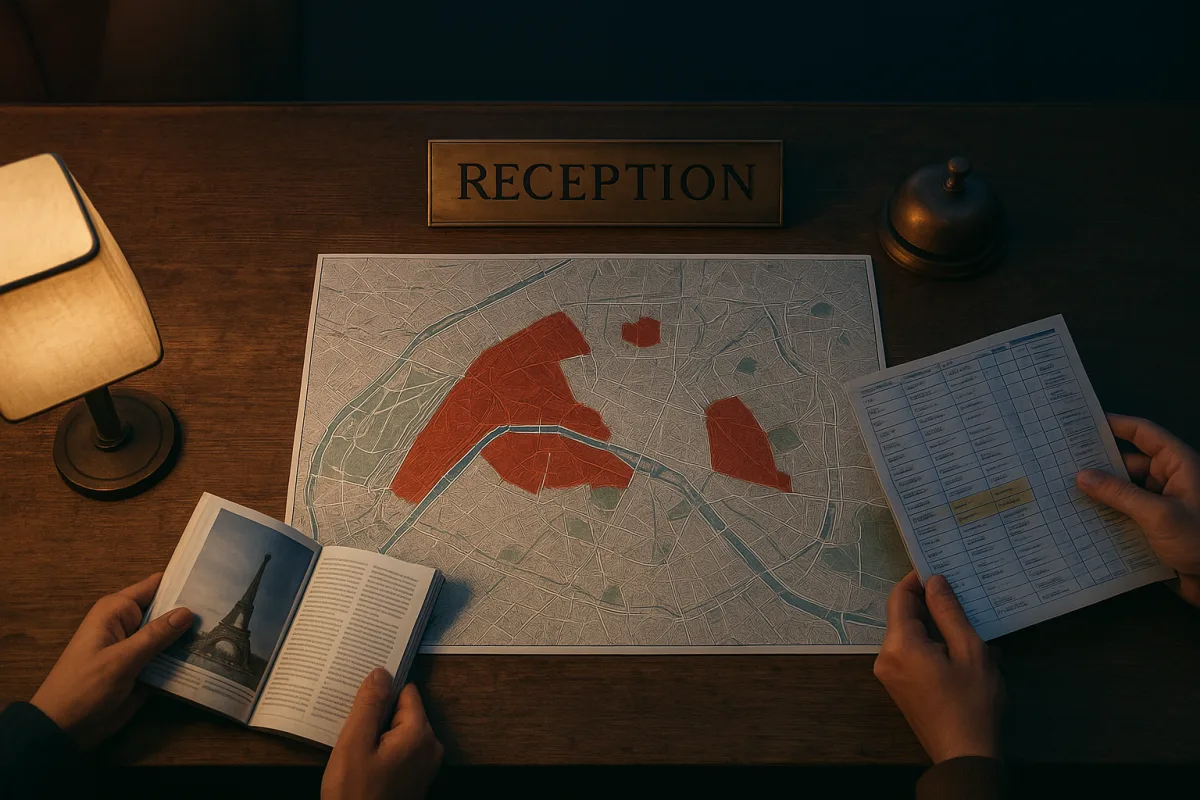
The number worth understanding: Paris hotel occupancy is not a safety rating
The easiest way to misunderstand France’s protests is to look at hotel demand and conclude that Paris is functioning normally. Hotels can be busy while visitors are facing closed Metro stations, curfews, altered walking routes, and cancelled museum plans.
Paris hotels recorded 75.0% occupancy in August 2026, up 2.7% year on year. Their average daily rate, usually shortened to ADR, was €342.97, up 8.7%, while revenue per available room reached €257.19. [7]
Those are strong figures, and they matter because they show that visitors had not broadly abandoned Paris before the latest escalation. They do not mean that a traveller arriving after the October protests will have the same practical trip.
To use those figures properly, it helps to know what each one measures. Occupancy is simply the share of hotel rooms sold. A 75% occupancy rate means roughly three of every four rooms were occupied, not that three quarters of visitors were sightseeing normally.
ADR measures the average price paid for sold rooms. It is calculated by dividing room revenue by the number of rooms actually sold. It is not the cheapest available rate, the typical traveller’s full trip cost, or a guarantee of what a room costs next week.
RevPAR, or revenue per available room, combines the two. A hotel can calculate it by multiplying ADR by occupancy, or by dividing all room revenue by every room it could have sold, including the empty ones.
At Paris’s reported August levels, €342.97 multiplied by 75% produces roughly €257 per available room, close to the reported €257.19 RevPAR. [7] That relationship is why hoteliers use RevPAR to judge whether demand and pricing are both holding up.
Why the hotel figures lag behind the disruption
August data is a rear-view mirror. The significant violence, looting, curfews, and public-gathering restrictions affecting Paris intensified from mid-October, so August cannot tell a traveller whether their November booking will be convenient or their route will be open.
The available research reports some cancellations and early departures after violence on October 17, yet bookings for the following two weeks remained above the equivalent period in 2025. October hotel performance figures were not available at the time of reporting. [7]
That leaves an important gap. Hotels may still be taking bookings, charging high rates, and reporting solid occupancy while travellers shorten stays, skip central districts, or spend more time and money on taxis because train and Metro access is unreliable.
A high ADR can also be a poor reason to book central Paris during disruption. If a discounted room near a protest location requires repeated detours, late-night taxi journeys, or abandoned reservations, its lower nightly price may not be the cheaper trip.
The practical question is therefore not, “Are tourists still going to Paris?” They are. The better question is, “Can I reach the places I paid to see, from the particular neighbourhood where I am sleeping?”
How the official warning system actually works
The U.S. Department of State’s France advisory remains at Level 1, “Exercise Normal Precautions,” as of October 19, 2026. [1] That is useful context, but it is a country-level assessment, not a promise that every Paris arrondissement is operating normally.
A Level 1 rating means the U.S. government has not judged France’s overall risk level high enough to issue a nationwide warning against travel. It does not cancel a police order, reopen a closed museum, or restore service to a Metro station.
The more immediate layer is local authority action. Central Paris has seen curfews and bans on public gatherings around places including Place de la République and Les Halles, where the operational risk is not abstract political unrest but being unable to enter an area or leave it easily. [8]
Then comes the transport layer. Metro closures have affected Charles de Gaulle, Étoile, Concorde, Opéra, Bastille, Louvre, Rivoli, and Saint-Michel, among other stations. These are not fringe stops that only residents use. [6]
A visitor staying near the Arc de Triomphe, for example, may be able to reach the area but find Charles de Gaulle, Étoile skipped by trains or closed. A reservation near the Louvre can be equally awkward if Louvre, Rivoli is unavailable.
This is why the headline advisory and the on-the-ground experience can appear to contradict each other. They answer different questions. One asks whether France as a whole is generally open to travel. The other asks whether your Tuesday afternoon itinerary works.
What disruption means for a normal Paris day
A normal Paris plan is dense by design. Travellers often combine a museum in the 1st arrondissement, shopping near Opéra, a walk across the Seine, and dinner in the Latin Quarter, relying on short Metro hops between them.
Protest-related closures break that model. A closed station does not necessarily strand you, but it can add a long walk, force a line change, or shift you onto crowded buses and taxis when many other people are making the same adjustment.
The Louvre’s October 19 closure is the clearest example. The museum was shut after protesters barricaded entrances amid student strikes, so a timed ticket did not guarantee entry on the day. [5]
That does not mean every landmark is closed. Condé Nast Traveler reported that the Eiffel Tower remained open and busy, while suggesting smaller museums such as the Musée Gustave Moreau in the 9th arrondissement and Musée Zadkine in the 6th as alternatives to high-profile central sights. [6]
Those alternatives are not merely quieter cultural choices. They are a way to reduce dependence on the corridors most likely to be affected by demonstrations, police operations, barriers, and rapid changes to transport access.
For a traveller, the sensible planning unit is one neighbourhood per half-day. If you have a morning booking near Saint-Germain-des-Prés, build the rest of that morning around the 6th arrondissement rather than assuming a quick cross-city journey will remain easy.
Where to stay, and what a room price does not cover
The most affected areas have included République, Les Halles, and commercial districts where looting and property damage were reported. More than 1,500 shops were damaged, including Louis Vuitton and Apple stores, while Carrefour estimated losses above €10 million. [7]
Those figures describe business damage rather than visitor danger, but they explain why shopping districts can become difficult places to base a trip. Police cordons, damaged storefronts, cleaning operations, and restricted movement can all disrupt a hotel stay without affecting the entire city.
Condé Nast Traveler specifically advises avoiding hotels close to République, Bastille, Nation, and Place de Clichy during active protests. It suggests the 14th, 15th, and 13th arrondissements on the Left Bank as quieter residential alternatives. [6]
The 15th is especially practical for travellers who want a less central base without leaving Paris. It has direct Metro connections when services are running, and sights such as the Musée Bourdelle are nearby, reducing the need to cross the city daily. [6]
A €342.97 ADR is an average, not a room quote. It also excludes the rest of a disrupted day’s costs: airport transfers if rail links are interrupted, taxis after a closed station, unused advance tickets, meals booked elsewhere, and possibly a second hotel night.
There is no reliable public measure yet for how much protest disruption has increased an individual visitor’s daily spend. The honest budgeting approach is to leave a transport contingency rather than treating a cheap central hotel deal as a complete saving.
A workable plan for bookings already made
Travellers with a non-refundable Paris booking do not necessarily need to cancel. France is not a nationwide no-go destination, and there is no official evidence yet of a quantified long-term collapse in international tourism. [1]
But keep each day flexible. Check the official RATP service updates before leaving your hotel, rather than relying on a route saved in a mapping app the night before. RATP is the operator whose notices reflect station and line changes. [6]
Also check the Paris Préfecture de Police for announced demonstrations, traffic restrictions, and security measures. Authorized marches are often scheduled in advance, although violence and looting may develop beyond the formal demonstration route. [6]
If a major museum or attraction is central to the trip, book it early in the stay where cancellation terms permit. A closure on day one is frustrating. A closure on the only afternoon left before a flight home can remove the visit entirely.
Choose restaurants and evening plans near your accommodation when curfews are in effect. This is less about avoiding Paris after dark in general than avoiding a situation where public transport stops changing rapidly and a short journey becomes a difficult one.
Finally, do not plan around a single Metro interchange. Carry a charged phone, a portable battery, a payment card that works for taxis, and an offline map. In a city where stations can close intermittently, redundancy is more valuable than an ambitious itinerary.
Frequently Asked Questions
How do France protests affect tourism in Paris?
While Paris hotels showed strong occupancy and pricing figures in August 2026, these data predate the mid-October protests and violence. Since then, disruptions such as curfews, Metro closures, and museum shutdowns have complicated travel, meaning visitors may face difficulties reaching attractions despite hotels still reporting solid bookings.
Are tourist attractions open during France protests?
Some major attractions have been closed temporarily due to protests. For example, the Louvre Museum closed on October 19 after student barricades and strikes. Travelers should expect sudden closures and plan flexible itineraries accordingly.
What areas should tourists avoid during Paris protests?
Tourists are advised to avoid accommodation and travel around central Paris neighborhoods where demonstrations occur, including République, Les Halles, Bastille, Nation, Concorde, Opéra, and Place de Clichy. These areas have seen curfews, public gathering bans, and sometimes violence or property damage.
How do protests impact Paris hotel availability and prices?
As of August 2026, Paris hotels maintained about 75% occupancy with average daily rates rising, but this data does not reflect the disruption starting mid-October. Some cancellations and early departures occurred after violent protests, yet bookings for subsequent weeks remained above 2025 levels. Travelers should be cautious as hotel availability and prices may not reflect the practical challenges of accessing certain districts.
What travel advisories exist for France amid protests?
The U.S. Department of State maintains a Level 1 advisory for France, meaning "Exercise Normal Precautions." However, this broad rating does not override local curfews, protest bans, or Metro station closures in Paris neighborhoods. Travelers should monitor local conditions and official sources for real-time updates.
How we researched this
This article was assembled from 3 published articles, 8 cited references.
Nothing here is based on hands-on testing. Where a figure or finding appears, it belongs to the source cited beside it, and the writing says so rather than implying otherwise. Every source is listed below so you can check it.
Sources
Louvre Closed, Travel Warnings Mount: What France’s Protests Mean for Tourists — Skift
Is it Safe to Travel to Paris Right Now Amidst the France Protests? — CN Traveler
Kempinski Faces Leadership Upheaval as CEO and Senior Executives Depart: Scoop — Skift
Police, protesters clash in Paris as tens of thousands rally across France
How France's worst rioting in years erupted and how the government responded
Louvre in Paris closes after violent protesters barricade museum entrances | Fox News
Paris Metro Skips Key Tourist Stops as Protests Close Stations
Louvre Closed, Travel Warnings Mount: What France’s Protests Mean for Tourists
Related Articles

Hospitality and Airline Experience Innovations in 2026
Explore key innovations in hospitality and airline experience, including AI, capacity challenges, and premium travel improvements in 2026.
AI Innovations in Travel: Planning, Booking, and Hotel Tech
Explore AI innovations in travel, from planning and booking challenges to hotel tech and compliance costs in the evolving travel industry.

Luxury Hotel Travel Rewards 2026
Explore luxury hotel travel rewards in 2026 and learn how $600 hotel credits truly work to reduce your travel costs.
Arabian Travel Market 2026
Explore key tourism trends, GCC visa updates, and regional travel insights from Arabian Travel Market 2026 for Gulf trip planning.