
Budget Travel Venice
Discover budget travel Venice tips for affordable stays, dining, gondola rides, and safe sightseeing in iconic Venetian neighborhoods.
Book Cannaregio before looking at San Marco
A €90 gondola tariff card is a better first sight in Venice than a hotel listing beside St. Mark’s Square. The ride has a fixed official price, while where you sleep can quietly consume half a short-trip budget.
The Tour Guy stayed in eastern Cannaregio, the northern neighborhood of canals, bars, and residential streets, and shared a €660 apartment for two high-season nights among three people. That made the accommodation cost €220 each, with more space and privacy than a hostel.
Cannaregio is where we would stay on a modest Venice weekend. You can walk toward Rialto and San Marco, but return to streets where dinner does not have to come with a view-tax built into every plate.
Do not assume one Venice price applies to every date. Cannaregio hotel searches for November 13 to 15 showed rates from about $295 per night for a three-star hotel and $327 for a five-star property, while a November 22 to 23 weekend produced budget three-star listings from $93. [1]
Another booking search listed Cannaregio stays from $87, reinforcing the point that calendar dates, cancellation terms, and hotel category drive the price far more than a broad label such as “high season.” [2] Check several dates before settling on a flight.
Apartments can still work well for groups, but do not book from a social-media link or an unfamiliar payment page. Fake accommodation listings and cloned hotel websites are among the reported Venice fraud risks, so use the lodging’s verified site or a recognized booking platform. [4]
Build dinners around cicchetti, not canal tables
The menu board with food photos in several languages is usually the moment to keep walking. Wolters World flags restaurants on the Santa Lucia-to-San Marco tourist route with huge multi-language menus and dozens of generic pasta choices as common tourist-trap signals.
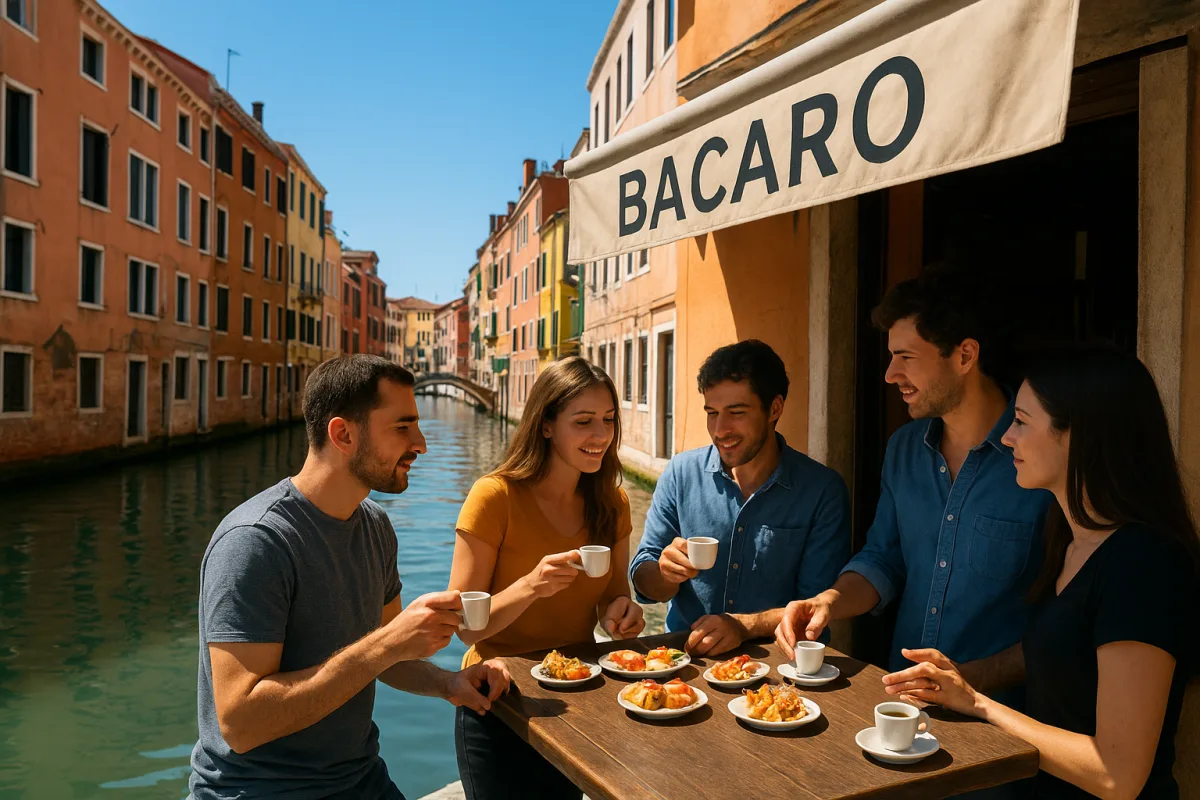
Instead, make aperitivo into dinner at a bacaro, a Venetian wine bar serving cicchetti, small snacks commonly built on bread with fish, vegetables, cheese, or other toppings. The Tour Guy recommends the bacari along Fondamenta dei Ormesini and Fondamenta della Misericordia in Cannaregio.
Their reported dinner budget is €20 to €25 per person for several cicchetti and wine, enough for an evening meal without a formal canal-side dinner. Bacaro and Timon are two named stops along this stretch, though the channel’s rule is simpler: pick somewhere busy, local-feeling, and appealing.
Near Rialto Market, The Tour Guy also suggests Cantina Do Spade for an ombra, Venice’s small glass of wine. Its budget allowed €18 for a mid-morning stop, a treat to make intentionally rather than an accidental all-day spending habit.
For lunch, look for tramezzini, Venice’s soft triangular sandwiches with generous fillings. At Bar alla Toletta in Dorsoduro, The Tour Guy paid about €8 for two sandwiches and water while standing at the counter, then budgeted €3 for two afternoon espressos.
Standing changes the coffee bill. Wolters World notes that Italian cafés commonly charge more for table service, while The Tour Guy budgeted under €4 for coffee when drinking at the bar. A seated San Marco coffee can be lovely, but it belongs in a splurge budget.
Check every bill before tapping your card. Wolters World advises reading it line by line, since a busy tourist restaurant can add an item you did not order, and a correction is easier while you are still at the table.
Price the headline sights as a package
Doge’s Palace, St. Mark’s Basilica, and a gondola are the places many budget travelers talk themselves out of visiting. We would keep all three, then choose between independent tickets and a guided bundle based on the actual difference.
The Tour Guy priced online Doge’s Palace admission at €30 and basic St. Mark’s Basilica admission at €10. Combined with half of a shared €90 daytime gondola, that works out to roughly €85 per person for two travelers. [3]
Its own three-and-a-half-hour small-group package started at about €119, including timed entry, guide, both admissions, and a 30-minute gondola ride. That is a €34 upgrade over the channel’s independent two-person calculation, not a substitute for the sights.
Paying extra for timed entry can be a good trade if your stay is only two days and queues would crowd out Cannaregio, Dorsoduro, or the lagoon. If you prefer to explore alone, buy the admissions separately and put the savings toward food.
Leave space for free Venice as well. The Tour Guy’s evening route through Dorsoduro, along the Zattere waterfront, and to Gelateria Nico looks beyond the checklist, with a chocolate-hazelnut gelato topped with whipped cream priced at €5.
Split the gondola correctly
A gondola is costly, but Wolters World is right not to call it a scam by default. It is a Venetian experience with a posted tariff, and the budget mistake is treating the boat’s price as a solo-traveler expense.
The official daytime fare is €90 for 30 minutes from 9 a.m. to 7 p.m., for a gondola carrying up to five passengers. The evening tariff is €110 for 35 minutes from 7 p.m. to 4 a.m. [3]
With four people aboard in daytime, that is €22.50 each before extras. With five, it falls to €18 each, which is the version we would aim for if you are traveling with friends or meet compatible travelers at your lodging.
Confirm the total, route, duration, and any add-ons before stepping in. A 20-minute extension officially costs €45 by day or €55 at night, while a musical serenade adds €150 to €200, and a gondolier should display the tariff card. [3]
Anyone quoting a per-person fare for the standard ride, or refusing to name the total first, is a reason to walk away. The reported risks are overcharging and unclear terms, not an undisclosed mandatory fee after the official fare. [3]
Reach Murano and Burano without losing the day
Murano and Burano can be a budget win or a time sink. The Tour Guy puts a 24-hour vaporetto pass at €25, covering the public water-bus network and making the islands the low-cost option for a final day.
Use that pass if you want to set your own pace, wander Murano’s canals, and decide how long Burano’s colorful lanes deserve. Wolters World recommends going independently specifically to avoid being held in a gift shop after a brief glass-blowing demonstration.
The alternative in The Tour Guy’s example was a €33 Murano and Burano trip, just €8 above the cited transit pass. It included a guide, private wooden-boat transport, a glass-blowing demonstration, a lace-making demonstration, and four and a half hours of structure.
That upgrade is compelling if you value the boat and want someone else to manage lagoon navigation. Skip it if you would resent a fixed itinerary or any sales pressure, then use the public pass and keep moving after the demonstration.
Do not confuse a workshop visit with a requirement to buy glass. Wolters World’s warning is about “free” excursions that spend far longer in the store than at the furnace, and that cost you something valuable even without a ticket price: your afternoon.
Buy a real mask only when you want one
Cheap masks are fine as a light souvenir, but do not pay artisan prices for something mass-produced abroad. Wolters World advises looking for a specialist shop with extensive mask stock if you want a genuine Venetian mask.
Authentic Italian-made masks have a wide range, from about €25 for simple papier-mâché work to more than €400 for elaborate gold-leaf and hand-painted pieces. Listed examples include a €33 Colombina and a €205 Piuma Sonia Half Face. [3]
A mask-making workshop can turn the purchase into an activity and give you a better sense of what you are paying for. If you only want a colorful photo prop, buy cheaply with clear expectations, or skip it and spend that money on a gondola seat.
Protect your cash, phone, and time in crowds
The vaporetto boarding line is where Venice asks you to watch your footing, your bag, your phone, and the person brushing past you all at once. Wolters World identifies crowded water buses, Rialto Bridge, Piazza San Marco, and the Accademia area as pickpocket pressure points.
Bring only the day’s payment cards and cash, then leave your passport and backup valuables in your hotel safe. Carry a wallet in a front pocket or use a secure bag worn across your front, not a backpack sitting behind you. [4]
Walk past anyone offering a “free” bracelet, rose, friendship, petition, or charity request. Reported scams use these interactions as distraction before demanding money or taking valuables, and refusing to engage is easier than arguing once a scene begins. [4]
Treat QR codes like payment links, not decoration. Venice safety guidance warns of fake codes on ticket machines and menus that lead to fraudulent payment pages, so use official transport, museum, restaurant, or hotel sites you have verified yourself. [4]
Use licensed transportation and agree on fares before anyone handles your luggage. Unlicensed taxi operators and unofficial baggage helpers demanding €10 or more are reported problems, especially where tired arrivals are looking for the fastest route to a hotel. [4]
Carry the Venice method to other European cities
Venice teaches a budget approach that travels well: sleep one neighborhood beyond the postcard center, share rooms, eat the local quick meal, and reserve a short list of paid highlights rather than paying admission everywhere.
Keep one deliberate comfort each day, whether that is a canal-side gelato, a guided cathedral entry, or a boat ride shared among friends. That is how you avoid the false economy of skipping the reason you came.
Put your money into experiences with a clear price and a defined inclusion list. A posted fare, a timed ticket, a bar counter, and a transit pass usually leave you with more control than a “free” excursion, a vague offer, or the first restaurant beside the landmark.
Frequently Asked Questions
How can I travel Venice on a budget?
Base yourself in the Cannaregio neighborhood and consider sharing an apartment with companions to reduce accommodation costs. Eat at busy local bacari for cicchetti and drink coffee standing at the bar to save money on meals. Use public vaporetti for lagoon trips and plan visits to major sights with a mix of independent tickets and guided options to balance cost and convenience.
What are affordable accommodation options in Venice?
Affordable options include three-star hotels and shared apartments in Cannaregio, with prices varying significantly by date and hotel rating. For example, budget three-star hotels can be found for around $87 to $93 per night on certain dates in November. Sharing an apartment among two or three people can reduce the cost further, offering more space and privacy than hostels.
How much does a gondola ride cost per person in Venice?
The official daytime gondola fare is €90 for up to five passengers for a 30-minute ride, which breaks down to €18 each if you fill all five seats. Evening rides cost €110 for 35 minutes. Additional charges apply for extras like longer routes or serenades, so confirm the total price before boarding.
Where can I eat cheaply in Venice without tourist traps?
Avoid restaurants with large multi-language menus along major tourist routes. Instead, eat cicchetti at busy local bacari in Cannaregio, such as those along Fondamenta dei Ormesini and Fondamenta della Misericordia, where a filling dinner can cost €20 to €25. For coffee, drink standing at the bar to pay under €4, and try tramezzini sandwiches at local bars like Bar alla Toletta for about €8.
Is it cheaper to visit Murano and Burano by public transport?
Yes, using public vaporetti to visit Murano and Burano is more affordable than guided boat trips. Unless a guided tour offers enough added value to justify its higher price, public transport is the budget-friendly option.
How we researched this
This article was assembled from 2 video sources across 2 channels, 4 cited references.
Nothing here is based on hands-on testing. Where a figure or finding appears, it belongs to the source cited beside it, and the writing says so rather than implying otherwise. Every source is listed below so you can check it.
Sources
Venice Pickpockets & Tourist Scams - What Can You Do?, Wolters World
Venice on a Budget: How to See Everything for €500, the tour guy
The best hotels in Cannaregio, Venice, ranked, from $295 a night
Is Venice Safe? Travel Tips & Safety 2026: Pickpockets & Scams
Watch Budget Travel in Iconic European Cities on Youtube
Also from the sources
Related Articles
Dublin Travel Guide: Itinerary, Budget & Getting Around
Plan your Dublin trip with this travel guide covering a 2-day itinerary, budget tips, transport options, and must-see attractions.
Budget Travel Tips for Singapore and Bangkok in 2026
Discover budget travel tips for Singapore and Bangkok, including affordable stays, transport, and daily costs to plan your 2026 trip smartly.
Travel Tips and Mistakes for Budapest and New York
Learn essential travel tips and mistakes to avoid on public transport in Budapest and New York for a smoother, cheaper trip.
Travel Dos and Don'ts in European Cities: Essential Tips
Discover essential travel dos and don'ts in European cities, including budgeting, safety, and booking tips for a smooth trip.