
Budget Travel Tips for Singapore and Bangkok in 2026
Discover budget travel tips for Singapore and Bangkok, including affordable stays, transport, and daily costs to plan your 2026 trip smartly.
Budget Travel Tips for Singapore and Bangkok
Start by choosing dates that do not inflate your bed price
Singapore is the harder city on a tight budget because accommodation sets the floor. Singapore Spirit’s 2026 budget estimate of S$75 to S$100 daily is achievable only with modest lodging, hawker meals and public transport rather than taxis and waterfront dining. [1]
Avoid booking Singapore over Chinese New Year, generally late January or February, or during the September Formula 1 Grand Prix. Creative Travel Guide flags both periods as times when demand pushes hotel rates upward, alongside school holidays and major events.
Bangkok generally gives a budget traveller more room. Bangkok cost guides put a basic daily total at about 900 to 1,400 baht, covering hostel accommodation, food, local transport and one modest activity or drink. [12][13][14]
That Bangkok number is not a luxury calculation. It assumes hostel-style lodging, and the available range for dorm beds is 300 to 600 baht nightly. Add several major temple tickets, rooftop drinks or repeated taxis and the low-end budget disappears quickly. [12][13]
For weather, plan your days rather than expecting either city to be comfortably walkable at noon. Singapore’s compact districts reward early starts and air-conditioned MRT breaks. In Bangkok, use rail for long crossings and reserve temple complexes or markets for morning and late afternoon.
Book the neighbourhood before you book the hotel
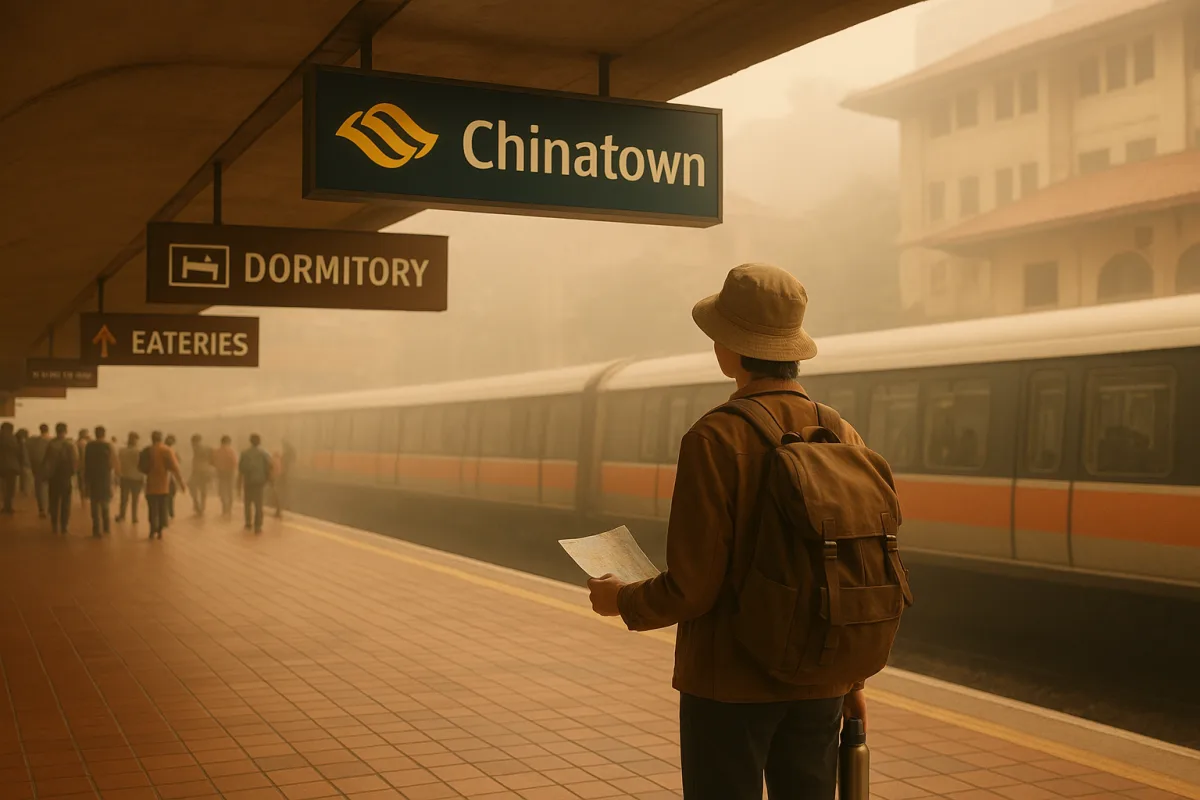
In Singapore, do not pay Marina Bay prices merely to be near the skyline. Creative Travel Guide recommends Chinatown, Little India, Bugis and Jalan Besar because MRT access matters more than sleeping beside the most photographed attractions.
Chinatown and Little India are the clearest value choices in the available pricing. Dormitory beds run S$25 to S$55 a night, while budget private rooms cost around S$70 to S$120. Those figures vary with dates, booking lead time and room type. [1][2]
Bugis is convenient for central sightseeing, but it is not documented as a hostel bargain. Available 2026 data places its mid-range hotels at S$150 to S$250 nightly, so it suits travellers splitting a room or prioritising location over the lowest bed price. [3]
Jalan Besar can be a useful compromise near Little India and Bugis, particularly for travellers who want a hotel rather than a dorm. Its reported mid-range average is about S$131 nightly, though no specific budget-private-room range is available. [2][3]
Check room dimensions before choosing the cheapest Singapore listing. Creative Travel Guide specifically cautions that lower-priced rooms can be notably small. A cheaper room works best when it is genuinely close to an MRT station and you plan to use it mainly for sleep.
Bangkok accommodation is more forgiving, but location still determines transport costs. Stay near a BTS or MRT station if your plan includes Siam, Silom or other modern districts. For Phra Nakhon’s temples, expect to combine rail with walking or river boats.
Get from the airport and pay for transport the sensible way
Singapore’s SimplyGo contactless system is usually the simplest short-stay option. Fares range from S$1.28 for trips up to 3.2 km to S$2.57 for longer journeys, so calculate whether a tourist pass actually beats pay-as-you-go travel. [4][5]
The Singapore Tourist Pass costs S$17 for one day, S$24 for two, S$29 for three, S$37 for four and S$45 for five days. It makes most sense for packed sightseeing days with repeated rides rather than a walking-heavy itinerary. [4]
An EZ-Link card costs S$5 for the card plus S$5 initial credit, and the card cost is non-refundable. TransitLink ticket offices, including those at Changi Airport’s Terminals 2 and 3, sell them. [4]
Build Singapore days geographically. Creative Travel Guide suggests beginning in Chinatown, walking through Clarke Quay towards Marina Bay, then continuing to Gardens by the Bay. That itinerary avoids treating every short hop as a taxi journey and still links major sights.
In Bangkok, BTS Skytrain fares run from 17 to 62 baht per trip and MRT fares from 17 to 45 baht. Contactless bank cards carry the same fares as stored-value cards, a practical choice for visitors who do not want leftover credit. [6][7][8]
A BTS one-day pass costs 150 baht, and an MRT one-day pass also costs 150 baht. There is no evidenced combined multi-day BTS and MRT tourist pass, so do not assume one ticket covers both systems. [6][7]
The Rabbit Card costs 200 baht upfront, consisting of a 100-baht card fee and 100 baht travel credit. It suits travellers making repeated BTS rides, but contactless payment is simpler for a shorter or mixed BTS-and-MRT stay. [6]
Do not let tuk-tuks become your Bangkok transport plan
Tuk-tuks remain useful as an occasional short-distance experience, not as budget transport. Research cited by Bangkok Knowledge puts 2 to 5 km rides at 100 to 200 baht, frequently around three times the price of a metered taxi. [15]
Agree the fare before boarding and decline unsolicited detours, especially offers tied to “closed” temples or bargain shopping. Bangkok budget sources warn that shop diversions and temple-related scams can turn an apparently cheap ride into an expensive, wasted afternoon. [12][15]
BTS and MRT are generally safer, cheaper and quicker for longer rides because they avoid road congestion, although pickpocketing remains possible in rush-hour crowds. Their weakness is coverage: the historic riverside and some temple areas still require walking, boats or a taxi. [16]
Use the Chao Phraya river as part of the sightseeing plan rather than paying for a private longtail boat by default. Expedia’s Bangkok guide identifies river ferries as a practical way to reach landmark areas around Phra Nakhon, including Wat Pho.
Spend on Bangkok’s temples deliberately, then use free neighbourhood time
Begin Bangkok’s historic day in Phra Nakhon, but price it before you arrive. The Grand Palace and Wat Phra Kaew charge foreign visitors 500 baht, are open 08:30 to 16:30, and stop ticket sales at 15:30. [9]
That ticket includes the Queen Sirikit Museum of Textiles, so include it rather than treating it as an additional purchase. Dress rules are strictly enforced, making this a poor place to arrive in beachwear and hope to buy a quick fix. [9]
Wat Pho costs 300 baht for foreign visitors and opens from 08:00 to 18:30. The ticket includes a water voucher, a small but useful inclusion when planning a hot walking day around the river. [10]
For a lower-cost, less heavily promoted alternative, Wat Suthat Thepwararam charges 100 baht and opens 08:30 to 16:00. The adjacent Giant Swing can be viewed free, making it a sensible addition after the Grand Palace rather than another large expense. [11]
Expedia’s guide calls Wat Suthat a quieter temple option and places it a short tuk-tuk ride from the Grand Palace. On a budget, walking or a metered taxi may be a better calculation than accepting the first tuk-tuk quote.
Give Chinatown an evening, not necessarily a large attraction budget. Expedia recommends Sampheng Market, Ong Ang Canal, Wat Traimit and Yaowarat Road, where street stalls make the district a food-focused alternative to a mall or rooftop-bar night.
Siam is convenient but can be expensive by design. Expedia identifies it with luxury malls and newer food destinations around Banthat Thong. Use the BTS to visit the Bangkok Art and Culture Centre, then set a food budget before entering the malls.
Silom offers a different low-cost balance. Lumphini Park costs far less than its surrounding rooftop bars and high-rise attractions, while its shaded paths provide a break from the spending pressure of shopping districts and evening cocktail venues.
Eat cheaply in both cities, but keep drinks out of the default budget
Singapore’s hawker centres are the practical answer to its higher restaurant prices. Creative Travel Guide recommends Maxwell Food Centre and Chinatown Complex Food Centre, where stalls serve dishes such as chicken rice, laksa and satay for a few Singapore dollars.
Use a mixed food budget rather than claiming every meal will be ultra-cheap. Have a local breakfast, make lunch a hawker-centre meal, then choose selected dinners carefully. The channel also suggests Eatigo and HungryHub for advance restaurant discounts.
Avoid eating every meal beside Marina Bay or inside major attractions. The view is free from many public spaces, while the food premium is not. Walk Marina Bay, photograph the skyline, then take the MRT back to Chinatown or Little India to eat.
In Bangkok, Yaowarat Road is built for an inexpensive evening of grazing, with grilled seafood, noodles and Thai-Chinese snacks. Expedia highlights sai krok isan sausage and Patonggo Savoey’s fried dough sticks as specific Chinatown stops worth seeking out.
Alcohol changes both budgets quickly, especially in Singapore. Creative Travel Guide advises checking bar social-media pages for happy hours and avoiding five-star-hotel rooftop bars unless there is a specific deal. Treat a skyline cocktail as a chosen splurge, not a nightly routine.
Keep paid Singapore attractions selective
Singapore rewards a free-neighbourhood itinerary. Spend time in Chinatown, Little India and Kampong Glam, then walk Marina Bay and Fort Canning Park. Creative Travel Guide notes that the Supertree Grove can be viewed from outside without paying an entry fee.
Choose paid attractions only after deciding what you would genuinely regret missing. The channel suggests a Singapore Pass for visitors planning several included attractions, particularly families, but it is only a saving if its included sites match your itinerary.
At Changi, Jewel’s Rain Vortex is free to see, which is useful before a flight without adding a paid activity. Some surrounding attractions cost extra, and Creative Travel Guide suggests checking Klook bundles before buying individual tickets.
The useful comparison between the two cities is straightforward. Singapore demands discipline on beds, restaurants and drinks, but has cheap, reliable public transport. Bangkok has lower daily costs, yet temple admissions, traffic and tuk-tuk scams punish travellers who do not plan routes.
Frequently Asked Questions
How much does budget travel cost in Singapore and Bangkok?
Budget travel costs about S$75 to S$100 per day in Singapore, covering dorm beds, inexpensive meals, public transport, and limited paid sightseeing. In Bangkok, a basic daily budget ranges from 900 to 1,400 baht, including hostel accommodation, food, local transport, and one modest activity or drink.
Where to stay cheaply in Singapore and Bangkok?
In Singapore, the cheapest accommodations are near MRT stations in Chinatown and Little India, where dorm beds cost S$25 to S$55 and budget private rooms run S$70 to S$120 per night. In Bangkok, hostel dorm beds typically range from 300 to 600 baht per night, with affordable options near BTS or MRT stations for convenient access to key districts.
What are the best budget transport options in Singapore and Bangkok?
Singapore’s SimplyGo contactless payment system offers fares from S$1.28 to S$2.57 per trip, making it a simple and affordable choice for short stays. In Bangkok, the BTS Skytrain and MRT are the best budget options, with fares starting at 17 baht and one-day passes costing 150 baht each, while tuk-tuks are generally more expensive and less economical.
How to plan daily expenses for budget travel in Singapore and Bangkok?
Plan for daily expenses of about S$75 to S$100 in Singapore, which includes modest lodging, hawker meals, and public transport. In Bangkok, budget around 900 to 1,400 baht daily, covering hostel stays, food, local transport, and one paid activity or drink, while keeping in mind that additional temple tickets or taxis can increase costs.
Which neighborhoods offer affordable accommodation in Singapore and Bangkok?
Affordable accommodation in Singapore is concentrated in Chinatown and Little India, favored for their low-cost dorm beds and budget private rooms near MRT stations. In Bangkok, staying near BTS or MRT stations in areas like Siam or Silom provides affordable lodging with convenient transport access, while Phra Nakhon offers proximity to temples but may require combining rail and river transport.
How we researched this
This article was assembled from 2 video sources across 2 channels, 16 cited references.
Nothing here is based on hands-on testing. Where a figure or finding appears, it belongs to the source cited beside it, and the writing says so rather than implying otherwise. Every source is listed below so you can check it.
Sources
Bangkok Travel Guide 2026: MUST-See Neighborhoods & Food — Expedia
Is Singapore Actually AFFORDABLE? Budget Travel Tips — Creative Travel Guide
How Much Does a Trip to Singapore Cost in 2026? A Realistic Budget Breakdown | JNP Travel
Singapore MRT Fares 2026 | Fare Table by Distance, Calculator
Getting Around Bangkok: Combining MRT & BTS for Seamless Travel – Thailand Unlocked
Bangkok Tuk-Tuk Scam Guide (2026): The 20-Baht Trap Explained
Watch Budget Travel Tips for Singapore and Bangkok on Youtube
Also from the sources
Related Articles
Dublin Travel Guide: Itinerary, Budget & Getting Around
Plan your Dublin trip with this travel guide covering a 2-day itinerary, budget tips, transport options, and must-see attractions.
Top Travel Destinations and Rising Cities to Watch 2026-2027
Discover top travel destinations and rising cities for 2026-2027 with tips on budgets, transport, and unique local experiences.
Underrated Travel Destinations Logistics and Budget Tips
Explore underrated travel destinations in 2026 with practical logistics, budget advice, and transport tips for a smooth trip.
Travel Tips and Guides for Armenia and Indonesia
Get practical travel tips and guides for Armenia and Indonesia covering itineraries, budgets, visas, and transport advice for a smooth trip.