
American Airlines First Class Upgrade Policy Explained
Learn how American Airlines prioritizes first class upgrades, including deadheading pilot policies and impact on elite travelers.
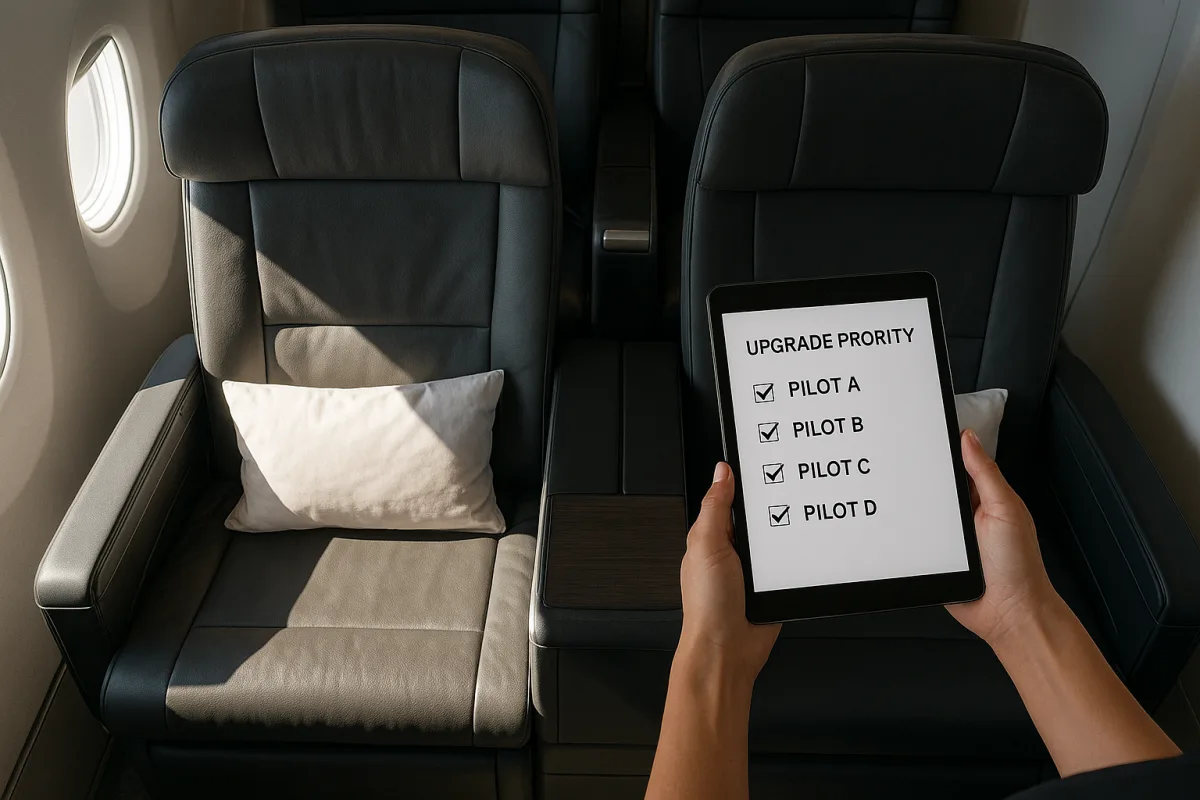
The American Airlines first-class upgrade queue, explained
The controversial part of American Airlines premium travel is not that pilots can sit in first class. It is where deadheading pilots sit in the upgrade queue, and how late in the process they can displace an elite customer.
A deadheading pilot is traveling because American needs that pilot somewhere else for work. That could mean positioning the pilot for their next operating flight, or bringing them back after the final flight of a work trip. It is not the same as commuting to a base or using employee leisure travel privileges. [3]
Under the pilot contract negotiated in 2023, American gives deadheading pilots top priority for available first-class upgrades during the final 24 hours before departure. The policy took effect in November 2025, according to reporting compiled in the independent research brief. [3]
That final-day window is the important detail. Before 24 hours, American uses its regular AAdvantage upgrade process. A passenger with high status can clear early, and once that upgrade is confirmed, the seat is no longer available for a pilot upgrade. [3]
In theory, that means a top-tier traveler has a way around the policy: clear before the last 24 hours. In practice, that is increasingly difficult, because American now sells more of its remaining premium inventory rather than releasing it as complimentary upgrades.
What happens to the last unsold seat
Think of a domestic flight with 20 first-class seats. Some are sold when the timetable opens, perhaps to travelers who pay for first class outright or buy a business-oriented fare that includes it.
Others may be sold later as cash upgrades. View from the Wing reports that American often offers remaining first-class seats for relatively low sums, sometimes $26 or $40, instead of reserving them for frequent-flyer upgrades. [3]
That leaves a smaller pool of seats for complimentary upgrades. If no seats remain, a deadheading pilot does not create one. The airline expects the pilot to travel in the available cabin and still report fit for duty. [3]
If a seat remains inside 24 hours, though, the pilot moves ahead of customers still waiting. That can include American’s most valuable AAdvantage members, even passengers holding ConciergeKey status, its invitation-only top tier. [3]
The controversy is therefore mostly about a scarce resource. A traveler can spend heavily with American, earn status, see an upgrade shown as possible, and then lose the final available first-class seat to a pilot traveling for work.
American has confirmed that pilots receive this priority only in the 24-hour period and only when premium seats are available. [3] The airline is following a collectively bargained working condition, rather than giving individual crew members an informal perk.
Why pilots wanted this benefit
Deadheading is work-related travel, even if the pilot is seated as a passenger. Federal duty-time rules treat deadheading as duty, not rest, so the time counts toward the limits governing a pilot’s workday. [3]
That point matters because it rebuts one common explanation of the policy. A pilot does not get to travel four hours in first class, treat that time as restorative rest, then begin a completely fresh maximum flying duty period.
Flying in a passenger seat can certainly be more comfortable in first class, especially on a long domestic route. It may also make a demanding work trip more tolerable, which is a legitimate subject for labor negotiations.
But the evidence available does not establish that coach seating made the operation unsafe before American granted this priority. View from the Wing notes that the airline still requires pilots to be fit for duty regardless of cabin. [3]
There is also a practical distinction between a deadheading pilot and a pilot who has already cleared an upgrade early as a regular traveler. This policy concerns the former, because American has an operational need to move that employee.
For the pilot, the system is straightforward: be assigned to deadhead, check in within the eligible period, and receive priority if first class is still unsold and unassigned. The outcome depends on availability, not simply on seniority or personal preference.
Why elite flyers see it differently
The frequent-flyer complaint is not usually that pilots should travel badly. It is that American markets elite status as a meaningful path to upgrades while making those upgrades harder to obtain through both paid sales and last-minute pilot priority.
A customer who spends $30,000 or $50,000 a year with the airline may have chosen less convenient flights, paid more flexible fares, or directed credit-card spending to American partly for the promise of recognition. [3]
When that customer is still waiting at the gate, first class is not just a better seat. It is the visible measure of whether the loyalty program delivered the benefit it implied.
American’s public upgrade information explains the ordinary passenger hierarchy through status, upgrade instruments, and Loyalty Points. View from the Wing argues that the airline should state pilot priority plainly as part of that hierarchy. [3]
That would not make the policy more popular, but it would make it bookable information. A traveler deciding between a 7 a.m. American flight and a competitor’s slightly later option could assess the actual odds instead of assuming status alone controls the result.
There is no public figure showing how much revenue American loses, if any, because of dissatisfaction with this policy. Customer complaints are visible, but the financial effect on bookings, AAdvantage engagement, and card spending has not been quantified. [3]
That uncertainty is worth keeping. It would be too neat to claim that pilot upgrades are responsible for American’s broader financial challenges, when the airline’s costs, network decisions, aircraft plan, and fuel exposure matter far more.
Paid upgrades have changed the value calculation
For a traveler, the old mental model was simple: fly enough, reach a high elite tier, and expect a reasonable chance of a free seat at the front on domestic routes. That model is no longer reliable.
American wants passengers to buy up. Its premium revenue rose 22.9% year over year in the third quarter of 2026, faster than coach revenue, which grew 18.5% by the measure cited in the airline’s results. [5]
The company has also said passengers increasingly buy regular Main Cabin fares instead of Basic Economy after American removed complimentary seat selection and upgrade eligibility from its most restrictive fare. The reported step-up was six percentage points. [5]
From American’s perspective, selling a $40 first-class upgrade brings immediate revenue. Giving the seat to an elite member may reinforce long-term loyalty, but it does not create a ticket-by-ticket cash payment on that specific flight.
That does not mean a $40 upgrade is always irrational. On a two-hour flight, it may be a reasonable price for a larger seat, early boarding, a meal or drink where offered, and a better chance of overhead-bin space.
It does mean travelers should stop treating a possible complimentary upgrade as part of the fare they bought. If first class matters for a particular trip, either purchase it outright or decide what cash offer is worth accepting.
For trips where the front cabin does not matter, choose a fare based on the ticket price, schedule, baggage needs, and seat selection rules. Status can still add value, but it should be treated as an uncertain extra.
Baggage is the premium benefit travelers can price exactly
American’s baggage rules are far easier to value than upgrades. On domestic itineraries, including Puerto Rico and the U.S. Virgin Islands, a standard Main Cabin passenger pays $45 for the first checked bag if prepaid online, or $50 at the airport. [7]
The second bag costs $55 prepaid or $60 at the airport. A third and subsequent domestic checked bag costs $200, which makes it worth consolidating luggage or comparing a shipping quote for longer trips. [7]
Basic Economy costs more. The first checked bag is $50 prepaid or $55 at the airport, while the second costs $60 prepaid or $65 at the airport. Those rates apply to tickets bought on or after the relevant 2026 policy dates. [7]
A bag must generally stay within 50 pounds and 62 linear inches, measured by adding length, width, and height. Overweight or oversized charges can apply on top of the normal bag fee, so a large suitcase is not automatically covered by a free allowance. [7]
For a traveler checking one bag on four domestic flight segments in a year, the ordinary prepaid cost is $180. On that narrow arithmetic alone, an eligible American Airlines card with a free first bag can be useful.
Most eligible AAdvantage credit cardholders receive a first checked bag free on domestic American-operated flights, while elite members receive complimentary bag allowances across American flights. [7] Credit-card and elite allowances generally do not stack into extra free bags.
Premium-cabin tickets offer clearer value too. Domestic first class, business class, and premium economy include two checked bags, while Flagship First and Flagship Business Plus include three, according to The Points Guy’s policy guide.
For international travel, check the route before assuming a universal fee. American’s official 2026 update lists $70 for a first checked bag and $100 for a second on certain South American routes, but allowances vary elsewhere by destination and fare. [7]
How the fleet plan fits the upgrade problem
American cannot improve upgrade availability merely by changing the queue. It needs more premium seats, especially on domestic aircraft where elites, paid-upgrade buyers, and deadheading crews are all competing for the same limited front cabin.
The airline’s plan is to bring premium seating, including Main Cabin Extra, to roughly 40% of narrowbody seats. That is broader than adding first class alone, because Main Cabin Extra is a paid step between standard economy and the front cabin. [5]
American has also committed to five additional Airbus aircraft for delivery from 2027 through 2029, although it has not disclosed the specific models or financing terms. It also agreed to acquire two used Boeing 777-200ER aircraft in the fourth quarter of 2026.
The nearer-term passenger experience will depend more on retrofits than those new orders. Reporting by View from the Wing says American plans additional first-class and Main Cabin Extra seats, refreshed cabins, and seatback screens on narrowbodies, largely beginning in 2028.
The FAA’s October 2026 clearance of Boeing’s 737 Max 10 also matters to American’s longer-range capacity planning. American expects deliveries beginning in 2027, though an approved aircraft is not the same as immediate fleetwide premium-seat relief. [1]
Premium travel is now a revenue strategy, not a loyalty promise
American’s management is leaning into premium revenue because it needs to. Third-quarter 2026 revenue reached $16.3 billion, up 19.3%, yet the carrier still recorded an adjusted net loss of $0.28 per diluted share. [5]
Fuel costs rose by $1.9 billion year over year, a 67.5% increase, according to the airline’s reported third-quarter figures. [5] Its operating margin was negative 0.07%, compared with 6.87% at Delta and 6.06% at United. [5]
That is the commercial backdrop for the upgrade queue. American has reason to sell seats that once would have gone to elites, and reason to add more premium capacity, but it also has to honor a pilot contract negotiated when pilot labor had substantial leverage.
For travelers, the useful response is practical rather than emotional. Price the seat you need, count confirmed bag benefits, and view any complimentary upgrade as a possibility that becomes less likely when first class sells well or a deadheading pilot enters the final-day queue.
Frequently Asked Questions
How does American Airlines prioritize first class upgrades?
American Airlines follows a standard AAdvantage upgrade process until 24 hours before departure, allowing elite travelers to clear upgrades early. Within the final 24 hours, deadheading pilots receive top priority for any remaining first-class upgrades, ahead of AAdvantage members still waiting. This priority applies only if premium seats remain available at that time.
What is the deadheading pilot upgrade policy on American Airlines?
Under a 2023 pilot contract effective November 2025, deadheading pilots—those traveling for work repositioning—get top priority for first-class upgrades during the last 24 hours before departure. This policy applies only if premium seats remain unsold and does not guarantee an advance confirmed upgrade.
Can pilots get first class upgrades ahead of elite customers on American Airlines?
Yes. Within 24 hours of departure, deadheading pilots are given priority over all other customers, including the highest-tier AAdvantage members, for any remaining first-class upgrades. However, this priority only applies if premium seats are still available at that late stage.
When do deadheading pilots get priority for upgrades on American Airlines?
Deadheading pilots receive upgrade priority only during the final 24 hours before the flight's departure. Before this window, upgrades are processed through the regular AAdvantage system, where elite travelers can clear early and secure upgrades ahead of pilots.
How do paid upgrades affect complimentary upgrades on American Airlines?
American Airlines often sells remaining first-class seats as paid upgrades close to departure, sometimes at relatively low prices. This practice reduces the number of seats available for complimentary upgrades, making it harder for elite travelers to clear upgrades early and increasing the likelihood that deadheading pilots will receive any last available premium seats.
How we researched this
This article was assembled from 5 published articles, 7 cited references.
Nothing here is based on hands-on testing. Where a figure or finding appears, it belongs to the source cited beside it, and the writing says so rather than implying otherwise. Every source is listed below so you can check it.
Sources
American Airlines baggage fees and how to avoid paying them — The Points Guy
The unspoken rules of Japanese body language — BBC Travel
American Airlines Confirms Pilots Get First Class Upgrades Ahead Of Its Best Customers—Should They? — View from the Wing
American Airlines Quietly Orders Five More Airbus Jets—And Buys Two Used Boeing 777s — View from the Wing
American Airlines Revenue Jumps 19%, Losses Grow—But Signs The Premium Pivot Is Working — View from the Wing
FAA clears the way for airlines to put Boeing's long-delayed 737 Max 10 into service
American Airlines Confirms Pilots Get First Class Upgrades Ahead Of Its Best Customers—Should They?
American Airlines Q3 2026 slides: revenue surges 19% amid fuel crisis By Investing.com
American Airlines (AAL) Q3 2026 Earnings Call: Fuel Costs Offset 19.3% Revenue Growth
American Airlines updates bag fees and Basic Economy fares - American Airlines Newsroom
Related Articles
Airline Upgrade and Refund Policies
Learn about 2026 airline upgrade and refund policies, including paid upgrades, skipped segments, and elite upgrade changes.
Alaska Airlines Premium Upgrades: Reserve vs Aurora Suites
Explore Alaska Airlines Premium Upgrades, comparing Premium Reserve and Aurora Suites to help choose the best option for your trip.
Airline Innovations 2026: Enhancing Passenger Experience
Explore airline innovations in 2026 improving passenger experience, from automatic check-in to biometric travel and better disruption handling.
Airline Loyalty Program Changes and Updates in 2026
Explore 2026 airline loyalty program changes, status updates, and how fare choices impact upgrades and benefits across major US airlines.