
Traveling Europe with Rail Passes in 2026: Guide & Tips
Learn how to use rail passes for traveling Europe in 2026, including costs, reservations, pass types, and planning tips for budget-friendly trips.
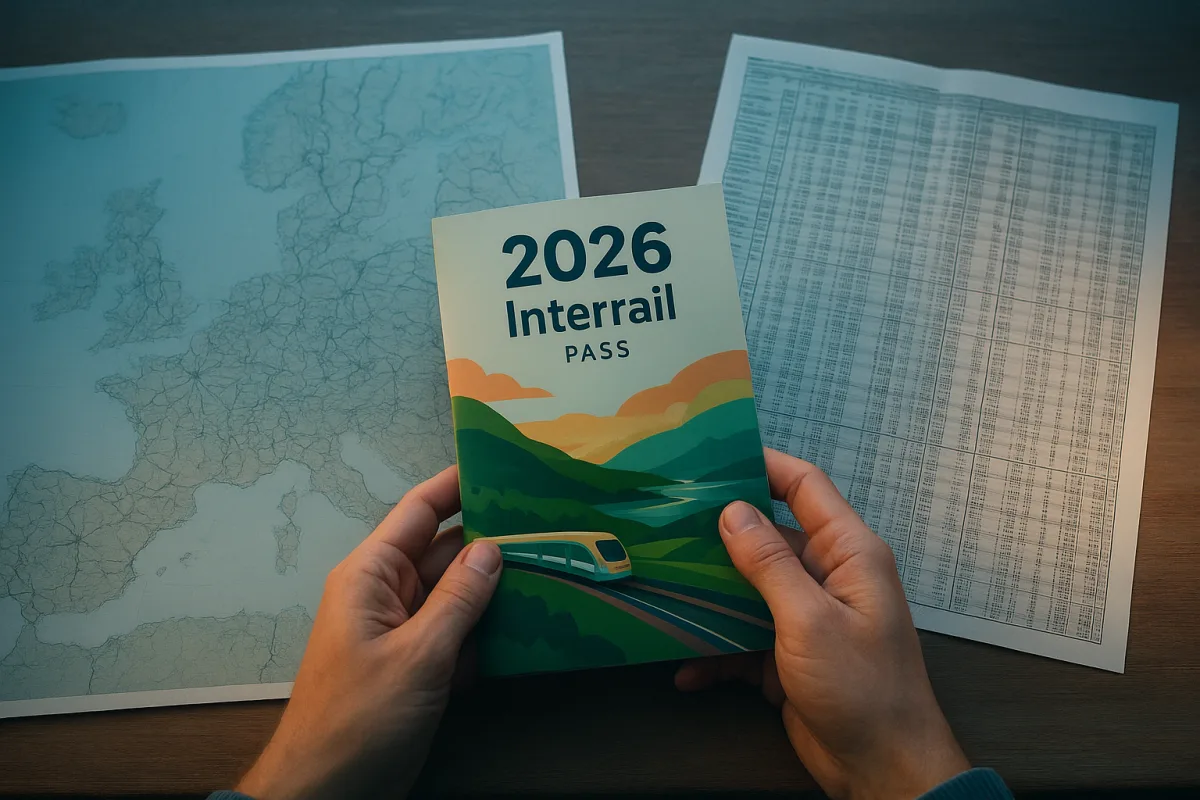
Start with the name change, then ignore the marketing fuss
If you have searched for Eurail and found Interrail instead, you have not missed a new product. In 2026, the Eurail name was folded into Interrail for travellers worldwide. The coverage and core benefits did not change. [1]
That means non-European visitors can now buy an Interrail pass under the same brand formerly associated with European residents. It still covers travel in 33 countries with 35 participating operators, but that is not the same thing as unlimited access to every train. [1]
Happy to Wander’s 2026 guide usefully flags the practical change most buyers will notice: digital passes are now the default, while paper passes carry an extra charge. Buy a mobile pass unless you have a specific reason to carry paper.
The name change will not solve border logistics, reservation rules or operator exclusions. A pass is a prepaid ticketing framework, not a guarantee that every departure has a pass-holder seat available when you want one.
Decide whether a pass is worthwhile before choosing one
The expensive mistake is buying a Global Pass because the route looks geographically ambitious, then discovering that most trains need paid reservations. Start with a spreadsheet containing every long rail journey you actually expect to take.
Add the normal advance fare for each trip, then add the likely reservation charge where applicable. EuroRail Times suggests a pass becomes more compelling when point-to-point fares total roughly 1.5 times the pass price, allowing room for reservation costs and flexibility. [2]
That calculation particularly favours travellers making expensive cross-border or last-minute journeys. It is less convincing for a week spent on slow regional trains in one country, or for an itinerary built around inexpensive advance tickets.
A One Country Pass deserves a separate comparison. Happy to Wander argues that these are often poor value, though the answer depends on the country and route. A Global Pass covers a much wider network, so do not assume a national pass is automatically cheaper.
The pass also makes more sense when your route is slightly uncertain. If you want to decide later whether to add Ljubljana after Vienna, or Bologna after Venice, a flexi pass can protect you from late-booking ticket prices.
Choose the duration that matches how you actually move
Interrail sells Flexi Passes for a set number of travel days within one or two months. A travel day lets you take multiple eligible trains, so it suits an itinerary with longer stays and occasional relocation days.
For 2026, adult Flexi Passes cost €283 for four days in one month, €318 for five days, €381 for seven days, €447 for 10 days in two months, and €553 for 15 days in two months. [9]
Youth prices are €212, €239, €286, €335 and €415 respectively. Senior prices are €255, €286, €343, €402 and €498. Those prices cover the pass itself, not reservations or upgrades. [9]
A seven-day pass, for example, is sensible for a route such as Amsterdam, Cologne, Prague, Vienna, Budapest, Ljubljana, then Venice. Spend two or three nights in each place, and use each pass day for a real intercity move.
Continuous passes suit a different traveller: someone taking trains nearly daily, perhaps combining cities with day trips. Adult prices are €476 for 15 consecutive days, €586 for 22 days, €696 for one month, €804 for two months and €931 for three months. [9]
The equivalent Youth Continuous Passes cost €357, €440, €522, €620 and €717. Senior prices are €428, €527, €626, €717 and €804. Again, those figures exclude mandatory seat reservations. [9]
For most independent trips, the Flexi Pass is the more defensible purchase. As Happy to Wander notes, a continuous pass only pays when you genuinely expect to ride often, rather than taking trains because the pass makes them feel free.
Choose a route that does not turn reservations into the whole trip
The rail pass works best on an itinerary where regional and conventional intercity trains do much of the work. It becomes more cumbersome where every major leg relies on a high-speed service with a limited pass-holder quota.
France is the clearest example. TGV reservations cost €12 to €37 on top of the pass, while Eurostar reservations commonly cost €29 to €37. A Paris, London, Amsterdam, Barcelona itinerary can therefore accumulate substantial supplements. [3]
Do not assume the pass works on the cheapest version of every route, either. EuroRail Times notes that France’s low-cost Ouigo services do not accept Interrail, so travellers must buy a separate ticket or choose another train. [2]
That matters when comparing a pass against advance fares. A €447 10-day Global Pass can look good beside flexible high-speed fares, but much less so beside a carefully booked Ouigo or other low-cost ticket that the pass cannot cover.
Build in alternatives before committing accommodation. If a Paris to Barcelona direct train has no pass-holder places, an itinerary that can absorb a night in Lyon or a route through another city is much easier to rescue.
Book the pass, then reserve the difficult trains first
Buy direct from Interrail if the price is the same, mainly because it gives you a cleaner customer-service route. Happy to Wander reports that authorised sellers such as Trainline and Rail Europe issue an activation code for the same app-based pass.
Before payment, check that the website has selected the correct traveller category. Happy to Wander notes that the booking flow can default to youth pricing, which makes displayed prices look better than an adult fare.
Once the pass is in the Rail Planner app, reserve the trains most likely to create problems before booking hotels around them. These are Eurostar, international high-speed services, overnight trains and popular French, Italian and Spanish departures.
Interrail warns that pass-holder seats can be limited, especially in the May-to-September peak and around holidays. There are no formal blackout dates, but a train can be effectively unavailable once the operator’s pass allocation has gone. [11]
Some reservations open only 60 to 90 days before travel, and some must be booked through the carrier or at a station rather than inside the Interrail system. Check the train-specific instructions rather than assuming the app can issue every reservation. [2]
If you are travelling in July or August, do not leave a high-speed route to chance because you hold a pass. The pass permits travel, but it does not overrule a reservation requirement or create extra seats.
Use the app, but keep the itinerary independently recorded
Interrail’s mobile pass became integrated with the Rail Planner app in May 2026, allowing travellers to buy and use a digital pass in the same ecosystem. [8] Download routes and ticket details before leaving reliable Wi-Fi.
The app is useful for activating travel days and showing the pass to inspectors, but it should not be the only place you store a plan. Keep confirmation emails, reservation references and accommodation addresses accessible offline as well.
For the planning stage, Railey is a free route-building tool launched in 2026. It allows travellers to map and share an Interrail itinerary without creating an account, which is useful before you have committed to a pass. [7]
Use Rail Planner to identify participating services, then check the operator’s own website for reservation rules. That extra step is tedious, but it is cheaper than learning at the platform that a train needs a supplement.
Make each travel day do enough work
On a Flexi Pass, a travel day is not one train journey. Use it for a substantial move, then add eligible connections on the same calendar day. A Munich to Vienna morning train and a Vienna to Budapest afternoon train can be one travel day.
Avoid spending a €55 to €95 equivalent pass day on a short route that might have a cheap regional ticket. The exact effective daily rate depends on the pass, but the principle is straightforward: save days for costly or long journeys.
Night trains can improve the arithmetic if you were going to pay for a hotel anyway. EuroRail Times reports that an ÖBB Nightjet reservation with a pass can cost €9 to €29, compared with roughly €49 to €99 without a pass. [2]
That does not mean every night train is a bargain. A berth reservation is still an extra cost, and popular departures sell out. It works best when the train replaces a paid night and delivers you somewhere useful the next morning.
Travel in the season your pass can actually serve
Late October through March is the easier period for reservation-heavy rail travel. EuroRail Times says trains are less crowded and reservations are generally easier than in the main tourist season, though winter timetables and weather can affect routes. [2]
Summer can still work, but choose less obvious city pairs and make reservations earlier. Wolters World’s interview with Rick Steves guidebook writer Cameron Hewitt makes a useful itinerary point: travellers often funnel into the same short list of places.
Instead of using a pass only to link the headline cities, use it to reach nearby alternatives. Hewitt cites Treviso, around 20 minutes by train from Venice, as a lower-pressure stop with canals, food and historic architecture of its own.
The same principle applies across the network. A pass is most valuable when it gives you freedom to leave an overcrowded route, not when you use it to replicate every social-media itinerary at peak time.
Watch for promotions, but check their travel window. Renfe ran a 15% discount campaign on Interrail and Eurail passes valid until March 31, 2026. [5] That deal is expired now, but it shows why checking operator promotions before purchase is worthwhile.
Frequently Asked Questions
What is the difference between Eurail and Interrail passes in 2026?
In 2026, the Eurail Global Pass was renamed Interrail worldwide, unifying the brand globally. The coverage remains the same, valid across 33 countries and 35 participating rail operators, with no change in benefits or practical coverage. The main difference is the brand name; non-European travelers now buy the same Interrail pass formerly associated with European residents.
How much do Interrail passes cost in 2026?
Interrail Flexi Pass prices for adults range from €283 for 4 travel days in one month to €553 for 15 travel days in two months. Continuous Pass prices range from €476 for 15 consecutive days to €931 for three months. Youth and senior discounts apply, but these prices exclude mandatory seat reservations and supplements.
When is it worth buying a rail pass for Europe in 2026?
A rail pass is worth buying when the total cost of individual point-to-point fares plus reservation fees is roughly 1.5 times the pass price, allowing savings and flexibility. It is especially beneficial for expensive cross-border or last-minute journeys and when your itinerary is uncertain or flexible. Passes are less cost-effective for short regional trips or when advance tickets are inexpensive.
Which trains require reservations with a rail pass in Europe?
Many high-speed and night trains require mandatory seat reservations not included in the pass price. For example, Eurostar reservations typically cost €29 to €37, and TGV reservations range from €12 to €37. Reservations are often compulsory on popular routes in France, Spain, Italy, and on Eurostar services.
How do I plan a budget-friendly rail trip across Europe in 2026?
To plan economically, cluster long-distance train travel on a few days and stay multiple nights in each location to maximize pass travel days. Avoid routes dominated by high-speed trains with costly reservations, and verify which operators accept the pass. Traveling between late October and March can ease reservation availability and reduce costs compared to peak summer months.
How we researched this
This article was assembled from 2 video sources across 2 channels, 11 cited references.
Nothing here is based on hands-on testing. Where a figure or finding appears, it belongs to the source cited beside it, and the writing says so rather than implying otherwise. Every source is listed below so you can check it.
Sources
Rick Steves' Europe's Cameron Hewitt's Best Travel Advice - Honest Travel Podcast — Wolters World
Travelling Europe with a Rail Pass | NEW 2026 Updates Explained (Interrail for 1st Timers Guide) — Happy to Wander (Travel Tips & Inspo)
PAX - Eurail becomes Interrail as rail brand unifies globally
Interrail 2026: Which Pass, Reservations & Is It Worth It? | EuroRail Times
Interrail 2026 : vrai bon plan ou mythe ? L'avis honnête | Voyagepocket
Global Pass: Cheapest Rail Pass in Europe | Best Budget Train Pass
Watch Traveling Europe with Rail Passes in 2026 on Youtube
Also from the sources
Related Articles

Labor Day Travel Costs and Trends in 2026
Explore Labor Day travel costs and trends in 2026, including airfare, gas prices, and tips to plan your budget effectively.

Travel Costs and Airfare Trends 2026: What to Expect
Explore travel costs and airfare trends for 2026-2027, including fuel impact and budget airline fees to help plan your trip budget.

Travel Dos and Don'ts in European Cities: Essential Tips
Discover essential travel dos and don'ts in European cities, including budgeting, safety, and booking tips for a smooth trip.

Off-Grid Travel Experiences: Cultural and Practical Insights
Explore off-grid travel experiences with tips on tent living, boat living, and visiting unique cultural communities.