
Alaska Airlines Premium Upgrades: Reserve vs Aurora Suites
Explore Alaska Airlines Premium Upgrades, comparing Premium Reserve and Aurora Suites to help choose the best option for your trip.
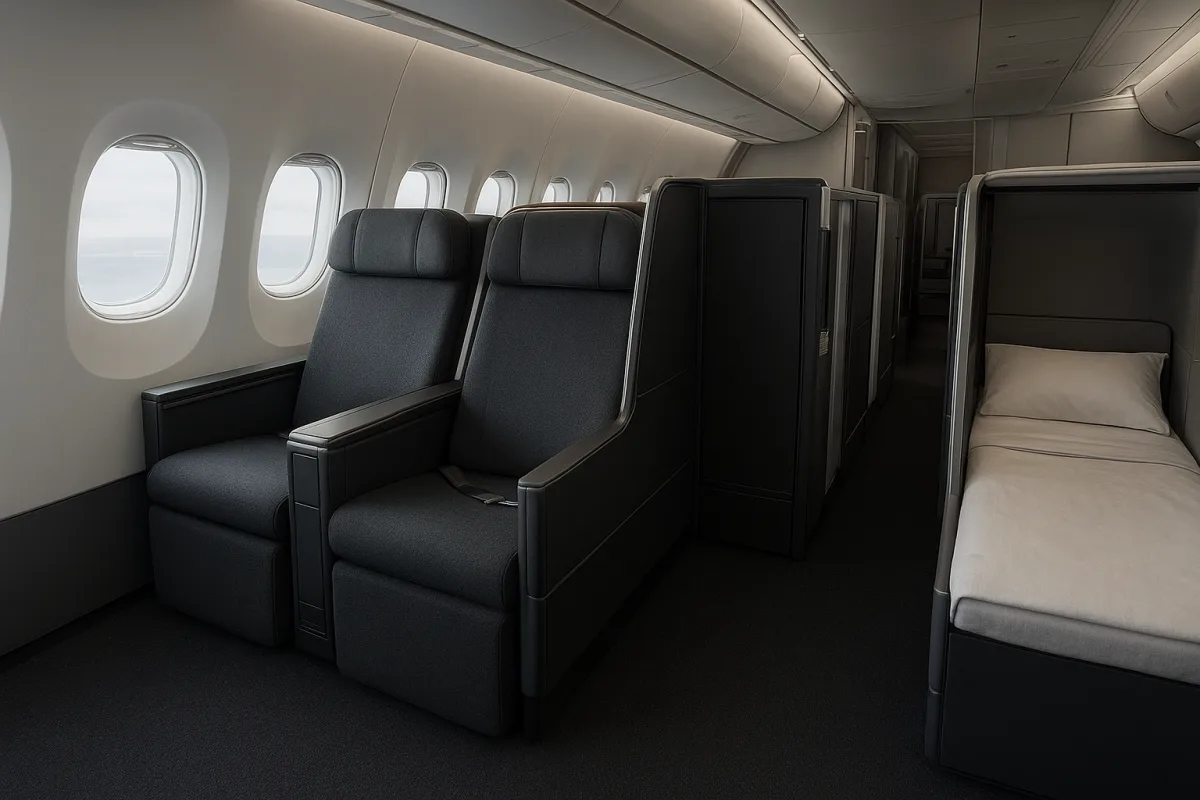
The decision: Premium Reserve or an Aurora Suite?
Alaska Airlines is moving beyond its familiar West Coast model of extra-legroom seats and recliners. The practical choice for travelers is not whether the airline is becoming more premium. It is whether Premium Reserve or an Aurora Suite justifies the extra fare on a particular trip.
Premium Reserve is the new premium-economy proposition: a larger recliner, 38 inches of legroom according to Skift’s reporting, and a clear step between Alaska’s existing Premium Class and lie-flat business class. Aurora Suites are the airline’s long-haul business product, with beds, direct aisle access and doors on Boeing 787-9 aircraft. [9]
For now, Aurora Suites are the real, bookable premium development. Alaska’s Boeing 787-9 cabins have 34 lie-flat suites with privacy doors and direct aisle access, launched on international services from Seattle. [2][3]
The sensible decision is straightforward. Take Premium Reserve if the flight is daytime, you will work or read rather than sleep, and a business-class fare would strain the trip budget. Take Aurora if the route is overnight or long enough that arriving rested has real value.
Neither choice comes with a published fixed price. Alaska has not released public 2026 fare differentials, cash upgrade prices or mileage-upgrade costs for Premium Reserve or Aurora, so a traveler should compare the actual booking screen rather than assume a standard supplement.
That missing price data matters more than usual because Alaska Mileage Plan redemptions have become less generous. Mighty Travels reports that the program’s premium-cabin value shifted from roughly 1.5 cents to 2.2 cents per mile in 2026, making cash-plus-miles options worth checking against a full award booking. [11]
Premium Reserve versus Aurora Suites
The two cabins should not be judged as substitutes on every journey. They solve different problems, but running them through the same criteria makes the trade-off clearer.
| Criterion | Alaska Airlines Premium Reserve | Alaska Airlines Aurora Suite on Boeing 787-9 |
|---|---|---|
| Cabin type | Premium economy, positioned above standard extra-legroom seating. | International business class. |
| Space | Skift reports 38 inches of legroom and a recliner-style seat. [9] | A lie-flat suite with direct aisle access and a privacy door. [2][3] |
| Sleep | Better for a nap than regular economy, but not a bed. | The clear choice for overnight flights and jet-lag management. |
| Privacy | No published indication of suite-style privacy or doors. | Privacy doors are installed on the 34-seat 787-9 cabin. [2][3] |
| Best use | Daytime transcontinental travel, or travelers who want more room while controlling spend. | Overnight international travel, especially when a hotel night or a working arrival depends on sleep. |
| Route certainty | Alaska has announced the product, but route-by-route deployment and pricing need checking during booking. | Operating from Seattle on London, Incheon and Rome services, with Tokyo expected in fall 2026. [2][3] |
| Upgrades and awards | No public upgrade price or mileage chart has been published. | No public fixed upgrade price has been published, and award value needs comparison with cash-plus-miles offers. [[11]](https://www.mightytravels.com/2026/08/alaska-2026-chart-surgery-west-coast-breakeven-shifts/?utm_source=openai "Alaska 2026 Chart Surgery: West Coast Breakeven Shifts |
| Lounge value | No dedicated access policy has been published for Premium Reserve. | The future Seattle business lounge is relevant, but Alaska has not yet published specific access rules for Aurora passengers. |
| Main drawback | It may cost materially more than Premium Class without delivering a flat bed. | It is likely the costly option, and availability is limited to 34 suites per 787-9 flight. [3] |
Premium Reserve is the more rational purchase when the trip is short enough that sleep is not the point. On a Seattle to New York daytime flight, extra pitch, a leg rest and a quieter cabin can be enough, particularly if the fare gap to Aurora is large.
Aurora is the better use of money or miles on a westbound overnight from Europe, or a long Seattle departure to Asia. A bed does not eliminate jet lag, but it changes the logistics of arrival: fewer travelers will need to write off the first morning in London or Seoul.
The limitation is that Alaska has not provided enough detail to calculate a normal break-even point. There is no published seat-width comparison, bed-length figure, upgrade schedule or standard Premium Reserve surcharge, so claims that one is objectively better value would be premature.
Do not confuse Premium Reserve with Premium Class
Alaska already sells Premium Class, its existing extra-legroom economy section. Alaska says that product adds four inches of legroom over Main Cabin and includes complimentary beer, wine and cocktails on most flights longer than 350 miles. [6]
That makes Premium Class the budget-minded third option, even though it is not the head-to-head decision here. It suits a two- or three-hour West Coast hop where a better seat and drinks matter more than a dedicated premium-economy cabin.
Premium Reserve should be a larger step up, with the reported 38-inch pitch and leg rest. The missing detail is how it will compare seat-for-seat with the premium-economy cabins operated by American, Delta and United, because Alaska has not released a full specification sheet.
Do not assume a premium ticket includes lounge entry, either. Alaska’s published rules provide complimentary lounge access to Alaska or Hawaiian first-class passengers only when at least one same-day segment is 2,000 miles or longer. [6]
For shorter qualifying situations, a single-entry Alaska Lounge pass costs $35 when capacity permits. That is a useful figure for a traveler comparing an inexpensive Premium Class or Premium Reserve fare against one with lounge access, but it is not a guarantee. [6]
The 737 MAX 10 promise is not yet a booking strategy
Alaska’s proposed domestic premium product is more interesting than its current schedule allows. Skift reported plans for 12 Aurora Suites on Boeing 737 MAX 10 aircraft, alongside Premium Reserve, while View from the Wing reported that the domestic suites would not have doors.
If that plan arrives as described, it would finally give Alaska a lie-flat option for lucrative transcontinental routes. A 12-seat cabin could be practical for Alaska because it needs to fill fewer high-fare seats than a larger competitor cabin, but it would also mean fewer upgrades.
The timing needs caution. AviatorDB reported that FAA certification for the 737 MAX 10 was expected by late September 2026, with first deliveries and passenger service anticipated from spring to mid-May 2027. [7]
There is also conflicting public information about Alaska’s suite plan. The September research record notes no independently verified, detailed announcement of domestic MAX 10 suites or associated lounge policy, despite contemporary reporting describing a 12-suite plan. Travelers should therefore treat it as an announced direction, not an itinerary feature.
United’s MAX 10 experience explains the risk. Air Journal reported that United had hundreds of lie-flat seats awaiting installation because certification delays kept the aircraft from arriving, a reminder that a seat map rendering is not the same thing as an operating route. [8]
No Alaska-specific implementation problem has been reported. Still, do not buy a flexible ticket on the assumption that Seattle to New York, Boston or another transcontinental route will receive a bed by a particular month. Alaska has not published the route list or an upgrade policy.
How Alaska stacks up against American and United
Alaska’s 787 Aurora Suite is credible against the major US carriers’ business-class products, but the available specifications do not support a neat ranking. Detailed comparisons of seat dimensions, bed length, storage and onboard amenities have not been published across all three products.
American Airlines is replacing Flagship First with Flagship Suites, a higher-density premium cabin that will have 70 private-door suites instead of 52 business seats and eight first-class seats. Flagship First is due to disappear by March 28, 2027. [4]
American’s product suits travelers who want a large private-door business cabin and are flying routes where the redesigned aircraft is scheduled. Its weakness is transition risk: cabin type will vary by aircraft, so the exact flight number matters more than the generic “Flagship” label.
United Airlines Polaris Studio is the more explicitly upscale rival. NerdWallet reports eight Polaris Studio suites with 25 percent more space than standard Polaris seats, upgraded meals and 27-inch screens. [5]
United’s Studio suits travelers willing to pay for the airline’s best available business-class seat, especially when space and screen size matter. It falls down for upgrade-seekers because there are only eight Studios, while Alaska’s 787 has 34 Aurora Suites overall. [3][5]
Neither American nor United has published a universal fare premium that can be fairly compared with Alaska’s new cabins. Check the exact flight, seat map, connection and lounge rules, then compare the all-in fare rather than treating a cabin name as a fixed product.
Lounge upgrades: useful, but wait for the rules
Alaska’s planned Seattle business-class lounge is intended to address a gap at its home airport. View from the Wing reported that the expanded C Concourse lounge complex would total about 41,000 square feet and include showers, wellness spaces and made-to-order table-service dining in its exclusive section.
That is the right direction for an airline selling international business class. A long-haul premium ticket feels incomplete when the ground experience is merely a crowded general-membership lounge, especially in Seattle, where competitors already make lounge access part of the premium proposition.
The practical problem is access. Alaska has not published a specific rule confirming that an Aurora passenger, or a future domestic MAX 10 suite passenger, automatically gets into this business-class lounge.
Until that changes, use Alaska’s existing policy as the dependable baseline. Lounge members can enter Alaska Lounges and Honolulu’s Plumeria Lounge, while Oneworld Emerald and Sapphire members qualify when traveling internationally outside the US, Canada and Mexico. [6]
Alaska residents with Club 49 status also have access when traveling to, from or through Alaska. [6] Those rules may matter more than cabin choice for a traveler building in a long Seattle connection.
Why this rollout is happening now
The premium push is partly commercial necessity. Skift reported that Alaska lost nearly $500 million in the first half of 2026, with fuel costs a central cause. [9]
Finsee’s review of Alaska Air Group’s second quarter put fuel at $4.43 per gallon, up 85 percent year over year, adding $600 million in expense and contributing to a $0.92 earnings-per-share loss. [10]
Premium seating is not a cure for fuel prices, but it gives Alaska more high-margin inventory on routes where travelers will pay for space and sleep. That is also why travelers should expect prices to be highly date-sensitive rather than neatly standardized.
Who each option suits
Premium Reserve suits travelers taking daytime flights, paying personally, or needing more room without turning a flight into a major budget line. It is also the sensible option when the Aurora fare difference could instead cover several hotel nights, rail tickets or meals at the destination.
Aurora Suites suit travelers on overnight Seattle long-haul routes, business travelers who must function on arrival, and mileage collectors who find a reasonable cash-plus-miles offer. The 787 cabin is the more complete product, but published pricing is too thin to call it a universal bargain.
Premium Class suits short-haul travelers who mainly want four additional inches of legroom and included drinks. Alaska’s own description makes it a modest comfort upgrade, not an alternative to Premium Reserve or a lie-flat suite. [6]
The future 737 MAX 10 Aurora Suites suit travelers who can wait for confirmed service and want a potential domestic lie-flat product. Until Alaska publishes routes, fares, access rules and operating dates, the 787 Aurora Suite is the Alaska premium cabin worth planning around.
Frequently Asked Questions
What is Alaska Airlines Premium Reserve and how does it compare to Aurora Suites?
Alaska Airlines Premium Reserve is a premium-economy product offering a larger recliner with about 38 inches of legroom, positioned above Premium Class but below business class. Aurora Suites, available on Boeing 787-9 aircraft, are international business-class suites featuring lie-flat beds, direct aisle access, and privacy doors. Premium Reserve suits daytime travel and those wanting extra space without a bed, while Aurora Suites are designed for overnight or long-haul flights where sleep and privacy are priorities.
Which Alaska Airlines premium upgrade is best for overnight flights?
Aurora Suites on the Boeing 787-9 are the best choice for overnight flights. They provide lie-flat beds, privacy doors, and direct aisle access, making them ideal for arriving rested after long or overnight journeys. Premium Reserve seats offer more space than economy but do not include a bed, so they are less suitable for overnight rest.
Are Alaska Airlines Aurora Suites available on all routes?
No, Aurora Suites are currently available only on select international routes operated by Boeing 787-9 aircraft from Seattle to London, Incheon (Seoul), and Rome, with Tokyo service expected to start in fall 2026. They are not available on all Alaska Airlines routes.
Does Alaska Airlines Premium Reserve include lounge access?
There is no published policy indicating that Premium Reserve includes lounge access. Alaska Airlines has announced plans for a Seattle business-class lounge, but access rules for Premium Reserve passengers have not been clarified and should not be assumed as an automatic benefit.
What are the differences between Alaska Airlines Premium Reserve and Premium Class?
Premium Reserve offers a larger recliner-style seat with about 38 inches of legroom, positioned above Premium Class, which provides four extra inches of legroom over Main Cabin seats and complimentary beverages on longer flights. Premium Reserve is a step up with more personal space but does not include a flat bed or suite features. Pricing and upgrade costs for Premium Reserve have not been published, so travelers should check booking details for specific fares.
How we researched this
This article was assembled from 2 published articles, 11 cited references.
Nothing here is based on hands-on testing. Where a figure or finding appears, it belongs to the source cited beside it, and the writing says so rather than implying otherwise. Every source is listed below so you can check it.
Sources
Alaska Airlines Adds Premium Economy and More Business Class — Can It Catch Up to the Big 3? — Skift
Alaska Is Putting Beds On Its 737s—And Building A Lounge Most Passengers Can’t Get Into — View from the Wing
High airfares could stick around even if jet fuel prices fall
Alaska Airlines launches its first-ever International Business Class suites
Alaska Airlines' 787-9s now feature 34 lie-flat suites with privacy doors - Air Traveler Club
American Airlines Sets an End Date for Flagship First—Here’s What Replaces It | thePointsPage
First Look: United’s Most Premium Plane With Polaris Studios - NerdWallet
Alaska Airlines 737 MAX 10 Certification Expected Within Days | AviatorDB
United Airlines : des centaines de sièges-lits en attente du 737 MAX 10 | Air Journal
Alaska 2026 Chart Surgery: West Coast Breakeven Shifts | Mighty Travels
Related Articles

Airline Innovations 2026: Enhancing Passenger Experience
Explore airline innovations in 2026 improving passenger experience, from automatic check-in to biometric travel and better disruption handling.
Airline Service Enhancements and New Flight Routes in 2026
Discover upcoming airline service enhancements and new flight routes, including seatback screens and premium cabin upgrades for 2026.

Hospitality and Airline Experience Innovations in 2026
Explore key innovations in hospitality and airline experience, including AI, capacity challenges, and premium travel improvements in 2026.

Travel Credit Card Comparison 2026: Chase vs Amex Platinum
Compare Chase Sapphire Reserve and Amex Platinum cards for 2026 travel budgets, rewards, lounge access, and perks to choose the best travel credit card.