
Airline Hotel Voucher Policies: What Passengers Should Know
Learn how airline hotel voucher policies work, when airlines pay for hotels, and what changes affect delay classifications starting in 2026.
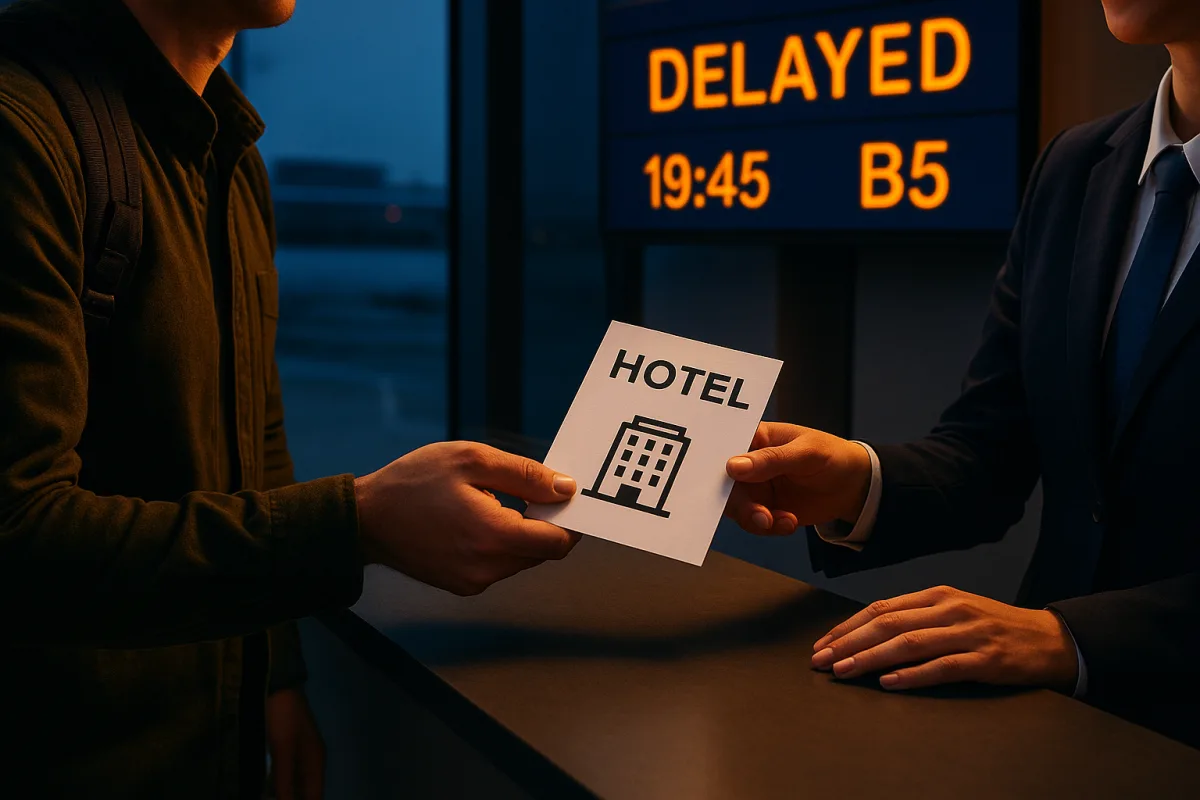
When an Airline Says It Will Pay for a Hotel, What Does That Actually Mean?
The phrase that decides your overnight: “within airline control”
The most important line in an airline delay is not the estimated departure time. It is the internal label attached to the disruption: within airline control, or outside airline control.
That label determines whether an overnight delay becomes an airline-paid problem or a passenger-paid one. It can affect hotel vouchers, meal vouchers, transport to accommodation, rebooking options, and the chances of recovering money spent independently.
The complaints reported by View from the Wing about American Airlines hotel vouchers, a crew-related cancellation, and internal airline workplace conflict all look unrelated at first. For passengers, though, they converge at the same question: what did the airline record as the cause?
A missing crew may sound straightforwardly like an airline failure. But the airline’s final coding can be more complicated, especially if the shortage follows weather, air-traffic disruption, a medical issue, or a crew member being removed.
That distinction matters because airlines do not generally offer a hotel merely because a passenger is stranded overnight. They offer one under their own customer-service commitments when the airline accepts that it caused the disruption.
Why this is changing on October 19
The U.S. Department of Transportation’s customer-service dashboard shows that Alaska, Allegiant, American, Delta, Hawaiian, JetBlue, Southwest, and United voluntarily commit to complimentary accommodation for passengers affected by an overnight disruption within the airline’s control. Frontier does not make that commitment. [1]
“Voluntarily” is doing considerable work in that sentence. The promise is published by the carrier, and it is conditional. It is not a universal hotel guarantee triggered by any canceled flight.
A DOT rule taking effect on October 19, 2026 narrows the practical scope of those commitments by classifying ten more disruption causes as outside airline control. The reported examples include unscheduled maintenance, removal of an unruly passenger, and cybersecurity attacks. [2]
For a traveler, this means the cause stated at the gate may matter more than the visible result. An aircraft sitting at the airport overnight and an airport hotel costing $180 can still leave the passenger paying if the event is coded outside control.
The rule also explains a familiar frustration: passengers often think “maintenance” means the airline failed to maintain the aircraft. In airline policy, a maintenance event can instead be placed in a category that limits accommodation obligations. [2]
That does not make an independent hotel booking irrational. It means the traveler should treat reimbursement as a claim to document, not money that is already secured.
A crew problem is not automatically a hotel problem
View from the Wing reported that a Delta Connection captain approaching Detroit requested supervisors meet a flight after conflict between flight attendants appeared likely to escalate. The regional aircraft landed normally, but the report illustrates how staffing incidents can reach passengers indirectly.
The same publication reported a May 2026 Endeavor Air cancellation from Cleveland to Detroit after police removed flight attendants following an alleged altercation. Travelers were told the flight lacked crew, which was true, but not the whole operational story.
There is no public 2026 dataset showing how often crew conflicts cause cancellations or delays. The available examples are isolated cases, rather than evidence of a broad pattern across U.S. regional aviation.
Still, the passenger-facing consequence is concrete. A flight can be canceled because the required cabin crew is unavailable, and passengers then need a rebooking, possibly an overnight room, and perhaps transport before the next departure.
In Canada, crew-shortage disruptions can generate compensation of CAD 400 to CAD 1,000 after a delay of three hours or more, unless the airline can establish it had reasonable contingency plans. That is a compensation rule, distinct from a hotel-voucher rule.
In the United States, a controllable cancellation or significant controllable delay brings a right to no-cost rebooking under DOT requirements, but it does not create a universal federally mandated entitlement to meals and a hotel. Those provisions depend heavily on carrier policies. [3]
So the useful question at the service desk is not simply, “Was this caused by crew?” Ask: “Is this being treated as within airline control, and will you provide hotel, ground transportation, and meal vouchers under your customer-service plan?”
Ask for the answer in writing if possible, or photograph the voucher screen and save app notifications. A later reimbursement claim is much easier when the airline’s own explanation is preserved.
What the voucher actually buys
A hotel voucher is usually a payment authorization, not a reservation at a hotel you would have selected yourself. Airlines frequently contract with outside accommodation providers, which may be trying to locate rooms quickly during irregular operations.
That system encourages the airline and booking provider to find availability at an agreed rate. It does not necessarily optimize for cleanliness, proximity, late-night food, a functioning airport shuttle, or enough remaining sleep to make the arrangement worthwhile.
View from the Wing reported an American Airlines passenger’s allegation that a crew-related delay led to a motel with roaches and no shuttle despite a prior assurance. The passenger later paid for another hotel after the cancellation.
The same report cited other traveler accounts involving low-cost airport-area properties, complaints about dirty rooms, and an American Airlines offer of a Motel 6 to a business-class passenger. These are complaints, not a measure of hotel quality across the industry.
What they do establish is a consumer misunderstanding worth avoiding: a premium airfare does not automatically purchase premium disruption accommodation. The ticket cabin and the emergency hotel booking are separate parts of the airline’s operation.
No U.S. jurisdiction identified in the supplied research requires an airline-provided hotel to meet a stated star rating, branded-property standard, cleanliness benchmark, or maximum distance from the airport. The voucher may cover a usable room, but it does not promise a pleasant one.
Nor does a hotel offer necessarily include transport in every circumstance. American’s published customer-service plan says it will provide an approved hotel and transport to and from it for an overnight controllable disruption, but passengers should still confirm the practical details at the desk. [1]
A room 25 minutes away that requires a $35 taxi is less valuable than one connected to the terminal, particularly when the replacement flight departs at 6 a.m. The cost is measured in sleep, not just the nightly rate.
When booking your own room makes sense
The case for booking independently is strongest when the voucher queue is long, the rebooked flight is early, or the assigned hotel is plainly unsuitable. It is also strongest when several flights have canceled and room inventory is disappearing by the minute.
Before spending, ask an agent whether the airline can issue written authorization or whether it will reimburse a reasonable self-booked room. The phrase “reasonable cost” is deliberately flexible, so save screenshots showing local hotel prices at the time.
Keep an itemized folio, not only a card statement. Save receipts for the hotel, airport transfer, meals if relevant, boarding passes, cancellation notices, and messages showing when the airline advised you of the overnight disruption.
Do not assume the most expensive remaining room will be reimbursed. Equally, do not assume the airline can deny every claim because you booked first, especially where its own customer-service plan promised accommodation but no usable voucher arrived.
The practical decision is financial. If you cannot absorb a temporary charge, wait for an airline-issued arrangement and document the delay. If you can absorb it, compare the cost of a room against the cost of losing most of the night.
Travel insurance can be useful here, but policy wording matters. Some plans pay fixed delay benefits after a stated number of hours, while others reimburse only eligible costs after deductibles, exclusions, and any airline payment are applied.
Rebooking is the other half of the calculation
A hotel solves one night, not the trip. A passenger whose flight is canceled can choose a refund if the offered rebooking does not work, rather than accepting an itinerary that destroys the purpose of the trip. [4]
That choice can be expensive if a replacement ticket later costs more, so decide before requesting the refund. Once refunded, the airline no longer owes transportation on the original ticket.
For controllable disruptions, Alaska, American, Delta, Hawaiian, JetBlue, and United say they can rebook passengers on partner airlines without extra cost. Allegiant, Frontier, and Southwest do not make the same commitment. [3]
This difference matters most at smaller airports or on late departures. A carrier with no interline or partner rebooking option may offer the next seat on its own limited schedule, which can turn a one-night disruption into a two- or three-day delay.
American Airlines has also introduced a zero involuntary denied-boarding policy from September 30, 2026. Gate staff must obtain enough volunteers before the aircraft doors close, rather than involuntarily bumping confirmed passengers from an oversold flight. [5]
That policy addresses oversales, not cancellations, crew shortages, or maintenance. It may reduce one source of involuntary disruption, but it does not change the hotel question when an aircraft or crew cannot operate.
The comparison travelers should make before accepting help
The United States is relatively weak on overnight-care obligations compared with Europe and Canada. Under EU Regulation 261/2004, airlines must provide care including accommodation during qualifying delays even when extraordinary circumstances, such as severe weather, remove cash-compensation liability.
Canada requires accommodation when a disruption is within airline control, the passenger receives less than 12 hours’ notice, and the wait extends at least two hours beyond scheduled departure. Those are clearer statutory triggers than most U.S. arrangements.
In the U.S., start with the airline’s current customer-service plan on the DOT dashboard, then read the carrier’s conditions of carriage if you are considering a self-booked replacement. Policies can change, and the October 19 classification shift makes exact wording more consequential. [1][2]
The short version is uncomfortable but useful. An airline hotel voucher is not a benefit attached to your ticket price, a reward for waiting patiently, or proof that the airline will make the disruption comfortable.
It is a conditional operational remedy, offered after the airline decides what caused the disruption and what its own policy requires. Knowing that before the cancellation turns an unpleasant airport night into a decision you can make quickly.
Frequently Asked Questions
What does it mean when an airline offers a hotel voucher?
When an airline offers a hotel voucher, it means the airline is providing a coupon or credit for a hotel stay, typically when the disruption is classified as within the airline’s control. However, the voucher does not guarantee a specific hotel brand, quality, shuttle service, or location, as no U.S. rules set those standards.
When are airlines required to pay for hotel stays during delays?
In the U.S., airlines generally provide hotel accommodations only when the delay or cancellation is classified as within their control. This classification affects whether passengers receive hotel vouchers, meal vouchers, or transport to accommodations. There is no universal federal mandate requiring hotel stays for all overnight delays.
How do airlines classify delays as within or outside their control?
Airlines assign internal labels to disruptions based on their causes. Events like weather or air traffic control issues are usually outside their control, while staffing or operational issues may be within control. Starting October 19, 2026, the DOT will allow airlines to classify more events—such as unscheduled maintenance, unruly passenger removals, and cybersecurity incidents—as outside their control.
Can passengers get reimbursed for self-booked hotels after a flight delay?
Passengers who pay for their own hotel stays during delays can attempt to seek reimbursement, but it is not guaranteed. They should keep all receipts and understand that reimbursement depends on whether the airline accepts responsibility for the disruption, which is often tied to the within-control classification.
What changes are coming to airline delay classifications in 2026?
Effective October 19, 2026, the U.S. Department of Transportation rule will allow airlines to classify ten additional types of disruptions—including unscheduled maintenance, removal of unruly passengers, and cybersecurity attacks—as outside their control. This change reduces airlines’ obligations to provide hotel accommodations and other amenities for these events.
How we researched this
This article was assembled from 4 published articles, 5 cited references.
Nothing here is based on hands-on testing. Where a figure or finding appears, it belongs to the source cited beside it, and the writing says so rather than implying otherwise. Every source is listed below so you can check it.
Sources
Île Seguin: This tiny island just outside Paris is about to become the city's newest cultural destination — CN Traveler
American Airlines Passenger Says Her Free Hotel Had Roaches—Never Let Them Pick Where You Sleep — View from the Wing
Delta Captain Calls For Help With His Own Crew—As Flight Attendants Throw Down — View from the Wing
Allegiant Employee Says Co-Worker Told Racist Jokes, Then The Airline Fired Her — They Won In Court — View from the Wing
New DOT Rule Changes How Airlines Classify Delays From 19...
Flight Delay and Cancellation Compensation: What to Know - NerdWallet
American Airlines Ends Involuntary Bumping on Oversold Flights – Aviation Shop
Related Articles
Airline Service Enhancements and New Flight Routes in 2026
Discover upcoming airline service enhancements and new flight routes, including seatback screens and premium cabin upgrades for 2026.
Airline Upgrade and Refund Policies
Learn about 2026 airline upgrade and refund policies, including paid upgrades, skipped segments, and elite upgrade changes.
Hospitality and Airline Experience Innovations in 2026
Explore key innovations in hospitality and airline experience, including AI, capacity challenges, and premium travel improvements in 2026.
Google AI Travel Booking: How It Works and What to Know
Learn how Google AI travel booking works, its benefits, limitations, and how it affects hotel loyalty and flight price tracking.