
Travel Safety Tips: Preparing for Scary Experiences Abroad
Discover essential travel safety tips to prepare for emergencies, choose safe transport, and handle scary experiences while traveling abroad.
The quick list
Best overall: The remote-route plan, for riders crossing Lesotho’s mountain interior who need to prevent a bad trail from becoming a no-contact emergency.
Best value: The licensed louage and local-driver plan, for budget travelers in Tunisia who can trade a little flexibility for a safer intercity ride.
Best for unpredictable cities: The exit-and-local-help plan, for solo travelers navigating unfamiliar neighborhoods, protests, and late-night transportation.
Best for families: The private-care backup plan, for parents traveling with children where the nearest public hospital may not be the right hospital.
You are usually deciding how much inconvenience to accept before something goes wrong. Take the longer road, pay for a safer ride, book insurance with the right exclusions, or carry equipment that may never leave your bag.
The accounts from Lost LeBlanc and Wolters World show four different failures: route planning, road transport, local security, and medical access. None has one universal fix, but each rewards preparation made before your phone has no signal.
| Option | Group and route layout | Time pressure | Stated cost | Main trade-off | What to arrange first |
|---|---|---|---|---|---|
| Remote Lesotho motorbike route | Two riders on a steep, unmarked mountain trail, with villages far apart | A known highway route was estimated at 5 to 6 hours | No trip or rescue price reported | Adventure and isolation versus a realistic recovery route | Satellite communication, shared itinerary, water, tools, weather check |
| Tunisia louage | Licensed shared intercity van, generally 7 to 9 passengers | Leaves when full, no fixed timetable or advance booking | Fare not reported | Cheap, flexible transport versus limited control over driver behavior | Inspect vehicle, use belts where available, be willing to wait |
| Guadalajara and Lima street-security response | Travelers on foot or in an open pickup, then moving through poorly lit blocks | Decisions made after dark or during a sudden crowd dispersal | Cab fare not reported | Saving money or following companions versus getting out fast | Charged phone, cash for a cab, local route knowledge |
| Beijing family medical backup | Parents seeking urgent care for a two-year-old | Immediate, with multiple hospital transfers | $400 lifetime private-hospital membership, as reported by Wolters World | Higher up-front cost versus quicker, more navigable care | Insurer contacts, hospital list, child records, transport plan |
Best overall: avoid the route that can trap you
Lost LeBlanc’s Lesotho ride began with a choice among three ways toward the country’s highlands. The predictable highway would take five to six hours, while an old mining or forestry road sounded rough but possible.
The third route came with a direct warning from the lodge owner: avoid it. A Land Rover had reportedly been stranded there for weeks, and three motocross riders had previously burned out their clutches and required a rescue.
A navigation error put the riders on that third track. It became a descent over steep rock and riverbed-like terrain, with repeated motorcycle drops, damaged brakes, fuel spilling on rocks, no reliable water intake, and no phone signal.
This is the case where we would spend more time and money before leaving. The highway is not a defeat. A route that lets you turn around, call for help, and arrive before dark is often the best adventure decision.
The key failure was not only the terrain. It was the loss of options. Once the riders had descended far enough, going back uphill was no longer realistic, so every mechanical problem and injury had to be managed downhill.
They were helped by local children from nearby villages, then reached a point where a borrowed phone could contact the lodge. That local help was generous, but it was luck, not a recovery plan you can assume will exist.
Remote parts of Lesotho have limited cellular coverage because mountain terrain and infrastructure constrain the network. Do not rely on 911 or 112 working as your fallback, and keep local emergency contacts available before heading into the highlands. [1]
A personal locator beacon sends a one-way distress signal without a subscription. A satellite messenger costs more over time because it uses a subscription, but two-way messages and location sharing are far better if you are injured, delayed, or deciding whether to abandon a bike.
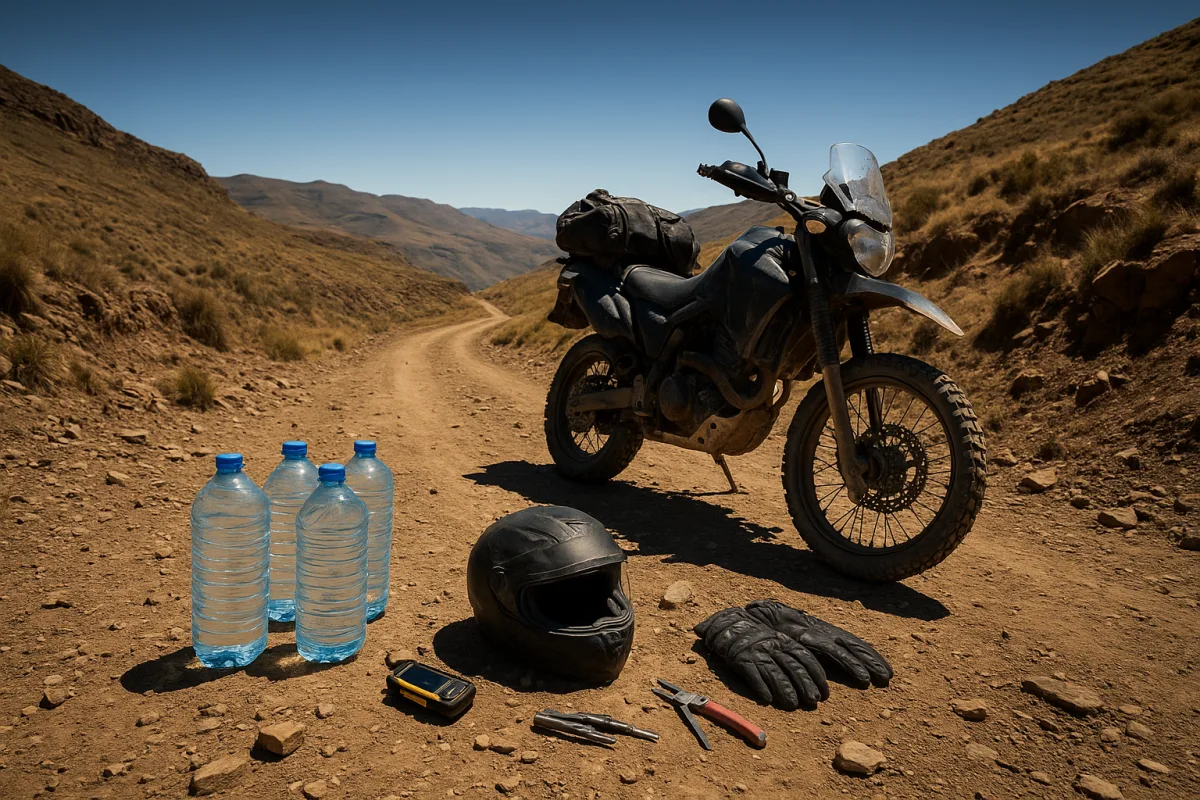
For the riding itself, pack for a fall and a breakdown. Off-road guidance recommends a certified DOT- or ECE-rated full-face helmet, armored jacket and pants, sturdy gloves, tall stiff boots, eye protection, and body protection for the chest, back, and knees. [3]
Bring a tool kit, spares, two pairs of gloves, water, food, and a route plan shared with someone who will notice a missed check-in. Monitor the forecast and stop before nightfall, when unlit roads, livestock, fatigue, and reduced visibility compound every problem. [3]
Best value: shared transport, with an exit plan
Mark Wolters of Wolters World puts driving at the center of many of his scariest travel experiences. In Tunisia, he recalled riding in a louage, the shared vehicle system linking cities, with no seat belts and alarming driving behavior.
Louages are licensed and inspected shared vans on fixed intercity routes. They normally carry seven to nine passengers, have no advance reservations or timetable, and leave only once full, which makes them cheap and convenient but unpredictable. [1]
The budget advantage is clear if you are moving between Tunisian cities without renting a car. The downside is that your control is limited: you do not choose the route, passenger load, or the driver’s judgment once the van departs.
We would use a louage for daylight city-to-city travel, but not treat it as the automatic best option. Check the vehicle before boarding, take an available seat belt, and wait for another departure if the driver appears impaired, exhausted, or reckless.
No current material establishes how consistently seat-belt rules are enforced in louages. Reports indicate that driver behavior varies and that louages have a higher accident rate than trains, so a train is the better choice where the timetable fits your trip. [1]
Best for unpredictable cities: leave early, spend the cab fare
Wolters’s stories from Guadalajara and Lima show a different travel risk: the moment when the safest decision is to stop trying to complete the evening as planned. Neither situation required wilderness gear or specialist insurance first.
As a teenager in Guadalajara, Wolters was chased for hours after riding in the back of a pickup truck. His group eventually hid behind a wedding party, then faced several dark blocks in an area his companions considered unsafe.
A cab driver intervened and took them away even though the group initially said they had no money. The immediate lesson is concrete: keep enough local currency, card access, and phone power to take a cab or ride when walking stops feeling right.
The Lima incident was more ambiguous. While backpacking in Peru during the period when Shining Path was active, Wolters saw a crowd suddenly run from a street, followed by a military personnel carrier, and left with the crowd.
You do not need to identify every disturbance before moving away from it. Watch how local people react, avoid standing at the edge to film or investigate, and return to your hotel or another known place before trying to understand events.
This option costs little until it does not. A charged battery, downloaded map, hotel address saved offline, and an agreed ride-home budget can be cheaper than the consequences of accepting a ride, walking through an unknown district, or staying near unrest.
Best for families: plan for the hospital you actually need
The hardest Wolters World account is not a crime story or a road story. While teaching in China, Wolters and his wife needed urgent care after their two-year-old son caught his hand in the hinge of a metal door.
They first went to a Beijing bone hospital, only to be redirected to a children’s hospital. Wolters described that public facility as seeing about 10,000 children per day, with parents and grandparents adding to the crowd and confusion.
The family then crossed to a private children’s hospital, where they bought a $400 lifetime membership. That charge was not a complete medical bill, but it opened a route to an X-ray, clearer communication, and a diagnosis of no broken bones.
The point is not that private medicine is always necessary or superior. It is that “the nearest hospital” can be wrong for your child, and an overcrowded public facility can add delay when you are trying to navigate language barriers and panic.
Before travel, save the contacts for your insurer’s assistance line, your lodging, a local emergency number, and two suitable hospitals. Carry prescription details, allergy information, vaccination records where relevant, and enough money or card capacity for an unexpected private visit.
For children, prioritize prevention before the itinerary gets busy: proper car seats, booster seats and seat belts, close supervision around vehicles and water, and accommodation that prevents unsupervised access to pools or streets. [2]
Pay for rescue only after reading the exclusions
Evacuation coverage looks reassuring on a policy comparison, but the headline limit is not the whole product. Reported limits range from $50,000 to $2 million, with exclusions often applying to pre-existing conditions and high-risk activities. [4]
That makes a major difference for a Lesotho motorcycle trip. Tell the insurer exactly what you are doing, including off-road riding, the engine size if requested, elevation, and whether you will be beyond road access, then get its answer in writing.
For Balkan travelers, one cited regional policy starts at €1.50 per day, while Store & Go Shkoder lists €30,000 for evacuation and €10,000 for search and rescue. Those figures are coverage caps, not guaranteed payouts or complete trip costs. [5]
We would not buy solely on the cheapest daily premium. Choose the policy whose emergency assistance can coordinate transport from where you will actually be, then carry the assistance number offline and share your itinerary with a person at home.
Who each option suits
The remote Lesotho motorbike plan suits experienced off-road riders who can afford extra preparation and are willing to abandon a dramatic shortcut. It is the strongest choice if your route includes unmarked tracks, steep descents, weak cell service, and a real chance of mechanical failure.
The Tunisia louage plan suits independent budget travelers moving between cities in daylight. Use it when you can wait for a vehicle that feels acceptable, but choose rail or a private transfer when you are tired, traveling with children, or uneasy about the driver.
The city exit plan suits solo travelers, students, and nightlife travelers who may be tempted to follow new acquaintances or keep walking to save money. It works because it gives you permission to leave early, take a cab, and disappoint the group.
The family medical backup plan suits parents and caregivers traveling anywhere with unfamiliar health systems. The $400 Beijing membership reported by Wolters World is a reminder that paying for a clearer route through care can be cheaper than losing hours in the wrong facility.
The insurance-first plan suits anyone going remote or active who could need evacuation, search and rescue, or specialist medical transport. Read the activity exclusions before booking the trail, not after the bike is stuck below a mountain pass.
Frequently Asked Questions
What are essential travel safety tips for remote destinations?
In remote areas like Lesotho’s mountain routes, it is critical to carry a satellite communication device such as a personal locator beacon or satellite messenger, enough water for at least a day, and tools to repair your vehicle. Travelers should share their route plan with someone who can notice a missed check-in, monitor weather conditions, and avoid traveling after dark to reduce risks from poor visibility and terrain hazards.
How can I prepare for emergencies while traveling abroad?
Before departure, build a medical plan that includes knowing the nearest appropriate hospital, carrying insurance details, and budgeting for private care if public options are overwhelmed. It is also important to have emergency-evacuation insurance, but travelers should check for exclusions related to high-risk activities, which may leave them responsible for rescue costs.
What safety gear should motorcyclists carry on remote routes?
Motorcyclists should wear certified full-face helmets (DOT or ECE rated), armored jackets and pants, sturdy gloves (preferably two pairs), tall stiff boots, and body protection for the chest, back, and knees. Additional gear like neck braces and eye protection (goggles) is recommended, along with carrying a tool kit and spares to handle breakdowns.
How do I choose safe local transport options when traveling?
When using shared local transport such as Tunisia’s louages, wait for a vehicle where you feel comfortable with the driver and the availability of seat belts. If the driving feels unsafe, it is advisable to leave and wait for another vehicle, even if it costs extra time. Inspecting the vehicle and being prepared to exit can reduce risk.
What medical preparations should families make before traveling?
Families should prepare a private-care backup plan that includes a list of suitable hospitals, insurance contacts, and medical records for children. This plan helps ensure quicker access to appropriate care, especially in places where public hospitals may be overwhelmed or not the best option for urgent treatment.
How we researched this
This article was assembled from 2 video sources across 2 channels, 5 cited references.
Nothing here is based on hands-on testing. Where a figure or finding appears, it belongs to the source cited beside it, and the writing says so rather than implying otherwise. Every source is listed below so you can check it.
Sources
Trapped 2 Days on Lesotho’s Worst Motorbike Trail, Lost LeBlanc
Our Scariest Travel Stories from Decades of Travel, Wolters World
Antigua and Barbuda - Traveler view | Travelers' Health | CDC
Does Travel Insurance Cover Emergency Evacuation? Limits & Costs - LegalClarity
Watch Travel Safety and Scary Experiences on Youtube
Also from the sources
Related Articles
Travel Tips and Warnings for Popular US Destinations
Get practical travel tips and warnings for popular US destinations like Chicago and the Smoky Mountains to plan safer, smoother trips.
Lesotho Motorcycle Travel Challenges and Safety Tips
Explore Lesotho motorcycle travel challenges, safety tips, and planning advice for remote routes and budgets in Africa's highlands.
Travel Dos and Don'ts in European Cities: Essential Tips
Discover essential travel dos and don'ts in European cities, including budgeting, safety, and booking tips for a smooth trip.
Mexico City Travel Safety Tips and Warnings for Tourists
Get essential Mexico City travel safety tips, neighborhood advice, and warnings to help tourists navigate the city safely in 2026.