
Hospitality and Airline Experience Innovations in 2026
Explore key innovations in hospitality and airline experience, including AI, capacity challenges, and premium travel improvements in 2026.
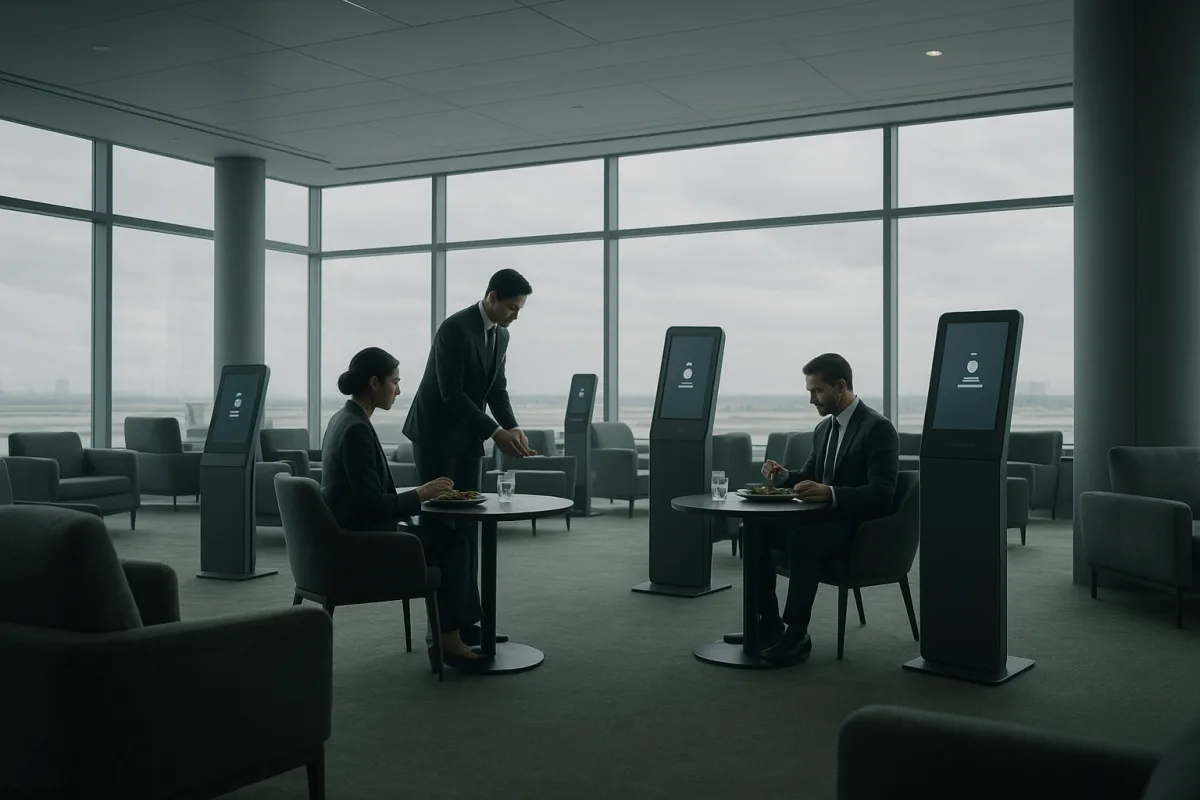
The travel experience is increasingly a capacity problem
The useful way to understand several current travel-industry changes is not as a battle between luxury and budget. It is about capacity: how many guests, passengers or cardholders a company can serve without adding equivalent numbers of people and square feet.
Hotels want fewer managers doing repeatable administrative work. Airlines want cabin crews to keep a packed aircraft safe while still producing a welcoming service. Airport lounges promise quiet, food and space, then risk becoming crowded precisely because access becomes more valuable.
For a traveller, this explains why a much-advertised improvement can feel excellent at 11 a.m. and disappointing at 6 p.m. The product is often not the wine list, chatbot or priority line. The product is whether the system has slack when everyone arrives together.
That matters when choosing a departure time, booking a hotel, or paying for a premium card. The marketing language is about personalisation and exclusivity. The operational reality is a queue, whether it is visible at a lounge reception or buried in a hotel manager’s inbox.
Start with the hotel number: five percentage points of GOP
Dallas-based AI Hospitality Group, a startup launched by former Remington Hospitality chief executive Sloan Dean, gives the clearest numerical version of this idea. Skift reports that the company expects agentic AI to improve gross operating profit margin by 500 basis points at independent full-service hotels.
Five hundred basis points means five percentage points, not a 5 percent increase. If a hotel’s gross operating profit margin rises from 33 percent to 38 percent, it keeps $38 from every $100 of revenue after operating expenses, rather than $33.
That distinction is worth making because hotel margins are usually discussed in percentages while operational changes happen in minutes. Someone answering a guest message, reconciling a supplier invoice or preparing a morning report may only save ten minutes, but those tasks recur every day.
Gross operating profit, commonly shortened to GOP, is hotel revenue less the direct costs of running the property. Rooms, food and beverage, housekeeping, front-office labour, utilities and departmental expenses all affect it. Interest payments, taxes and some owner-level costs generally sit outside that measure.
AI Hospitality Group’s proposed model is therefore not simply a hotel chatbot that recommends nearby restaurants. Skift says the operator intends to run full-service hotels with software and AI handling more processes and with fewer managers, then charge fees linked to profit growth rather than top-line revenue.
That fee structure changes the incentive. A conventional hotel manager can earn more as revenue rises, even if additional revenue requires costly staffing or discounting. An operator paid partly on profit improvement has reason to examine both sides of the equation.
The difficult part is deciding which work can genuinely be automated without shifting frustration to guests or overloading the remaining staff. HospitalityOS notes that AI costs vary substantially by hotel size, software licensing and implementation complexity, so there is no credible universal price for “adding AI” to a hotel. [2]
A front desk cannot be eliminated simply because a property uses automated messaging. Guests still need help after a cancelled flight, during a room problem, or when a digital key fails. The value lies in reducing routine work so employees can handle exceptions properly.
Skift says AI Hospitality Group had raised $7.5 million in seed funding and had been designing operations for three hotels. That is substantial startup capital, but it is not evidence that the promised margin improvement has already been achieved across operating properties.
The independent research brief is more cautious than the startup’s framing. It puts U.S. hotel GOP margin at 44.9 percent in the first half of 2026, up 3.6 percentage points year on year, while AI Hospitality Group’s cited 33-to-39 percent range applies to a narrower independent full-service segment.
In other words, the projected five-point improvement may be meaningful for a hotel with relatively weak operating economics, but it should not be presented as a benchmark for every American hotel. There is no published evidence yet of realised, broad AI-driven GOP gains across chains or the wider industry.
For travellers, this is not an abstract accounting exercise. A property trying to improve margin through automation may offer faster replies and fewer check-in bottlenecks. It may also have fewer people available when several guests need a human solution at once.
The outcome depends on demand patterns. A 120-room airport hotel can run smoothly with lean staffing on an ordinary Tuesday, then struggle when a weather disruption sends forty stranded passengers to reception within half an hour.
Aircraft cabins have the same bottleneck, with higher stakes
The cabin version of this issue is more serious because flight attendants are not principally hospitality staff in the legal sense. Federal staffing rules require them for safety, and their work includes emergency preparedness, evacuations, medical incidents and compliance with cabin-safety instructions.
View from the Wing reported an online complaint from a Delta flight attendant who said they had become disengaged from enforcing some rules because passengers complain and employees fear management will side with the customer. It is one crew member’s account, not a finding about Delta as a whole.
The article also points out that crew behaviour varies between flights and airlines. One team may actively manage bags, galleys and seatbelt compliance, while another may make an announcement and move on. Passengers notice this inconsistency, then test the boundary next time.
This is capacity pressure in its least flattering form. A flight attendant must simultaneously watch safety issues, handle service, assist a connection, settle a seating problem and respond to disruptive behaviour. When the cabin is full, each added exception takes attention from another task.
The enforcement consequences are not imaginary. The Federal Aviation Administration can pursue civil penalties ranging from $1,100 to $75,000 per violation, and up to $175,000 in hazardous-materials cases, alongside certificate actions and settlements. [1]
In April 2026, the FAA proposed a $255,000 civil penalty against American Airlines, alleging that 12 flight attendants who tested positive for substances returned to safety-sensitive duties before completing required follow-up testing. [1] That case concerns airline compliance systems, not ordinary cabin-rule enforcement, but it illustrates the regulatory stakes.
Passengers should take a practical lesson from this rather than treating service inconsistency as permission. Keep bags within the announced limits, clear the aisle, follow seatbelt instructions and avoid making crew negotiate basic rules during boarding, when their available attention is at its lowest.
Priority lanes redistribute waiting, they do not remove it
Security is another example of finite capacity being redistributed. The Transportation Security Administration’s “Serve with Honor, Travel with Ease” initiative gives military travellers priority access at selected airports, either through dedicated lanes or front-of-line treatment.
View from the Wing reported that the programme covers 33 airports and that active-duty travellers already have access to free TSA PreCheck when using their Department of Defense identification number while booking. The newer benefit can move eligible travellers ahead of others already in PreCheck queues.
For an eligible traveller, that can be useful at an airport serving a large military community. For everyone else, it does not create additional screening staff or scanners. It changes who waits, and can make a nearby regular lane slower.
This is why queue design matters more than it first appears. A dedicated lane can work well when enough eligible people use it consistently. If it sits underused while a general lane builds, the airport has divided staff and equipment less efficiently.
The same principle applies to airline priority boarding and hotel elite check-in desks. A separate line feels valuable to those admitted, but the system only improves overall flow if the operator has staffed it correctly and demand is predictable.
Airport lounges sell relief from the terminal, until access expands
American Airlines’ decision to admit qualifying Flagship Business passengers to Flagship Dining at Dallas-Fort Worth and Miami is a strong illustration of the trade-off. The previously first-class-oriented sit-down rooms are now available to eligible long-haul international, premium transcontinental and Flagship Hawaii business-class travellers.
View from the Wing reports that elite status alone does not grant entry to the restaurants, even when it grants entry to the surrounding Flagship Lounge. That restriction matters because a sit-down dining room has tables, kitchen capacity and staff, not unlimited buffet access.
The Dallas menu includes Bollinger La Grande Année Champagne, retailing at about $200 for the 2018 bottle according to View from the Wing, alongside Chateau Montelena Chardonnay at roughly $83 retail. Those figures describe retail bottle value, not a price passengers pay inside the lounge.
American’s change is a real improvement for business-class travellers, particularly on itineraries where a proper meal before departure makes airport timing easier. Yet it also dilutes the former appeal of Flagship First Dining: a notably quiet room serving very few people.
The menu itself reflects what scale requires. Burgers, crab cakes, chicken breast and beef filet are dishes a lounge kitchen can produce repeatedly, while more intricate restaurant-style cooking becomes harder when a departure bank sends many passengers to dine at once.
There is no published data directly measuring whether American’s access expansion has reduced satisfaction or created longer waits. Still, airport-lounge research from Sodexo Live! and YouGov finds that travellers value food, drink, comfort and hospitality, while crowding undermines the experience those features are meant to provide. [7]
For a traveller holding an eligible American ticket, the practical move is simple: do not budget your airport time around a guaranteed immediate table. Arrive early enough to use the dining room if available, but have a backup meal plan in the main Flagship Lounge.
Why banks are building lounges at this scale
The coming Chase Sapphire Lounge at Seattle-Tacoma International Airport makes the economics of premium waiting space visible. View from the Wing reports it will occupy 16,000 square feet near Delta’s lounge complex, using space connected to a wider reshuffle of existing lounges.
Chase is expected to invest $70 million across the initial build and a midterm refurbishment over a 15-year lease, according to reporting on the Seattle project. [3] The investment is in a fixed asset at an airport where space is limited and passenger demand is concentrated.
That $70 million should not be mistaken for annual operating cost or projected profit. The available reporting does not disclose staffing, catering, utilities, maintenance or profitability, and there are no reliable public margins for financial-institution lounges of this size.
What the number does show is that lounge access has become a customer-acquisition tool large enough to justify airport construction. A 16,000-square-foot lounge is not a small cardholder perk. It is an attempt to create dependable capacity in a congested terminal.
The wider market points in the same direction. Southwest Airlines has discussed spending $53 million on a 30,000-square-foot Nashville lounge as part of a broader premium shift, according to AirMag.aero. [4] American Airlines has also continued expanding lounges and passenger-facing digital services, APEX reported. [5]
For cardholders, the key question is not whether a lounge looks expensive in a rendering. It is access rules, hours, guest policy and likely crowding at the specific airport and time you use it. A lounge that is excellent before a midday flight may be full before evening departures.
That is the shared lesson across AI-run hotels, cabin crews, priority security and premium lounges. Better travel is not delivered merely by adding technology, Champagne or a new access tier. It comes from matching demand, staff and physical space closely enough that the system still works when travel becomes messy.
Frequently Asked Questions
How is AI improving hotel operations and margins?
AI Hospitality Group projects that AI can improve gross operating profit margin by five percentage points at independent full-service hotels by automating repeatable administrative tasks and reducing management workload. This improvement means a hotel could keep $38 from every $100 of revenue after expenses instead of $33. However, these gains are projections for a specific hotel segment, and there is no published evidence yet of broad industry-wide AI-driven margin improvements.
What capacity challenges affect premium travel experiences?
Premium travel experiences often depend on having sufficient staff and space available when demand peaks. For example, lounges and hotels may feel excellent during off-peak times but become crowded and less comfortable during busy periods. This capacity constraint means that the quality of premium services can vary significantly depending on how many guests arrive simultaneously and how much slack the system has.
How do airline cabin crews manage safety and service under pressure?
Flight attendants have legally mandated safety duties including emergency preparedness and rule enforcement, which they must perform in confined and high-pressure environments. They also handle customer complaints and face uneven management incentives, which can lead to disengagement from enforcing some rules. The combination of safety responsibilities and customer service demands creates a challenging balance for cabin crews.
What are the latest innovations in airport lounges and airline hospitality?
New airport lounges, such as the 16,000-square-foot Chase Sapphire Lounge at Seattle-Tacoma, represent significant investments in space and amenities by financial institutions. Airlines like American Airlines now offer business-class passengers access to exclusive dining experiences like Flagship Dining, although limited dining room size can cause waits during peak departure times. However, operators generally do not disclose lounge operating margins or profitability.
How does demand impact the quality of premium travel services?
The quality of premium travel services is heavily influenced by demand patterns. When many guests or passengers arrive simultaneously, services like lounges, hotel front desks, and cabin crews can become overwhelmed, reducing the perceived quality. Premium fares or memberships do not guarantee consistent service if the system lacks capacity during peak times.
How we researched this
This article was assembled from 5 published articles, 7 cited references.
Nothing here is based on hands-on testing. Where a figure or finding appears, it belongs to the source cited beside it, and the writing says so rather than implying otherwise. Every source is listed below so you can check it.
Sources
Ex-Remington CEO Is Building an ‘AI-Native’ Hotel Operator: Exclusive — Skift
“I Hate The Passengers”: Delta Flight Attendant Admits Giving Up Enforcement Of Safety Rules — View from the Wing
TSA Now Lets Military Travelers And Veterans Skip Security Lines — View from the Wing
American Opens Flagship Dining To Business Class—$200 Champagne, A New Menu, And A Very Small Dining Room — View from the Wing
Exclusive: Chase Plans A 16,000-Square Foot Sapphire Lounge At Seattle Airport — View from the Wing
Hotel AI Costs Explained: Budget Guide for 2026 – HospitalityOS
Chase Plans Major Expansion with $70 Million Sapphire Lounge at Seattle-Tacoma International Airport
FTE Global 2026: American Airlines Expands Lounges and Connects More of the Passenger Journey - APEX
Who Can Access United Polaris Lounges? Carrier Rolls Out Major Policy Changes | TravelPulse
Related Articles
Airline Innovations 2026: Enhancing Passenger Experience
Explore airline innovations in 2026 improving passenger experience, from automatic check-in to biometric travel and better disruption handling.
Airport Lounge Access Credit Cards
Compare airport lounge access credit cards like Citi Strata Elite and Marriott Bonvoy Brilliant to find the best fit for your travel needs.

Overtourism Management in Europe: Challenges and Solutions
Explore overtourism management in Europe, including reservation systems, vehicle controls, and impacts on residents and housing.
Travel Costs and Airfare Trends 2026: What to Expect
Explore travel costs and airfare trends for 2026-2027, including fuel impact and budget airline fees to help plan your trip budget.