
Arabian Travel Market 2026
Explore key tourism trends, GCC visa updates, and regional travel insights from Arabian Travel Market 2026 for Gulf trip planning.
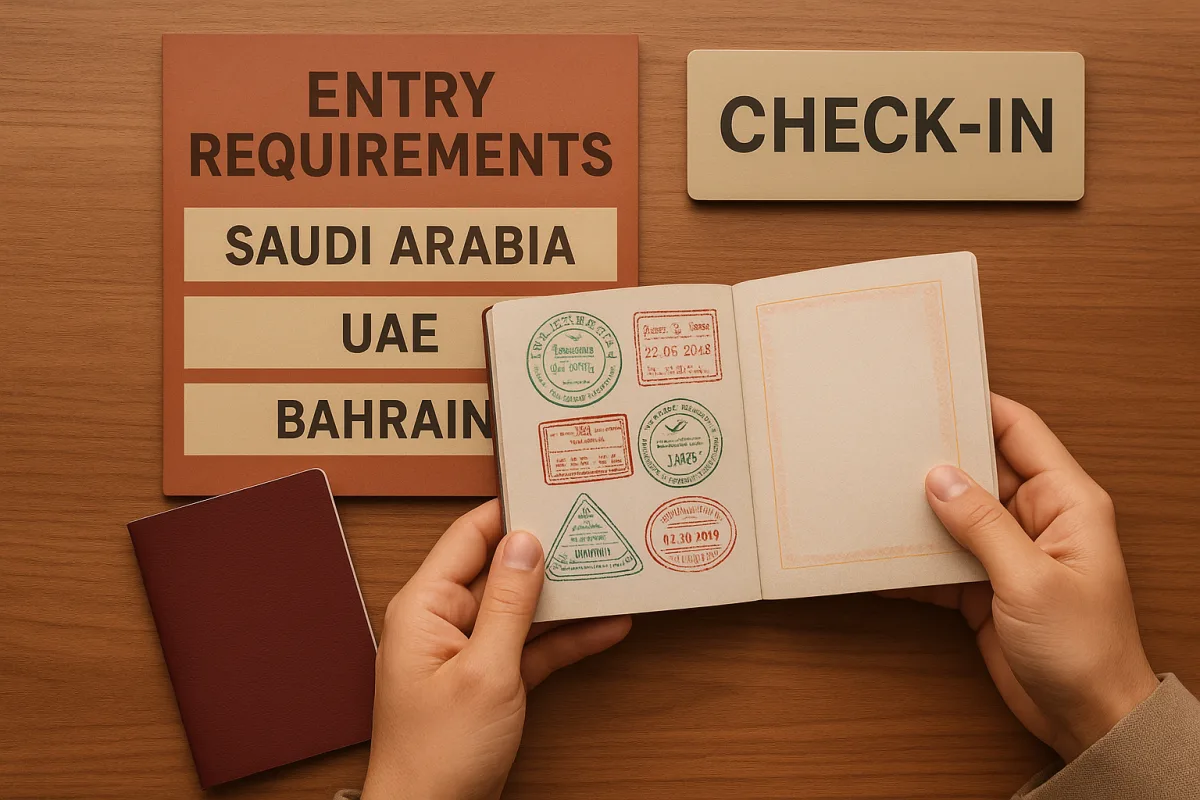
The shift at Arabian Travel Market 2026 is from selling destinations to making regional travel work
Arabian Travel Market 2026 is being framed around the future of global travel, but the more useful trend is practical regional integration. Gulf governments are trying to make a six-country trip easier to buy, easier to enter and easier to market. [6]
That is a material change from the older model, where Dubai, Abu Dhabi, Doha, Muscat, Riyadh, Jeddah, Manama and Kuwait City largely competed as standalone stops. The new pitch is a connected Gulf itinerary, supported by aviation, cruise growth, shared data and eventually a common tourist visa. [5][11][13]
The evidence is not confined to one trade-show announcement. GCC tourism ministers approved a recovery plan in September 2026, including joint initiatives, progress on a unified visa and shared tourism-data infrastructure. [11][12]
Meanwhile, the proposed GCC Grand Tours Visa is designed to cover all six GCC states through one application. Atlas Guide reports that it is expected to launch in the fourth quarter of 2026, covering citizens of 80 countries. [5]
Arabian Business has also reported renewed regional destination promotion at ATM 2026, including Morocco’s participation alongside Gulf tourism boards. Morocco’s stated target is 26 million annual visitors and 150,000 additional hotel beds by 2030. [9]
For an independent traveller, this means the region is becoming easier to think about as a route rather than a list of disconnected city breaks. It does not yet mean that the paperwork, border procedures or transport links are unified.
Strong baseline numbers, weaker conditions right now
The Gulf tourism story is not invented. GCC international tourism revenue reached $120.2 billion in 2024, according to Gulf Today, up 39.6 percent on 2019 and 8.9 percent on 2023. [2]
In 2025, travel and tourism contributed $385.8 billion to Middle East GDP and supported 7.1 million jobs, Gulf Times Now reported. Saudi Arabia’s tourism economy was estimated at $178 billion, while the UAE’s was $68.5 billion. [3]
Those are large numbers, and they help explain why tourism is now treated as economic infrastructure rather than a side business. Gulf states are investing in hotels, airports, cruise terminals, events, heritage projects and international marketing because visitor spending matters beyond leisure travel.
But the recovery narrative needs a qualification. The ongoing US-Iran conflict has created an immediate operational problem for the region’s air routes, traveller confidence and hotel demand, rather than a distant geopolitical concern.
The World Travel & Tourism Council estimated daily losses of €515 million across the Middle East travel and tourism industry during the disruption, according to Euronews. [1] That figure makes optimistic multi-year forecasts less useful for someone booking a trip next month.
Skift’s assessment of Gulf tourism described the current period as a lost year, and UAE hotel data underline why. Occupancy reportedly fell to 36.4 percent in March 2026 and had recovered only to 60 percent by July. [7]
That July occupancy figure remained 16 percent below the previous year. It is difficult to call that a swift recovery, even when long-term investment plans, visitor targets and airline capacity are all moving upward. [7]
ICAEW and Oxford Economics forecast a 2.4 percent GCC economic contraction in 2026, followed by 8.1 percent growth in 2027 as energy routes normalise and tourism demand recovers. [4] That is a forecast, not a guarantee.
For travellers, the practical interpretation is simple: watch conditions closer to departure than usual. A winter trip booked many months ahead may still be sensible, but build in flexible hotel cancellation and avoid tight self-booked air connections.
The GCC Grand Tours Visa could change trip planning, eventually
The most consequential regulatory proposal is the GCC Grand Tours Visa. It is expected to be valid for one year, permit multiple entries and allow stays of up to 30 days, with a reported fee of about $100. [5]
If launched on those terms, it would reduce one of the main frictions in building a route through the UAE, Saudi Arabia, Oman, Qatar, Bahrain and Kuwait. A traveller could potentially combine Dubai, Muscat and Doha without applying for multiple tourist visas.
Atlas Guide reports that the scheme is expected to increase intra-GCC international travel by 25 percent. [5] That projected impact should be read carefully: it is an expectation before launch, not observed traveller behaviour or confirmed booking data.
There is also no published evidence yet on approval times, insurance requirements, nationality-specific conditions, treatment of long stays, or how consistently border officers will apply the rules. Those details determine whether a visa is genuinely useful on the ground.
Until the system is live, book each country under its current entry rules. Do not assume a UAE visa, residence permit or arrival stamp gives access to Saudi Arabia, Oman, Qatar, Bahrain or Kuwait.
The GCC ministers’ recovery plan makes unified visa progress an official regional priority, which is more significant than an isolated tourism-board promise. [11] Still, a priority at ministerial level is not the same as a usable online application portal.
Airport technology is improving, while compliance is tightening
The region is pursuing two apparently opposite airport trends. Dubai is working to reduce processing time through biometrics, while Saudi Arabia is placing more responsibility on airlines and passengers to have documentation correct before boarding.
Dubai’s General Directorate of Residency and Foreigners Affairs introduced its “Click and Travel” service, using biometric and facial-recognition processes to speed airport passage. [4] For eligible travellers, that could reduce the need for repeated document checks at departure and arrival.
The attraction is clear for frequent visitors and residents using Dubai International Airport. Dubai received 19.6 million international visitors in 2025, including roughly two million in December alone, so small reductions in processing time can matter at scale. [4]
The limitation is that biometric travel is not a substitute for understanding entry requirements. A fast airport lane does not solve an expired passport, a missing onward ticket, an incorrect visa category or an itinerary disrupted by airspace restrictions.
Saudi Arabia’s General Authority of Civil Aviation now requires airlines to verify passenger documents before boarding, covering entry, exit and transit compliance. [4] That shifts the risk of a paperwork problem earlier in the journey.
For someone assembling their own itinerary, this matters most on routes involving separate tickets. If a first airline refuses boarding because documents do not satisfy the final destination or transit country, the later booking may be lost too.
Check requirements using the airline’s document tool as well as the destination’s immigration authority. Do this before buying non-refundable domestic flights, desert camps, cruise segments or hotel packages that depend on an international arrival.
Aviation and cruise are being treated as route-building tools
Arabian Travel Market’s regional showcases are expected to put aviation and cruise expansion alongside leisure tourism. Middle East air-passenger demand is projected to rise 23 percent between 2025 and 2030, according to Focus HiDubai. [13]
That growth matters because Gulf geography rewards short hops. Dubai to Muscat, Doha, Riyadh or Bahrain is often more practical by air than by road, particularly for travellers without a locally valid driving arrangement or with limited holiday time.
Cruise development can extend that logic. A ship itinerary can join several Gulf ports without requiring a separate flight between each city, though passengers should still confirm visa requirements for every port and any overnight stays ashore.
The weak point is that capacity forecasts are not timetables. More projected passengers do not automatically mean low fares, convenient schedules or reliable connections, especially while regional conflicts affect routing and aircraft availability.
There is no published ATM 2026 evidence yet showing which proposed air or cruise partnerships have produced bookable routes, lower fares or successful multi-country packages. The show’s commercial conversations should not be confused with delivered transport infrastructure.
Culture is moving from add-on entertainment to the reason for the route
The cultural offering at ATM is broader than the Gulf’s familiar luxury-hotel and shopping image. Morocco’s participation is a useful marker, because its 2030 plan combines visitor growth with a large increase in hotel capacity. [9]
For travellers, Morocco and the Gulf are not interchangeable destinations. Morocco works best as a culture-led trip built around medinas, food, mountains, Atlantic cities and rail connections, while Gulf itineraries usually require more deliberate planning between major cities.
The common theme is that tourism boards are selling heritage, events and local identity alongside accommodation. This is sensible commercially, because an attraction, festival or historic district gives a visitor a reason to stay longer than a stopover.
It is also where trade-show messaging is thinnest. No published visitor-engagement data for ATM 2026 is available, and no independent reporting has yet shown whether cultural showcases translated into bookings, longer stays or spending beyond headline attractions.
Previous ATM figures show the scale organisers are aiming to build on. Dubai Fast Living reported 55,000 travel professionals, 2,800 exhibitors, 57,869 meetings and 6,600 buyers at ATM 2025. [10]
Those figures show a serious business marketplace, not proof that the 2026 strategies work. Until post-event data appears, claims about demand for new cultural routes, cruise products or multi-country trips should be treated as intent.
What to book, and what to leave flexible
For a 2026 or early-2027 Gulf project, choose one main base and add only one or two additional countries. Dubai remains the obvious base because of flight connections, visitor volume and its continuing tourism-support spending. [3][4]
Dubai’s AED 2.5 billion tourism support package, announced in June 2026, includes hospitality financial aid and global marketing campaigns. [3] That may support supply and promotion, but it does not guarantee that hotel rates will fall for your travel dates.
Book international flights and refundable accommodation first. Leave regional flights, tours and airport transfers flexible until you have checked current airspace conditions, visa status, operating schedules and any revised airline documentation rules.
The best time for a conventional city-and-desert itinerary remains the cooler season, broadly November through March. That is also when demand is strongest, so the practical trade-off is better walking weather against higher hotel pricing and busier attractions.
Summer can be cheaper, particularly in Dubai and Abu Dhabi, but it is not simply a bargain season. Outdoor sightseeing becomes limited by heat, and an itinerary needs more indoor museums, malls, galleries, restaurants and carefully timed early-morning excursions.
The new regional strategy is worth watching because it could eventually make a Gulf loop as straightforward as a multi-country European trip. In 2026, though, travellers should plan for the Gulf as a promising but incomplete network.
Frequently Asked Questions
What are the key tourism trends at Arabian Travel Market 2026?
Arabian Travel Market 2026 is shifting focus from promoting individual destinations to enabling practical regional travel integration across the Gulf. The event highlights efforts to create connected Gulf itineraries supported by aviation, cruise expansion, shared tourism data, and progress toward a unified tourist visa. This reflects a move away from competing standalone city stops toward a more seamless multi-country travel experience.
How will the GCC Grand Tours Visa impact travel in 2026?
The GCC Grand Tours Visa, expected to launch in the fourth quarter of 2026, will allow visitors from 80 countries to travel across all six GCC states with a single visa valid for one year and multiple entries. Priced at roughly $100, it aims to simplify travel logistics and is projected to increase intra-GCC international travel by 25%. However, until it becomes operational, travelers must still book each country separately.
What are the current challenges facing Gulf tourism in 2026?
Despite strong baseline tourism revenues and growth, the Gulf tourism sector faces significant short-term challenges due to the ongoing US-Iran conflict. This conflict has disrupted air routes, reduced traveler confidence, and lowered hotel demand, causing estimated daily losses of €515 million across the Middle East travel industry. Additionally, Saudi Arabia now requires airlines to verify travel documents before boarding, adding complexity to travel logistics.
How is regional travel integration evolving in the Arabian Travel Market 2026?
Regional travel integration is advancing through joint initiatives approved by GCC tourism ministers, including shared tourism-data infrastructure and progress on a unified visa. Aviation and cruise sectors are also expanding to support connected Gulf itineraries. These developments represent a strategic shift toward marketing the Gulf as a single, multi-stop destination rather than a collection of separate cities.
What should travelers know about logistics and visas for Gulf trips in 2026?
Travelers should plan Gulf trips as separate country bookings through 2026 since the unified GCC Grand Tours Visa is not yet active. Saudi Arabia requires airlines to verify travel documents before boarding, so carrying correct entry paperwork is essential. Dubai remains a practical multi-stop base, but hotel availability and prices may be under pressure despite government support measures.
How we researched this
This article was assembled from 5 published articles, 13 cited references.
Nothing here is based on hands-on testing. Where a figure or finding appears, it belongs to the source cited beside it, and the writing says so rather than implying otherwise. Every source is listed below so you can check it.
Sources
Live Tourism’s Biggest Operators Are Confirmed. Are You in the Room? — Skift
How to redeem American Airlines AAdvantage miles — The Points Guy
Chase’s Dallas Airport Lounge Beats Amex And Capital One—The Food Is Worth Changing Terminals For — View from the Wing
Blacklane car service: How it works and the best ways to save — The Points Guy
JetBlue Passenger Kicked Off In St. Maarten For Verbally Abusing Flight Attendant—Friends Debate Leaving Her Behind — View from the Wing
Iran conflict ‘costs Middle East travel and tourism industry €515 million a day’ | Euronews
GCC Tourism 2026: How Much Does It Add To Gulf GDP And Jobs? - Gulf Times Now
GCC Countries to Launch Unified Tourist Visa in 2026 | Atlas Guide Travel News
Arabian Travel Market 2026: Dates, Location, Registration - Dubai Fast Living
Inside the 10th GCC Tourism Ministers Meeting - Tourism Reporter
Arabian Travel Market 2026 Showcases Middle East Aviation And Cruise Expansion
Related Articles

AI Travel Assistants 2026
Explore AI travel assistants in 2026 and how they reshape trip planning, loyalty integration, and disruption support in travel and hospitality.

Labor Day Travel Costs and Trends in 2026
Explore Labor Day travel costs and trends in 2026, including airfare, gas prices, and tips to plan your budget effectively.

Travel Costs and Airfare Trends 2026: What to Expect
Explore travel costs and airfare trends for 2026-2027, including fuel impact and budget airline fees to help plan your trip budget.

Travel Credit Card Comparison 2026: Chase vs Amex Platinum
Compare Chase Sapphire Reserve and Amex Platinum cards for 2026 travel budgets, rewards, lounge access, and perks to choose the best travel credit card.