
Travel Challenges and Delays in Asia
Discover key travel challenges and delays in Asia, including Bangkok floods and border issues, with tips to navigate disruptions effectively.
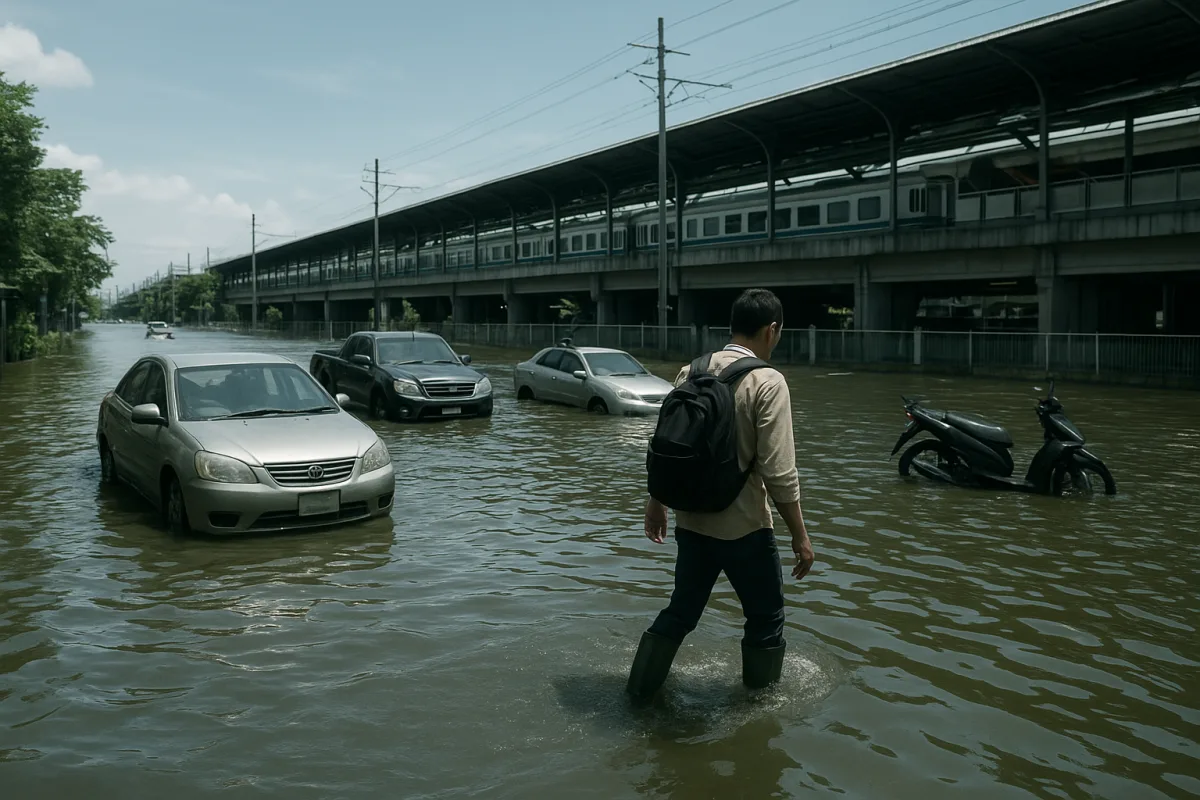
The travel disruption that matters is usually the last mile
A flooded capital and a closed border look like different travel problems. In practice, they expose the same weakness: a trip can be operational on paper while the final connection is not.
Bangkok’s Airport Rail Link, MRT and BTS are examples of this distinction. Thailand’s official update said the Airport Rail Link and MRT remained in service during late-September flooding, rather than closing citywide. [2]
That matters because a headline saying “Bangkok flooded” can suggest the airport is cut off. It does not tell a traveller whether the train runs, whether their hotel street is dry, or whether a taxi can reach the entrance.
The more useful question is not, “Is Bangkok open?” It is: “Can I make each link from aircraft to airport train, train to hotel, hotel to the place I actually need to be?”
This is the last-mile problem. Major infrastructure is built on protected alignments, with drainage, elevated sections or dedicated corridors. Local access depends on ordinary streets, canals, pavements, taxis, delivery vans and individual drivers.
A city can therefore have functioning rail transport and still have a difficult journey. A traveller who expects a simple 35-minute airport transfer may instead face an operational train followed by a road detour, luggage carry or long queue.
Why Bangkok could move while streets flooded
The rainfall was not an ordinary wet-season shower. Reporting cited by Al Jazeera and the Associated Press put the total at nearly 300 mm over 48 hours, with impacts reported across all 50 Bangkok districts. [1]
The Global Travel Mate channel’s September 27 street report illustrated the uneven result. It found parts of Phetchaburi Road still deeply flooded, with stranded cars and buses, while stretches around Ekkamai, Rama IV and Khlong Toei were dry.
That unevenness is central to planning. A map pin two kilometres away is not evidence that your route works, particularly if it crosses a lower road, canal junction or underpass.
The same channel reported that water levels in canals were unusually high and described pumping water toward the Chao Phraya River once conditions allowed. Its explanation is broadly useful: drainage capacity is not simply about how much rain falls.
It is about whether water can leave. If rain arrives faster than drains and pumps can move it, streets become temporary storage. If river levels are high, the final outlet is constrained too.
Global Travel Mate claimed pumps could handle around 60 mm per 24 hours, while the storm delivered more than 200 mm. That is a useful local observation, but not a figure independently verified in the supplied research.
What is verified is the practical outcome: 31 roads were affected, with detours and traffic delays, even as the BTS, MRT and Airport Rail Link resumed or continued operations. The rail network solved part of the trip, not all of it.
By September 28, Global Travel Mate found Phetchaburi Road reopened after the previous day’s flooding. On September 29, its follow-up showed tourist areas including Khao San Road, the Grand Palace vicinity, Silom and Sukhumvit functioning normally.
Neither account should be read as a blanket clearance notice. Associated Press reporting said some low-lying areas remained waterlogged as late as October 5. [1] Flood recovery works street by street, building by building and drain by drain.
How to book Bangkok when the network is running but access is uncertain
Start with accommodation, not attractions. Before booking, ask the hotel whether its entrance, lifts, water supply, breakfast service and road access are normal. Do not accept “Bangkok is open” as an answer.
Ask a narrower question: “Can a standard taxi reach the front entrance from Suvarnabhumi today?” If the hotel cannot answer, choose a property within a short, dry walk of an Airport Rail Link, BTS or MRT station.
This is not only about comfort. Some low-lying hotels reportedly flooded, leading to closures or reduced services. A cheap room can become expensive if you need last-minute transport, replacement accommodation and meals elsewhere.
For arrivals, retain a rail-based plan and a road-based backup. The Airport Rail Link’s continued operation was valuable precisely because roads were the variable part of the system. [2]
Leave a buffer after landing. Suvarnabhumi faced flight disruption, suspended cargo operations and roughly 10,000 stranded pieces of luggage during the wider emergency, according to El País reporting.
That means a tight connection can fail even if your own aircraft lands. Pack medication, a change of clothes, power bank, basic toiletries and copies of bookings in cabin baggage, rather than assuming checked luggage will appear quickly.
Do not rely on canal boats as an emergency substitute. Global Travel Mate reported the Khlong Saen Saep service stopped during the peak flooding, then later said it had resumed, but the independent research found no documented service status. Treat it as unconfirmed.
For an event, separate venue status from journey status. Global Travel Mate found the Rajamangala Stadium grounds dry after flooding around Ramkhamhaeng, and no official changes were reported for The Weeknd’s October 11 to 13 concerts.
That did not guarantee easy arrival. The sensible plan was to watch organiser announcements, leave early, use rail where possible, and be ready for the final road section to be slower than normal.
The same system failure at a border
The Georgia-Azerbaijan route in Kara and Nate’s Mongol Rally episode offers the overland version of Bangkok’s last-mile problem. Their group could travel onward, but their bus could not simply drive across the land border.
The group described Azerbaijan’s Georgia land border as closed to ordinary crossing after the Covid-era closure, requiring the vehicle to be handed to a shipping intermediary while the travellers waited in Tbilisi.
That changes what “getting from Georgia to Azerbaijan” means. It is no longer one border crossing. It becomes vehicle handover, export processing, transport across the frontier, import or transit clearance, reunion with the vehicle, then a ferry booking.
Every stage has a separate actor. The traveller deals with visas and flights. A freight agent handles the vehicle. Customs controls documents. Azerbaijan’s transport authorities regulate freight access. Port operators control the ferry queue.
Azerbaijan requires freight vehicles to hold a permit from the Ministry of Digital Development and Transport for entry, loading or transit. That permit is not a passenger visa, and a passenger visa does not move a vehicle.
Kara and Nate’s account makes the human consequence clear. Their large bus was left with an intermediary, paperwork was signed and notarised, and the team used a tracker to see whether it moved before booking flights to Baku.
That is not an unusual precaution. When your vehicle and your body must take different routes, carry everything needed to continue independently: passports, visas, payment cards, medicines, electronics, warm layers and essential gear.
Why quoted shipping times are not an itinerary
The available research gives an average Georgia-Azerbaijan overland transit time of about four days. That figure is a planning reference, not a promise, because it does not settle customs holds, border capacity or port access.
The supplied shipping-cost research is similarly incomplete. It gives a cost index of 1,703 to 3,194, but does not identify the currency or precisely what services are included. It cannot responsibly be treated as a traveller’s fare.
The only specific insurance prices in the research are $45 for total-loss cover on vehicles valued up to $4,000 and $55 for full cover. Those prices are insurance products, not shipping, border handling or ferry costs.
For a vehicle arriving in Georgia from the United States, documentation can include a bill of lading, title, commercial invoice, packing list, customs declaration, expert evaluation and identification. Missing paperwork is not a minor inconvenience at this stage.
Then comes the Caspian ferry. The research warns that Aliat port can face administrative delays exceeding one and a half months. A nominal four-day road transit and a six-week port wait can coexist.
This is why a separate flight ticket may be cheaper than protecting a rigid overland schedule. It is also why travellers should avoid non-refundable hotels, tours or visas in Kazakhstan, Uzbekistan or elsewhere that assume a particular ferry sailing.
The better budget is not a single freight quote. It is freight, insurance, storage risk, accommodation during delay, independent passenger transport, food, communications, possible visa changes and a cash reserve for a replacement plan.
Keep the disruption from becoming a health problem
Floodwater is not merely dirty. Post-flood reporting warned of waterborne illnesses including cholera and leptospirosis, alongside increased dengue risk as stagnant water supports mosquitoes.
Do not wade to save a taxi fare. Use bottled or boiled water where advised, cover cuts, wear protective footwear if conditions require it, and use insect repellent consistently after rain.
There is also an ethical practicalism to this. Global Travel Mate’s flood reporting showed the Bangkok Community Help Foundation preparing and distributing meals while some neighbourhoods remained inaccessible, even as central tourist districts reopened.
The foundation’s current site confirms it is distributing food, water, hygiene kits and clothing, but does not publish a verified current meal total. Travellers who want to volunteer should contact it directly through its website or Line group first.
Frequently Asked Questions
What are common travel challenges and delays in Asia?
Travel challenges often involve disruptions in the last mile of a journey, where major infrastructure like rail lines may operate normally but local access via roads, taxis, or canals is impaired. Flooding, border closures, customs paperwork, and ferry queues can cause significant delays, especially in cities like Bangkok and border crossings such as between Georgia and Azerbaijan.
How do Bangkok floods affect travel logistics?
Bangkok floods can cause uneven street flooding that disrupts road access even when rail services like the Airport Rail Link, MRT, and BTS remain operational. Travelers may face detours, stranded vehicles, and delayed taxi services, making the final connection from transport hubs to hotels or venues uncertain despite functioning major transport lines.
What should travelers know about last-mile travel disruptions in Asia?
Last-mile disruptions mean that a trip may be technically operational on paper but practically difficult due to local conditions like flooded streets or closed roads. Travelers should verify access to their specific hotel or destination rather than relying on general statements about citywide transport availability, as local routes can vary significantly in condition.
How to plan for border crossing delays between Georgia and Azerbaijan?
Travelers should build several days of slack into itineraries crossing the Georgia-Azerbaijan border due to customs paperwork, closed land borders, and ferry queues. Delays at Azerbaijan’s Aliat port can be extensive, sometimes lasting over a month, so it is unwise to book onward transport based solely on advertised freight transit times.
What precautions can travelers take during travel disruptions in Asia?
Travelers should confirm hotel access and transport options before booking, carry essentials like medication and a change of clothes in carry-on luggage, and prepare for possible delays. In flood-affected areas like Bangkok, avoid floodwater, carry mosquito repellent and bottled water, and expect potential increases in local prices due to disrupted deliveries.
How we researched this
This article was assembled from 5 video sources across 2 channels, 2 cited references.
Nothing here is based on hands-on testing. Where a figure or finding appears, it belongs to the source cited beside it, and the writing says so rather than implying otherwise. Every source is listed below so you can check it.
Sources
Bangkok Flooding 2026 – Day 3 | Streets Still Under Water After Heavy Rain — Global Travel Mate
Stuck Between Russia & Iran (Mongol Rally Ep. 7) — Kara and Nate
Bangkok Is Back! 🇹🇭 Why Tourists Should Visit After the Floods | Beautiful Weather Again — Global Travel Mate
Bangkok After the Floods 2026 🇹🇭 | The Day After Extreme Flooding — Global Travel Mate
Bangkok Flood Update: Will It Affect The Weeknd Concert at Rajamangala Stadium? — Global Travel Mate
Bangkok weather and travel update | 27 September 2026, 18.00 Hrs. - THAILAND.GO.TH
Watch Travel Challenges and Delays in Asia on Youtube
Also from the sources
Related Articles

Travel Challenges in Remote Locations
Explore travel challenges in remote locations with tips on logistics, borders, budgets, and weather for self-supported adventure trips.

Serviced Apartments and Historic Lockhouses
Explore serviced apartments in Bangkok and historic C&O Canal lockhouses for unique family stays with practical tips on costs, amenities, and bookings.

Portugal Day Trips from Lisbon: Highlights, Costs & Tips
Discover top Portugal day trips from Lisbon with costs, transport, and highlights for Évora, Sintra, and more. Plan your perfect day trip easily.
Underrated Travel Destinations Logistics and Budget Tips
Explore underrated travel destinations in 2026 with practical logistics, budget advice, and transport tips for a smooth trip.