
Thailand Visa Policy Changes 2026: New 30-Day Visa Exemption
Learn about Thailand visa policy changes in 2026, including the new 30-day visa exemption and how it affects travelers from 60 countries.
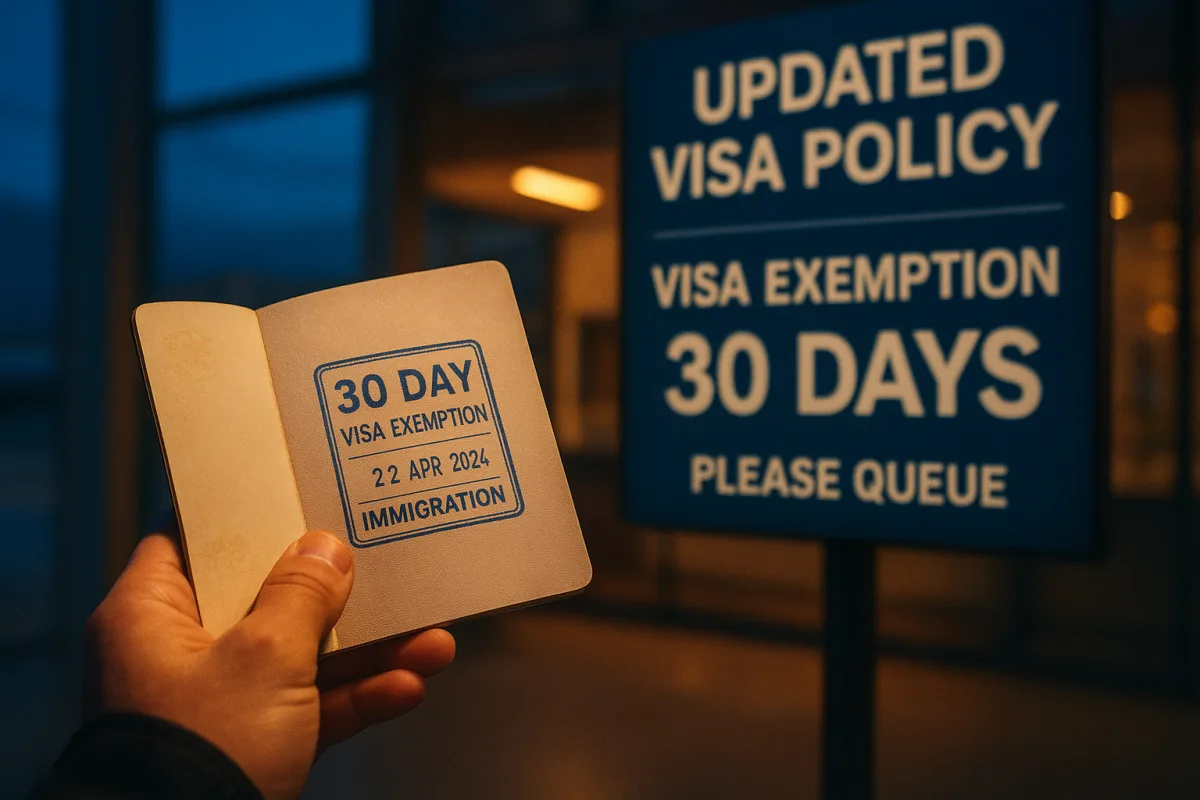
The number that matters is not 30 days, it is 30 days per entry
Thailand’s new rule is simple at first glance: the visa-free stay falls from 60 days to 30 days on 15 September 2026. But planning gets clearer once you treat that number as an entry permission, not a 30-day cap on every Thailand trip. [1][2]
A traveller flying from London, Los Angeles, Sydney, Toronto or Paris into Bangkok after the change receives permission to remain for 30 days, assuming they hold a passport from one of the 60 eligible countries and satisfy the officer at the border. [3][4]
That permission begins on the date of arrival. It is not calculated by hotel nights, it does not pause for domestic travel, and it is not refreshed by moving between Chiang Mai, Phuket, Bangkok and the islands.
For a two-week beach-and-city holiday, nothing material changes. A visitor arriving in Bangkok on 1 November and departing on 14 November is well inside the new allowance, with no visa application required beforehand under the exemption scheme.
The change matters for travellers who previously used Thailand as a two-month base. Think of a January spent between Nimman in Chiang Mai, Bangkok’s Ari neighbourhood and a rented apartment in Rawai, Phuket, before flying onward in March.
Under the old arrangement, a 59-night itinerary was possible without visiting an immigration office. After 15 September, the same itinerary requires either an extension after arrival or a visa obtained before departure. [1][7]
That distinction is worth making before booking non-refundable accommodation. “Visa-free” means no advance tourist visa for an eligible passport holder, not an unconditional promise that every traveller will be admitted or can remain indefinitely.
Who has 30 days, and who does not
The 30-day visa-exemption rule applies to nationals of 60 countries and territories. Reporting on the published changes identifies the United States, United Kingdom, Canada, Australia, France, Germany and most European Union member states among the group. [1][2][3]
For readers carrying one of those passports, the old 60-day exemption ends for entries from 15 September. Thailand’s Royal Gazette published the change on 31 August, so the key date is not rumour or an airline interpretation. [1][4]
It is important not to turn “60 countries” into shorthand for every passport that once appeared on Thailand’s broadly permissive visitor lists. Mauritius and Seychelles nationals receive 15 days visa-free, rather than the standard 30. [3][11]
Azerbaijan, Belarus and Serbia sit in a different category again. Their citizens need a Visa on Arrival, rather than joining the 60-country visa-exemption group. [3][11]
Thailand has also narrowed Visa on Arrival eligibility sharply, from 31 countries to four. That is a separate policy mechanism from visa exemption, but it matters because travellers often use the phrases interchangeably. [7][11]
In practical terms, check your passport’s scheme, not your nationality as described by a booking website or travel forum. A British resident travelling on a South African passport, for example, must follow the passport’s rules, not Britain’s.
The available reporting does not provide a complete country-by-country list of all 60 exemption-eligible territories. For unusual passports, dual nationals and travellers with refugee travel documents, the sensible step is confirmation from a Thai embassy or official government source before paying for flights.
The transition rule: arrival date decides the allowance
There is one useful piece of timing for travellers already committed to a long stay. If you enter Thailand on or before 14 September 2026, you retain the former 60-day allowance. [3][4]
That remains true if day 60 lands after 15 September. Thailand is not shortening permissions already granted at the border merely because the policy changes while you are in the country. [3]
For example, an eligible Canadian arriving on 10 September can receive 60 days and remain into early November, subject to the stamp or electronic entry record they are actually given. The traveller arriving five days later gets 30 days.
This makes 14 and 15 September unusually consequential dates, but it should not encourage a rushed border run. Immigration officers retain discretion, and reports of tougher questioning, refusals and delays exist, though there is no official data showing their scale. [7][9]
The safest routine is mundane rather than clever: carry evidence of an onward ticket within the allowed period, an address for the first night, and access to sufficient funds. Check the date recorded on admission before leaving the immigration desk.
Do not rely on a calendar calculation alone. A flight delayed past midnight, an arrival diverted to the following day, or an incorrect assumption about the entry date can turn a 60-day plan into a 30-day one.
How a 30-day extension makes a 60-day stay possible
The crucial mechanic is that a visa-exempt entrant can apply for one 30-day extension at a Thai immigration office. If granted, that takes a standard visa-free stay from 30 days to a possible 60 days total. [3][4]
“Possible” is the operative word. The first 30 days is the admission period granted on arrival. The additional 30 days comes from an application inside Thailand, so it involves an officer, paperwork and a trip to the appropriate immigration office.
For a traveller basing themselves in Bangkok, that means planning around the local immigration process rather than assuming it can be done at Suvarnabhumi Airport on departure. In Phuket, Chiang Mai or Koh Samui, check the local office serving your address.
The supplied reporting confirms the availability of a 30-day extension but does not establish a current extension fee. That is a cost to verify directly before making a 45- or 60-day accommodation commitment, rather than copying an old blog post.
Build the administration into the itinerary. A month split evenly between Bangkok and Koh Lanta may sound efficient, but an immigration-office visit can consume a weekday and become inconvenient if you leave the application until the last few permitted days.
For someone staying 31 to 45 days, the extension is generally the least disruptive route because it avoids obtaining a visa in advance. For 60 days, it can also work, but it leaves more to arrange after arrival.
The new policy therefore does not eliminate the two-month Thailand trip. It shifts one part of it from automatic border admission to an administrative task undertaken during the trip. That is the real reduction travellers need to budget time for.
When an advance tourist visa is the better tool
A Single Entry Tourist Visa, usually called a TR visa, remains the cleaner option for a trip designed to run beyond 30 days from the outset. It permits 60 days and can be extended by a further 30 days. [5][7]
That structure gives a potential 90-day stay, compared with 60 days under the visa-exemption-plus-extension route. It also means a traveller knows before boarding that their initial admission is intended to cover a two-month itinerary. [5][7]
The research supplied puts the TR visa fee at THB 80, made up of THB 50 plus a THB 30 processing charge, and gives a processing estimate of one to two weeks after a complete application. [5][6]
Those figures deserve a warning label. Visa fees, payment methods, supporting-document requirements and appointment systems can vary by embassy or consulate, so confirm them with the Thai mission handling your application before treating THB 80 as a final trip cost. [5][6]
This route suits a traveller who has already booked a six-week rail-and-island itinerary, perhaps beginning in Bangkok, continuing north to Chiang Rai, then ending in Krabi. It is less useful for someone simply taking a 22-day holiday.
A Multiple Entry Tourist Visa, or METV, is for repeated entries over six months. Each entry can allow 60 days, but the reporting says applicants need roughly £5,000 in funds and six months of bank statements. [7]
That financial documentation makes the METV a specialist choice, not an upgrade every long-term traveller needs. It suits someone genuinely entering and leaving Thailand several times, not a visitor whose only concern is adding ten days to one holiday.
Why a land-border hop is a poor plan
The 30-day exemption applies at land borders too, but Thailand limits most eligible travellers to two visa-exempt land entries per calendar year. Malaysia, Brunei, Indonesia and Singapore are exceptions to that particular cap. [7][11]
That rule is aimed at the familiar pattern of leaving Thailand briefly for Laos, Cambodia or Malaysia, then returning to restart a visitor stay. It means the border crossing is not a dependable substitute for using the correct visa.
A traveller can still cross overland for a real trip. Taking the train south to Malaysia, or travelling onward through Laos, remains possible. The limitation is on repeatedly relying on visa-exempt re-entry, not on overland travel itself.
There is no reliable published data on how consistently the two-entry land limit is enforced or how it has changed traveller behaviour. That uncertainty is exactly why a planned “border run” should not be the foundation of a longer itinerary. [7]
Air entry does not erase the broader issue either. A traveller with a history of back-to-back short stays may face questions about their purpose, funds and onward plans. Anecdotal reports describe delays and refusals, but do not quantify them. [9]
If your plan involves remote work, frequent exits or living in Thailand for much of the year, do not assume tourist entry will fit merely because each individual stay is under 30 days. The category of permission should match the activity.
The DTV is for a different kind of long stay
Thailand’s Digital Nomad Visa, or DTV, is the longer-stay alternative repeatedly raised alongside the new tourist rules. It is a five-year multiple-entry visa allowing up to 180 days per entry, with one possible 180-day extension. [10]
Its application cost is THB 10,000, and applicants must show THB 500,000 in funds. The requirements are materially more demanding than a tourist trip, especially because reporting says financial and freelance documentation is receiving closer scrutiny. [10]
That makes the DTV sensible for someone who can document qualifying remote work or a relevant long-stay purpose, and who intends to spend substantial time in Thailand. It is disproportionate for a six-week holiday or a winter escape.
The policy rationale reported around the changes includes concern about unauthorised work and misuse of short-term entries. Independent evidence measuring the scale of those activities or the effect of the new rules has not been provided. [7][9]
For ordinary visitors, the useful takeaway is narrower: a tourist exemption is now designed around 30 days. If you need 31 to 60 days, plan an extension or a tourist visa. If you need months, investigate the visa category before you fly.
Do the arrival paperwork before the flight
Every traveller should also complete the Thailand Digital Arrival Card, or TDAC. It has been mandatory since 1 May 2025 and replaced the old paper TM6 arrival form. [8]
The TDAC is not a visa and does not add days to your permitted stay. It is arrival documentation, so it sits alongside, rather than replaces, the question of whether you are entering under an exemption, tourist visa or DTV.
Before departure, check three separate things: your passport’s entry category, the departure date your permission must cover, and the TDAC requirement. Keeping those as separate tasks prevents the common mistake of treating one completed form as all required immigration clearance.
Finally, use the date on the immigration record as the operational truth for your trip. The new system is less forgiving of casual two-month planning, but it is still straightforward if you decide before booking whether your stay is 30, 60 or 90 days.
Frequently Asked Questions
What are the new Thailand visa policy changes effective September 2026?
Starting 15 September 2026, Thailand reduces the visa-free stay for nationals of 60 countries from 60 days to 30 days per entry. Travelers can still stay up to 60 days, but the second 30 days requires an in-country extension application at a Thai immigration office. The change was officially published in the Royal Gazette on 31 August 2026.
Which countries are affected by Thailand's visa exemption reduction?
The reduction applies to passport holders from 60 countries and territories, including the United States, United Kingdom, Canada, Australia, France, Germany, and most European Union member states. Some countries like Mauritius and Seychelles have different allowances, and others such as Azerbaijan, Belarus, and Serbia must obtain a visa on arrival.
How long can travelers stay visa-free in Thailand after September 15, 2026?
Travelers from the eligible 60 countries can stay visa-free for 30 days per entry starting on 15 September 2026. Those entering before 15 September retain the previous 60-day allowance even if their stay extends beyond that date.
Can travelers extend their stay beyond 30 days in Thailand without a visa?
Yes, travelers can apply for a 30-day extension at a Thai immigration office after arrival, making the practical maximum stay 60 days without obtaining a visa beforehand. This extension is not automatic and requires an application process.
What is the process for applying for a visa extension in Thailand?
To extend the visa-free stay beyond 30 days, travelers must visit a Thai immigration office in person and submit an application for a 30-day extension. The extension is granted at the discretion of immigration authorities and is not guaranteed automatically.
How we researched this
This article was assembled from 5 published articles, 11 cited references.
Nothing here is based on hands-on testing. Where a figure or finding appears, it belongs to the source cited beside it, and the writing says so rather than implying otherwise. Every source is listed below so you can check it.
Sources
Asanas at Sea? The Best Places for Yoga Around the World Are Also the Most Unconventional — CN Traveler
Air Canada Will Announce 5 New Destinations On Thursday, But You Can Read Them Here First — View from the Wing
20 Fall Getaways From NYC for Apple-Picking, Wine-Tasting, and Leaf-Peeping — CN Traveler
GHA Discovery: Receive Lifetime Top Tier Elite Status—No Stay Required—Or $5,000 In Stay Credits — View from the Wing
GHA Discovery: Receive Lifetime Top Tier Elite Status—No Stay Required—Or $5,000 In Stay Credits — View from the Wing
Thailand Cuts Visa-Free Stays to 30 Days on September 15—Here’s What to Check | thePointsPage
Thailand Visit/Tourist Visa Processing Time 2026 — Timeline & Planning Guide | VisaProcessInfo
End of Thailand's 60-Day Visa-Free Stay: Why the DTV Is Now the Main Long-Stay Route (June 2026)
Thai Cabinet Approves Revision of Thailand’s Visa Exemption and VoA Schemes - THAILAND.GO.TH
Related Articles

Airline Loyalty Program Changes and Updates in 2026
Explore 2026 airline loyalty program changes, status updates, and how fare choices impact upgrades and benefits across major US airlines.

Travel Trends 2026: Industry Insights and Future Outlook
Explore travel trends 2026 with insights on AI planning, sustainability, traveler behavior, and industry forecasts for future travel.
Arabian Travel Market 2026
Explore key tourism trends, GCC visa updates, and regional travel insights from Arabian Travel Market 2026 for Gulf trip planning.

Travel Budget and Deals 2026: Best Discounts and Tips
Discover top travel budget tips and deals for 2026, including flight promos, safari packages, and gear discounts to save on your next trip.