
Fuel Surcharges and Rising Airfares
Learn how fuel surcharges impact rising airfares and what travelers should know about airline pricing amid soaring fuel costs.
When a Fuel Surcharge Is Not a Tax: Why the Fare You See Can Rise Faster Than Jet Fuel
The number on a ticket that matters: YQ
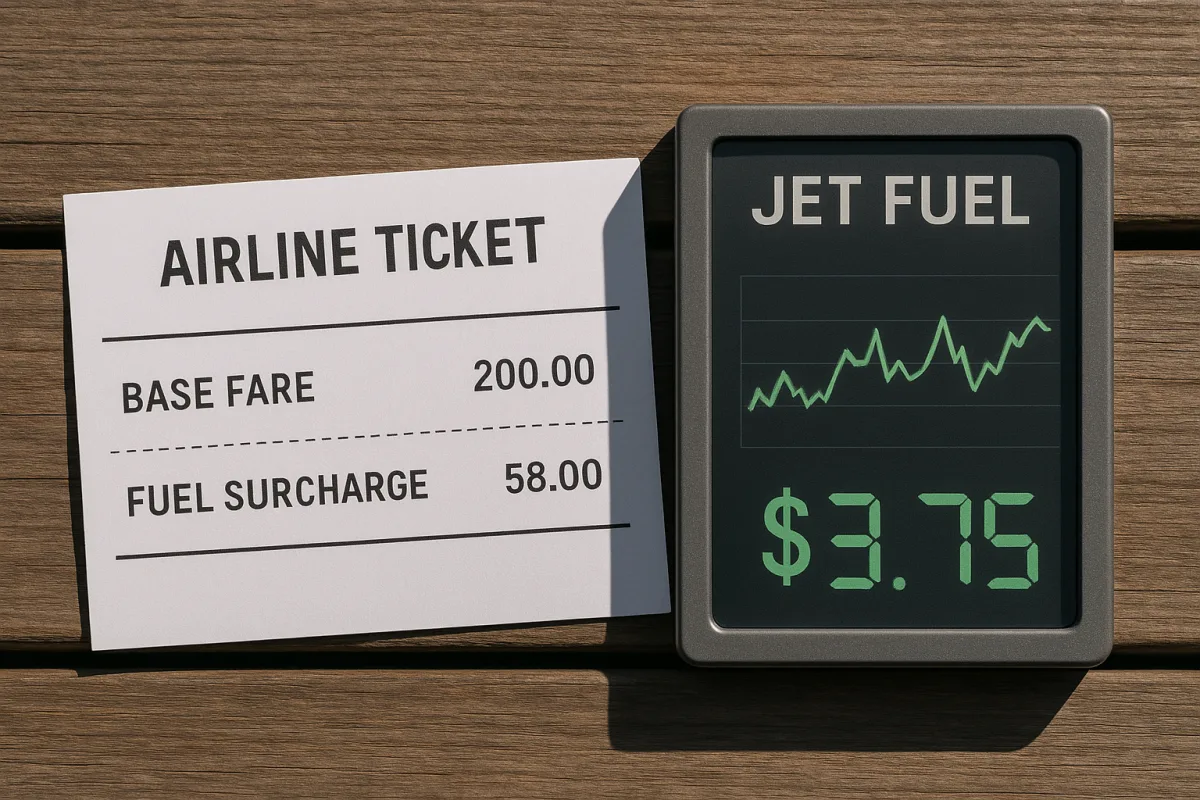
The most useful thing to understand in an expensive airfare year is the fuel surcharge, often labelled YQ or YR in the fare breakdown. It sounds temporary and technical. In practice, it is an airline-controlled portion of the ticket price.
This distinction matters because travelers tend to group every extra charge under “taxes and fees.” Taxes are set by governments and airports. Carrier-imposed charges, including many fuel surcharges, are retained by the airline or passed through commercial arrangements it controls. [3][4]
An airfare has several layers. There is the base fare, government taxes, airport charges and airline-imposed fees. Airlines can shift money among these layers, so comparing only the headline fare often gives the wrong answer.
A $500 ticket and a $500 ticket are not necessarily the same product economically. One carrier might show a $420 fare plus $80 in taxes. Another could show a $250 fare, $80 in taxes and $170 in carrier-imposed charges.
For the traveler paying cash, the total is what matters. For the traveler using points, the split can be decisive. A “free” award seat may require 70,000 points plus several hundred dollars in taxes and airline surcharges.
The Points Guy explains that YQ began as a way for airlines to respond to volatile fuel costs without constantly refiling every underlying fare. [3] That origin explains the label, but it should not imply a precise gallon-for-dollar connection today.
An airline can leave a surcharge in place while oil falls, remove it while fares rise, or build fuel costs directly into the fare. The charge is pricing strategy as much as fuel accounting.
Why fuel has become the argument
Jet fuel is not a minor operating expense that airlines can ignore for a quarter. Axios reported that Delta expected its fuel bill to rise by $6 billion this year, a scale large enough to reshape route planning, ticket prices and profit forecasts. [1]
The underlying supply disruption is serious. Reporting collected in the research brief says the Middle East conflict has reduced crude supplies by 20% and jet-fuel supplies by 40%, tightening the market airlines buy from. [6]
For a visible retail benchmark, GlobalAir listed the U.S. average Jet A price at $8.39 per gallon on October 14, 2026. Alaska was $9.57, while the central United States was $7.66. [2]
Those numbers need careful interpretation. GlobalAir tracks prices at fixed-base operators, where private aircraft and some business aviation customers buy fuel. Major airlines negotiate enormous-volume contracts, so their actual fuel cost will differ from an FBO’s posted rate.
Still, the regional spread illustrates the problem. Fuel is not delivered to every airport at the same cost, and airlines cannot choose to fly only the cheapest-fuel routes. A network carrier has schedules, crews, connecting passengers and airport commitments to maintain.
Skift reported that jet fuel prices had risen 102% year over year by mid-September 2026. Its central point is more helpful than the headline: an airline’s response depends on who else has leverage over its money.
Fuel costs may rise quickly, but other bills do not disappear. Aircraft leases, wages, airport charges, maintenance and debt payments remain. The airline then decides how much of the additional fuel bill it can put into fares.
Why airlines cannot simply pass on every cent
The simple version of airline pricing is that fuel rises and tickets rise. The real version is that each flight has a limited number of seats, competing carriers, different passenger types and a departure date that cannot move.
A seat from Chicago to Denver at 6 a.m. on a Tuesday has less pricing power than a nonstop transatlantic flight during a school holiday. The airline may absorb more fuel cost on the former because it cannot sell it at a higher price.
That is why a fuel surcharge is not universal. It works best where a carrier has strong demand, a valuable nonstop route, limited competition or customers whose travel dates are fixed.
Cathay Pacific is a clear example of a carrier using the tool. Its April 2026 fuel surcharge was about $200 per one-way long-haul segment, or roughly $400 before other taxes and fees on a round trip. [8]
On premium-cabin itineraries, the cumulative charge can exceed $1,000 over a long-haul trip, particularly where multiple segments are involved. [3][8] That is not an abstract accounting entry when choosing between a points redemption and a paid ticket.
United provides the counterexample. NerdWallet notes that United does not impose fuel surcharges, though it can of course recover fuel costs through base fares, mileage prices, baggage charges and other commercial decisions. [4]
The practical lesson is not that United is always cheaper. It is that a lower displayed fare or a tempting award chart can conceal the more expensive option once carrier-imposed charges are added.
The capacity constraint behind higher fares
Fuel pricing is only half the story. Airlines can spread costs across more seats if they can add aircraft. In 2026, that option is constrained by a long aircraft-delivery queue.
Skift says meaningful delivery slots for Airbus A320neo and Boeing 737 Max aircraft are scarce until roughly 2033, with widebody availability tight into the mid-2030s. That keeps airline growth constrained even when demand is strong.
The independent research brief puts numbers on that shortage: narrowbody backlogs exceed 7,000 aircraft, while Airbus and Boeing have about 3,000 widebodies on backlog. Production is running below the level needed to clear it quickly.
This turns a fuel spike into a traveler problem. If airlines cannot obtain efficient new aircraft or expand schedules, they have fewer seats available to spread costs across. Full planes allow higher fares, particularly on peak dates.
Carriers are also keeping older aircraft in service longer and leasing more planes, according to the research brief. Industry supply-chain disruption cost more than $11 billion in 2025, including $4.2 billion tied to older, less fuel-efficient aircraft.
That cost does not appear as a separate line on a boarding pass. It appears in a less obvious way: fewer bargain departures, more expensive peak weekends and airlines that are less willing to sell the last seats cheaply.
For travelers, this means flexibility has gained value. Shifting an outbound flight by a day, using a nearby airport, or accepting a connection can matter more than hunting for a promotional code after the schedule is already tight.
Who absorbs the fuel bill when the passenger does not
Airlines have other sources of cash that can soften the impact of fuel. Skift identifies premium travel, credit-card partnerships, airport relationships, labor agreements and aircraft suppliers as the counterparties influencing which carriers cope best.
Premium cabins have become particularly important. Skift reports that premium cabins generated $188 billion in global passenger revenue in 2024, 24% of the total, while U.S. premium capacity grew faster than economy capacity after 2020.
That helps explain why an airline may protect the front of the cabin while trimming low-fare availability. A business-class or premium-economy traveler can produce enough revenue to absorb a larger share of a flight’s fuel bill.
Credit-card partnerships provide another cushion. Skift reported that Delta collected $8.2 billion from American Express in 2025, about 14% of its adjusted operating revenue. That is cash not directly dependent on filling an economy seat.
The arrangement has a travel-budget consequence. Airline points can still be valuable, but the bank-funded loyalty ecosystem does not guarantee cheap redemptions when surcharges rise. The carrier can charge points, cash fees, or both.
American Airlines’ new Citi/AAdvantage Executive World Legend Mastercard illustrates the scale of the premium-card market, advertising Admirals Club membership valued at $1,400 among its benefits. [9] Such products make the airline-bank relationship commercially significant.
There is also a less comfortable example at Seattle-Tacoma International Airport. View from the Wing reported that the airport’s two Priority Pass lounges produced about $12 million in annual profit, with Priority Pass paying roughly $24 per visit.
The same reporting found food and drink costs of $3.54 per guest and described severe operational shortcomings during a February audit, including omelets heated on a microwave placed on a filing cabinet. The operator later said corrective action was taken.
That Seattle arrangement should not be treated as a national lounge standard. There is no comparable 2026 dataset for major U.S. airport lounges. It does show how banks, lounges, airports and airlines can earn money around the trip while the flight itself faces fuel pressure.
What to put in a 2026 travel budget
For a leisure trip, start with the all-in air cost rather than a target fare from last year. Axios-linked reporting puts the August year-over-year increase in U.S. airfares at 23.4%, contributing to a 9% increase in overall travel costs. [1]
Deloitte found that 45% of Americans planned summer vacations involving paid lodging, the lowest share in six years. [5] The finding suggests that higher transport costs are affecting whether people take trips, not merely where they book.
For a points trip, price the identical itinerary in three ways: cash, points plus fees, and a different airline or alliance partner. The cheapest points redemption is often the one with modest fees, not necessarily the one requiring the fewest miles.
Check the checkout screen before transferring transferable points. Transfers are usually irreversible. A $400 round-trip fuel surcharge can erase the advantage of a slightly lower mileage requirement, especially on a two-person booking.
For business travelers, the pressure is showing up in policy rather than cancelled travel. Global business-travel spending is projected to reach $1.71 trillion in 2026, while 85% of travel managers say they are increasing budgets. [7]
Deloitte reports that 45% of travel managers are mandating lower-cost flights, compared with 41% placing greater pressure on cheaper lodging. [5] In other words, the airfare line is taking priority in corporate cost control too.
The useful habit is to view YQ as an airline price, not an unavoidable tax and not a direct meter of fuel burned on your flight. In a constrained aircraft market, the carrier with the strongest route, customers and loyalty income decides how much of the fuel bill reaches your checkout page.
Frequently Asked Questions
What is a fuel surcharge on airline tickets?
A fuel surcharge, often labeled YQ or YR, is an airline-controlled portion of the ticket price meant to cover fluctuating fuel costs. It is not a government tax but a carrier-imposed charge that can appear on both cash tickets and award bookings. Airlines use it as a pricing tool to respond to volatile fuel prices without constantly changing the base fare.
How do fuel surcharges affect the total airfare?
Fuel surcharges add to the total cost of an airline ticket and can significantly increase the final price beyond the base fare and government taxes. For travelers using points, surcharges can add hundreds of dollars to an award ticket, making a “free” seat more expensive due to these additional fees.
Why do some airlines charge fuel surcharges and others do not?
Fuel surcharges are applied selectively based on an airline’s pricing strategy, route demand, competition, and passenger type. For example, United Airlines generally does not add fuel surcharges, instead reflecting fuel costs in a higher base fare, while other airlines like Cathay Pacific impose substantial surcharges on certain routes.
How do rising jet fuel prices impact airline ticket prices?
Rising jet fuel prices increase airlines’ operating costs, which they may partially pass on to passengers through higher fares or fuel surcharges. However, airlines cannot always fully pass on these costs due to competition, route demand, and fixed schedules, so the impact on ticket prices varies by market and carrier.
Can fuel surcharges make award flights more expensive?
Yes, fuel surcharges can add several hundred dollars to the cost of award flights, even when the base ticket is booked with points. For example, Cathay Pacific’s fuel surcharge in 2026 added about $200 to a one-way long-haul segment, making award travel more costly in cash terms.
How we researched this
This article was assembled from 3 published articles, 9 cited references.
Nothing here is based on hands-on testing. Where a figure or finding appears, it belongs to the source cited beside it, and the writing says so rather than implying otherwise. Every source is listed below so you can check it.
Sources
Fuel Doubled. Five Counterparties Now Decide Which Airlines Absorb It. — Skift
Seattle’s Priority Pass Lounges Make $12 Million Profit—While Heating Omelets On An Office Filing Cabinet — View from the Wing
Why Airfare Is Suddenly So Much More Expensive Than Expected — AirGuide Business
100LL & Jet Fuel Prices at U.S. Airports & FBOs By Region | GlobalAir.com
Business Travel Spending Hits $1.71 Trillion Record as Per-Trip Prices Surge
Cathay Pacific Fuel Surcharge 2026: What the Extra US$400 Means for Your Trip - Wego Travel Blog
Related Articles

Travel Costs and Airfare Trends 2026: What to Expect
Explore travel costs and airfare trends for 2026-2027, including fuel impact and budget airline fees to help plan your trip budget.

Labor Day Travel Costs and Trends in 2026
Explore Labor Day travel costs and trends in 2026, including airfare, gas prices, and tips to plan your budget effectively.

Hospitality and Airline Experience Innovations in 2026
Explore key innovations in hospitality and airline experience, including AI, capacity challenges, and premium travel improvements in 2026.

Cruise Trends and Deals 2026: Adults-Only and Top Offers
Explore 2026 cruise trends and deals, including adults-only cruises, pricing comparisons, and top offers like French Polynesia onboard credits.