
Bilt Points Amtrak Transfer: How to Redeem for Train Travel
Learn how to transfer Bilt points to Amtrak Guest Rewards and maximize your travel rewards with this new partnership and transfer ratio details.
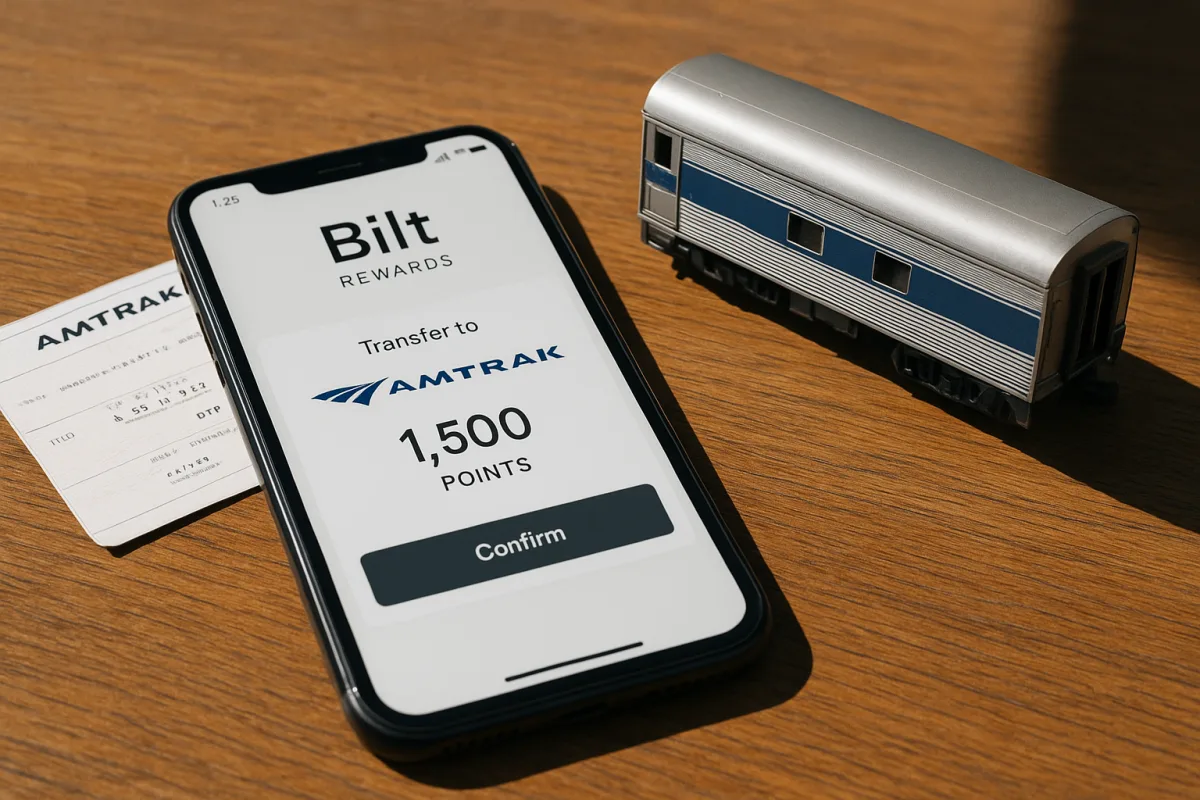
The important number is 2:1
Bilt Rewards has added Amtrak Guest Rewards as a transfer partner, giving Bilt members a route from rent-linked rewards and card spending into U.S. rail travel. The practical detail is the transfer ratio: two Bilt points become one Amtrak point. [8][10]
That means a 1,000-point Bilt transfer deposits 500 Amtrak points. Transfers are made in 1,000-point Bilt increments, although Bilt Blue-status members reportedly face a 2,000-point minimum, and published maximums reach one million Bilt points. [7][11]
This is not a small distinction. A traveler with 10,000 Bilt points does not have 10,000 Amtrak points to spend, they have 5,000 after transferring. That halving is the number to keep in view before looking at sleeper cars or first-class upgrades.
Bilt and Amtrak describe the partnership as a new way to turn Bilt rewards into rail travel, and it fills a real gap. The Points Guy notes that Amtrak has not had a major transferable-points partner since Chase Ultimate Rewards ended its relationship in 2015. [8][10]
For someone based in the Northeast who takes Amtrak regularly, access matters as much as theoretical value. A Bilt balance can now help pay for a Northeast Regional ticket, an Acela upgrade or part of a long-distance roomette without first earning points through Amtrak’s own credit cards.
But the transfer ratio makes this a targeted tool, not automatically the best redemption. Bilt points transfer to World of Hyatt at 1:1, and available valuations put Hyatt points around 2.05 cents each, versus roughly 1.4 cents for Alaska Airlines miles. [9][11]
Why the value is usually lower than it looks
Amtrak does not publish a traditional distance-and-zone award chart where, for example, Chicago to Seattle costs the same fixed number of points on every date. Instead, award prices broadly move with the cash fare. [3][8]
In plain terms, a costly train is generally costly in points too. Friday departures, holidays, peak foliage dates and the remaining inventory on a particular train can all make a redemption require more points than the same route on a quieter day.
Independent estimates put Amtrak Guest Rewards points around 2.5 to 2.9 cents each when used for train travel, while Citizen Daily Post reports a markedly lower 1.17-cent average. The disagreement reflects what is being measured and how selectively a traveler redeems. [1][2]
The higher figure is plausible when points replace an expensive rail fare. The lower figure is a warning against treating every redemption as equally good, particularly when points go toward lower-value options such as gift cards, which generally return about 0.83 to one cent per point. [1]
Use the middle of the higher train-redemption range, about 2.6 cents per Amtrak point, and the Bilt arithmetic is straightforward. Two Bilt points create one Amtrak point worth roughly 2.6 cents, or about 1.3 cents of train value per original Bilt point. [1][8]
That is not worthless. It is better than letting points sit unused, and it may save cash at exactly the moment a rail ticket is needed. It is simply weaker than a 1:1 transfer to a higher-value partner in many cases.
The Points Guy illustrated this with a New York to Washington Northeast Regional search: coach cost $25 or 938 Amtrak points, while business class cost $258 or 9,675 points. At the 2:1 ratio, business class would require 19,350 Bilt points. [8]
The cash and points prices in that example produce nearly identical value per Amtrak point. But they also show why travelers should not transfer first and search later. The same business-class trip consumes almost twenty times as many Bilt points as the coach seat.
Sleeper cars are the clearest use case, but not a bargain by default
The partnership will attract attention because Amtrak’s long-distance private rooms are expensive in cash and can turn a train journey into accommodation as well as transport. A roomette or bedroom includes meals and lounge access at eligible stations. [8]
That package is particularly relevant on routes such as the California Zephyr between Chicago and the Bay Area, the Empire Builder between Chicago and the Pacific Northwest, or the Southwest Chief to Los Angeles. Yet the points price is still dynamic.
The Points Guy found an Empire Builder Seattle-to-Chicago example priced at $225 or 8,438 points in coach, and $715 or 26,813 points in a private room. The private-room award would therefore require 53,626 Bilt points after the transfer. [8]
At first glance, using 53,626 Bilt points to avoid a $715 room charge may feel disappointing. It works out to about 1.33 cents per Bilt point, which is exactly what the 2:1 ratio predicts when Amtrak points redeem near 2.67 cents each. [8]
The reason to do it is not to beat every possible Bilt partner. It is to avoid spending $715, or whatever the room costs on the date you actually need, when a sleeper is the trip you want and your Bilt balance is otherwise idle.
Timing matters more for sleepers than for a short corridor ride. The room inventory is limited, and Amtrak’s dynamic pricing means a high-demand summer departure or holiday-period room can require more points, more cash, or simply have no desirable award space left. [3][4]
The research available does not identify a public 2026 blackout-date calendar. That should not be interpreted as a guarantee of unrestricted booking, since capacity and fare rules still govern what appears in an Amtrak search. [4]
Search the exact date in Amtrak Guest Rewards first, using the “Use points” option while logged into an account. Note both the cash fare and points fare, then transfer only if the room or seat remains bookable and the arithmetic works for your trip. [3][8]
Upgrades are a smaller and often smarter transfer
For travelers who already expect to buy a rail ticket, Bilt-to-Amtrak transfers may work best as an upgrade fund. Amtrak lists one-class upgrades from 2,500 points for a one-way trip of up to 12 hours, subject to availability and fare restrictions. [3]
At Bilt’s 2:1 ratio, that starting upgrade costs 5,000 Bilt points. View from the Wing notes that Acela first-class upgrades can begin at 2,500 Amtrak points, and that the cash value of an offered upgrade can vary widely. [5]
The decision is therefore a cash-replacement calculation. If an available upgrade costs $150 and requires 2,500 Amtrak points, using 5,000 Bilt points replaces three cents of cash cost per resulting Amtrak point, or 1.5 cents per Bilt point.
That is better than the approximate 1.3-cent baseline, although it still may not outrun a well-chosen hotel transfer. If Amtrak offers the same upgrade for far less cash, paying cash and retaining flexible Bilt points is usually the cleaner choice.
The mechanics matter. Upgrade redemptions require an eligible lower-class booking first, then application of the upgrade coupon within 12 hours of departure, with the train, fare and capacity determining whether it clears. [3][5]
This is not a way to turn any coach ticket automatically into a sleeper. Check the rules attached to the particular fare and train, and assume that premium inventory can disappear before a delayed points transfer lands in the account.
A lounge pass is another defined use, costing 1,500 Amtrak points per pass, subject to station capacity and policy. That equals 3,000 Bilt points, a poor exchange unless buying access would otherwise be important for a long layover. [3]
Transfer late, not early
The transfer process starts by linking active Bilt and Amtrak Guest Rewards accounts. Eligibility is limited to U.S.-based members aged 18 or older, and transfers are irreversible once submitted. [7][11]
Some early coverage said transfers would be nearly instantaneous. Current published guidance is less reassuring, stating that transfers generally process within 72 hours and may be delayed by technical or operational issues. Plan around the longer timeline. [7][8]
That distinction is crucial when pursuing a roomette or a low-priced Acela seat. A traveler who sees inventory at breakfast, transfers speculatively, and finds it gone by the time points arrive has converted flexible Bilt currency into Amtrak-only currency unnecessarily.
Amtrak points expire after 24 months without qualifying earning or redemption activity. A transfer can refresh an account’s activity, but that alone is not a strong reason to halve a flexible Bilt balance unless a small transfer prevents a useful existing balance from expiring. [4][5]
The best workflow is deliberately unglamorous: price the cash ticket, price the points ticket, calculate the Bilt points required by doubling the Amtrak total, then check whether the cash saving justifies giving up Bilt’s more flexible transfer options.
For a specific sleeper, a top-up to reach an Amtrak award, or a costly last-minute first-class upgrade, the partnership can be genuinely useful. For routine transfers made months before travel, the 2:1 ratio and dynamic award pricing make patience more valuable than enthusiasm.
Frequently Asked Questions
How do I transfer Bilt points to Amtrak Guest Rewards?
To transfer Bilt points to Amtrak Guest Rewards, you must link your Amtrak and Bilt accounts and be a U.S.-based member aged 18 or older with an active Amtrak Guest Rewards account. Transfers are made in 1,000-point Bilt increments (2,000 minimum for Blue Status members) and cannot be reversed once completed.
What is the transfer ratio between Bilt points and Amtrak points?
The transfer ratio is 2:1, meaning 2 Bilt points convert into 1 Amtrak Guest Rewards point. For example, transferring 1,000 Bilt points will deposit 500 Amtrak points into your account.
Is transferring Bilt points to Amtrak a good value?
Transferring Bilt points to Amtrak generally yields about 1.25 to 1.45 cents of train value per Bilt point due to the 2:1 ratio and Amtrak’s dynamic pricing. This value is lower than transferring Bilt points to Hyatt (around 2.05 cents per point) or Alaska Airlines miles (about 1.4 cents per mile), so it is best used to close small points gaps or fund specific Amtrak redemptions rather than as a default option.
Can I use Bilt points for Amtrak sleeper car upgrades?
Yes, you can use Amtrak points (obtained via Bilt transfers) for sleeper car upgrades, but there is no fixed-price award chart. The points required fluctuate with cash fares, season, and availability. Upgrades cost 2,500 points for a one-class upgrade on trips up to 12 hours, and you must book a lower class fare first and apply the upgrade coupon within 12 hours of departure.
How long does it take to transfer Bilt points to Amtrak?
Transfers are generally processed promptly but can take up to 72 hours. Because availability for certain seats or sleeper rooms can be limited, it is risky to transfer points without a confirmed booking or before checking availability.
How we researched this
This article was assembled from 2 published articles, 11 cited references.
Nothing here is based on hands-on testing. Where a figure or finding appears, it belongs to the source cited beside it, and the writing says so rather than implying otherwise. Every source is listed below so you can check it.
Sources
Bilt adds Amtrak as its first rail transfer partner — The Points Guy
Bilt Points Now Transfer To Amtrak—First Class Train Upgrades And Sleeper Cars — View from the Wing
Bilt's Amtrak Transfer: First Class Sleepers for Rent Points
World of Hyatt Transfer Partners (2), Ratios & Sweet Spots | TravelDiari
Related Articles

Travel Budgeting and Rewards Programs: How to Maximize Value
Learn how to budget your trip and maximize travel rewards programs for flights, hotels, and more with smart points redemption strategies.

Luxury Hotel Travel Rewards 2026
Explore luxury hotel travel rewards in 2026 and learn how $600 hotel credits truly work to reduce your travel costs.
Travel Credit Card Comparison 2026: Chase vs Amex Platinum
Compare Chase Sapphire Reserve and Amex Platinum cards for 2026 travel budgets, rewards, lounge access, and perks to choose the best travel credit card.

Airport Lounge Access Credit Cards
Compare airport lounge access credit cards like Citi Strata Elite and Marriott Bonvoy Brilliant to find the best fit for your travel needs.