
Travel Credit Card Rewards and Airline Deals in 2026
Learn how to maximize travel credit card rewards and find top airline deals for 2026-2027 with expert tips on points value and booking strategies.
The number to calculate before using any point
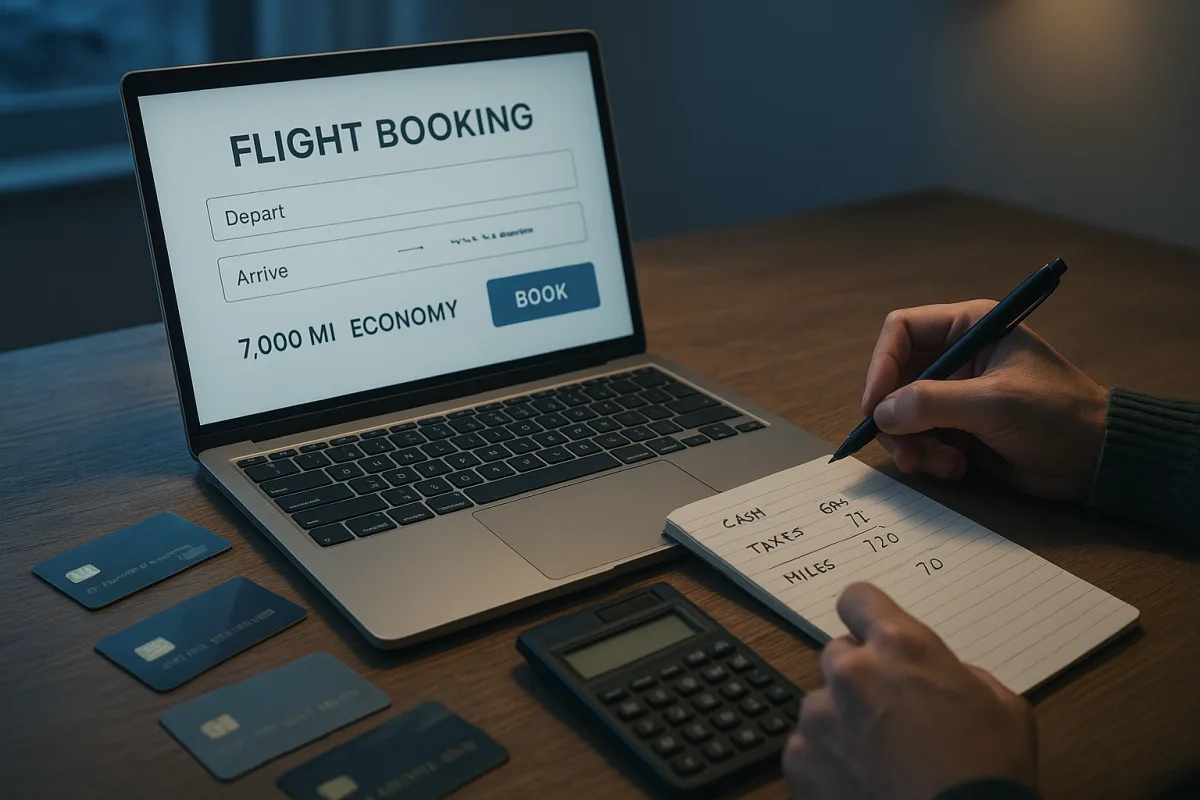
An 8,000-mile American Airlines flight from Philadelphia to Los Angeles looks like a bargain on the booking screen. It can be one. But the number that decides whether it saves you money is the cash fare you avoid per point spent.
Use this calculation: cash ticket price minus unavoidable taxes and fees, divided by the number of points or miles required. If a $180 one-way flight costs 8,000 miles plus $5.60, you save $174.40, or about 2.18 cents per mile.
That result is not a promise of value for every American mile. It is the value of that particular seat, on that particular date, compared with the trip you would actually have paid for.
This is the central mechanic of travel rewards. Points are not cash, and a large balance does not automatically mean a cheap trip. They are a restricted payment method whose value changes with award availability, fare prices, route, cabin, and the rules attached.
Start with the trip price, not the points balance
A cash fare has a visible dollar cost. An award ticket commonly has a points price plus government taxes and fees, and it may exclude extras such as a checked bag, seat assignment, meals, or flexibility.
The comparison should use the fare you would genuinely book. Comparing a 25,000-mile economy award with a $1,200 refundable business-class ticket makes the math look excellent, but it does not save you $1,200 if you would have flown economy.
This is where airline sales can work well. American’s current AAdvantage promotion covers travel from Jan. 11 through Feb. 28, 2027, with awards starting at 7,000 miles one-way from Chicago and 8,000 miles on many other domestic routes. [8]
The Points Guy found sale examples including 22,500-mile one-way economy awards to Zurich and 25,000-mile flights from Los Angeles to Tokyo or Sydney. These are economy awards, not discounted premium-cabin tickets, so judge them against the economy cash fare. [8]
American says the promotion applies to American Airlines and American Eagle-operated flights, excluding codeshares, and mileage pricing can change. The carrier has not published blackout dates, but award seats remain limited, so a sale does not mean every flight is available. [8]
A 7,000-mile Chicago departure can be excellent value on a Friday or Sunday when cash prices are high. On a quiet Tuesday with a $79 cash fare, paying cash and keeping the miles may be the better move.
The booking deadline is Nov. 11, 2026. The Points Guy reported the sale as a 72-hour event, so search first, note the exact cash fare beside the award price, and book the route you can use instead of collecting speculative tickets.
Why a welcome offer is not free airfare
A credit card welcome offer is often the quickest route to a useful points balance, but it has a price beyond the annual fee. You must meet the spending requirement, maintain the account, and avoid carrying interest, which can erase travel savings rapidly.
View from the Wing’s November roundup highlighted unusually large offers, including bonuses of up to 200,000 points on premium cards. Large numbers attract attention, but the right question is whether the required spending fits expenses already in your budget.
The Southwest Rapid Rewards Plus card, for example, was listed with an 80,000-point bonus after $1,000 in spending within three months and a $99 annual fee. For a Southwest traveler, that is a low spending threshold for a substantial bonus.
The same roundup noted that Southwest’s Companion Pass can let a named companion fly for taxes and fees when you fly, including on a points ticket. That can change the calculation for a couple taking several domestic trips through 2027.
But do not value 80,000 Southwest points as a fixed dollar amount before checking your likely routes. A point has value only at redemption, and a Companion Pass is valuable only if both travelers can take the same flights often enough.
We would apply for a card bonus only with a specific use in mind: a winter flight, a hotel stay, or a known year of travel. A bonus that sits unused can lose value if an airline raises award prices or a program changes partners.
The two-player system: separate accounts, coordinated plan
For couples, the major advantage is not a mythical joint travel-card approval. It is that each person can hold their own account and, when eligible, earn their own welcome offer.
Joint credit cards are now uncommon, and Capital One does not offer them. [1] Most couples will encounter the standard arrangement instead: one primary cardholder, plus an authorized user who can make purchases but is not the person legally responsible for the bill. [2]
The primary cardholder remains liable for authorized-user spending. That makes an authorized-user card a tool for shared groceries, gas, and travel expenses, not a substitute for agreeing on a spending limit before handing over the card.
Each partner is approved on their own credit profile and application. Applicants age 21 or older may include household income they can reasonably access, while applicants under 21 generally need independent income or a co-signer. [3]
The Points Guy recommends coordinating applications so two minimum-spending requirements do not collide. That is the rule we would follow. Two bonuses are only a win if your normal spending can clear both requirements without buying things early or carrying a balance.
Separate accounts can also solve a basic travel problem. One partner can earn flexible points for flights while the other earns hotel points in a program with properties where you are going, or both can earn the same currency for two award seats.
Adding an authorized user can make sense when the benefit genuinely extends. The Points Guy cites the American Express Platinum Card, where an additional Platinum card costs $195 and can provide lounge access and selected hotel-status benefits, though statement credits remain shared.
Do not pay an authorized-user fee solely to create a second traveler’s benefits if the card’s credits are pooled. A $200 annual credit remains a $200 annual credit, even if two cards can make purchases against it.
Chase points: compare the portal with the transfer
Chase Ultimate Rewards presents a second version of the same calculation. You can use points in Chase Travel, Chase’s online booking portal, or transfer them to participating airline and hotel programs. [4]
Chase Travel works much like an online travel agency: you can book flights, hotels, rental cars, cruises, tours, and activities with cash, points, or a mix. Its baseline redemption value is 1 cent per point, with select Points Boost offers reaching 1.5 to 2 cents. [4]
A 30,000-point portal booking at 1 cent per point offsets $300 of travel. At a 1.5-cent Points Boost rate, those same points cover $450. You need to see the rate on the exact booking page, not assume every itinerary receives the boost.
The Points Guy reports that portal flight prices average 6% higher than airline-direct prices. That means a $500 ticket could appear as a $530 portal booking, reducing the apparent value of your points before you even compare transfer options.
Transfers are usually strongest when a partner program has a low award price for an expensive flight or hotel. Chase transfers to World of Hyatt at 1:1 for Sapphire Reserve cardholders, while other cardholders receive a 4:3 ratio, according to current program terms. [4]
That difference can change the math sharply. A Hyatt night requiring 15,000 points costs 15,000 Chase points with a Sapphire Reserve transfer, but 20,000 Chase points at a 4:3 transfer ratio.
Portal bookings also have trade-offs at hotels. A third-party reservation typically will not earn hotel points, elite-night credit, or status benefits, although The Edit by Chase Travel is an exception at participating luxury properties, The Points Guy reports.
We would use Chase Travel for a low cash fare, an independent hotel with no meaningful loyalty program, or a flight where no award seat exists. For a Hyatt stay or an expensive international flight, transfer comparisons come first.
Airline bundles show why the cheapest award is often best
Frontier provides a clear example of how a redemption can look premium while spending points inefficiently. Its Basic award starts at 3,000 miles one-way, while the Business Bundle starts at 8,000 miles, plus taxes and fees from $5.60. [5]
The Business Bundle includes an UpFront Plus seat, a carry-on, and two checked bags up to 50 pounds each. It does not include complimentary food, drinks, or lounge access, so “business” means bundled convenience, not a conventional premium cabin. [5]
The Points Guy tested Basic from St. Louis to Denver and Business Bundle from Denver to Kansas City. The Basic ticket was workable for a two-hour trip with only a personal item, while the bundle’s empty middle seat and bags were pleasant but expensive. [6]
The key restriction is timing. Frontier allows miles to pay for bundles only during the original booking, not as a later upgrade, so you must know your luggage needs before redeeming. [5]
For most weekend trips, the Economy Bundle is the better middle ground. The Points Guy found it starts 2,000 miles above Basic and includes the carry-on that Basic excludes, without spending the additional 8,000 miles required for Business. [6]
We would reserve Frontier Business Bundle redemptions for a trip needing two checked bags or for a traveler who puts real value on the UpFront Plus seat. Otherwise, spend fewer miles and bring the bag you need.
A branded-card fee must pay for itself every year
The United Quest card illustrates the final part of the equation: recurring card benefits. Chase lists a $250 annual fee, a $200 annual United TravelBank credit, priority boarding, and a first and second checked bag for the primary cardholder and one companion. [9]
The $200 credit can offset most of the annual fee only if you would otherwise buy a qualifying United ticket. If you fly United once a year from Newark to Bozeman, as The Points Guy’s writer did, it can reduce a $488 round trip to $288.
The card also offers United award discounts and access to additional Saver award inventory, according to Chase. [9] Those benefits can outweigh the remaining $50 fee for a traveler repeatedly booking United awards, especially on routes with scarce cheap seats.
The Points Guy initially reported a $350 annual fee, but Chase’s current United Quest card page lists the fee as $250. [9] Check the issuer’s page before applying, because credits, welcome offers, and qualification rules can change.
A card can be worth keeping after the bonus, but only if its benefits clear a simple annual test. Add the credits you will actually use, the baggage fees you will avoid, and the mileage savings on redemptions, then subtract the fee.
Frequently Asked Questions
How do I calculate the value of travel credit card points in 2026?
Calculate the value by subtracting unavoidable taxes and fees from the cash ticket price, then divide that net savings by the number of points required for the award. For example, if a $180 flight costs 8,000 miles plus $5.60 in fees, the value per mile is about 2.18 cents. This method compares the actual cash fare you would pay to the points cost for that specific flight and date.
What are the best airline award deals for 2026-2027?
American Airlines’ winter award sale offers economy seats starting at 7,000 to 25,000 miles one-way on American and American Eagle flights for travel between January 11 and February 28, 2027. Notable deals include 7,000-mile flights from Chicago and 22,500-mile awards to Europe. Availability is limited, so compare the miles required to the cash fare to determine value before booking.
How can couples maximize travel credit card welcome offers?
Each person should apply for their own credit card account to earn separate welcome offers, as joint credit cards are now rare. Authorized user cards help share spending and benefits but typically do not earn a second welcome bonus. Coordinating applications and spending between two individual accounts can maximize total points earned.
When is the American Airlines winter award sale in 2026?
The booking deadline for American Airlines’ winter award sale is November 11, 2026. The sale applies to travel from January 11 through February 28, 2027, on American and American Eagle-operated flights, with award seats starting at 7,000 miles one-way on select routes.
Should I use Chase Travel portal or transfer points to airlines?
Use the Chase Travel portal when cash fares are low or award seats are unavailable, as points redeem at about 1 cent each, sometimes boosted to 1.5 to 2 cents. However, transferring points to airline or hotel partners often yields higher value, so check partner availability and redemption rates before deciding.
How we researched this
This article was assembled from 6 published articles, 9 cited references.
Nothing here is based on hands-on testing. Where a figure or finding appears, it belongs to the source cited beside it, and the writing says so rather than implying otherwise. Every source is listed below so you can check it.
Sources
How couples can maximize credit card rewards and benefits, The Points Guy
Best Rewards Card Offers Right Now, Up To 200,000 Points In Bonuses For Premium Travel [November 2026], View from the Wing
American launches award sale: 1 million seats discounted, starting at 8,000 miles, The Points Guy
Chase Travel explained: Points Boost, redemption rates and smart ways to book, The Points Guy
Is Frontier's Business Bundle worth the extra miles? I put it to the test, The Points Guy
Why I was pleasantly surprised with all the perks of the Chase United Quest card, The Points Guy
Including a Spouse’s Income When Applying for a Credit Card - NerdWallet
Frontier Business Bundle vs. Basic: Worth the extra miles? - The Points Guy
AAdvantage® terms and conditions (Effective March 1, 2026) − American Airlines
Related Articles

Travel Credit Card Perks
Explore travel credit card perks, airline benefits, and tips to choose the best card for your travel needs and maximize rewards.
Travel Credit Card Changes in 2027: What to Expect
Discover key travel credit card changes in 2027, including Bilt and Citi updates, fees, and loyalty program shifts to plan your travel spending wisely.

Travel Budgeting and Rewards Programs: How to Maximize Value
Learn how to budget your trip and maximize travel rewards programs for flights, hotels, and more with smart points redemption strategies.

Luxury Hotel Travel Rewards 2026
Explore luxury hotel travel rewards in 2026 and learn how $600 hotel credits truly work to reduce your travel costs.