
Hotel Booking and Upgrade Innovations
Explore hotel booking and upgrade innovations, including Marriott's upgrade queue and price transparency tips for smarter bookings.
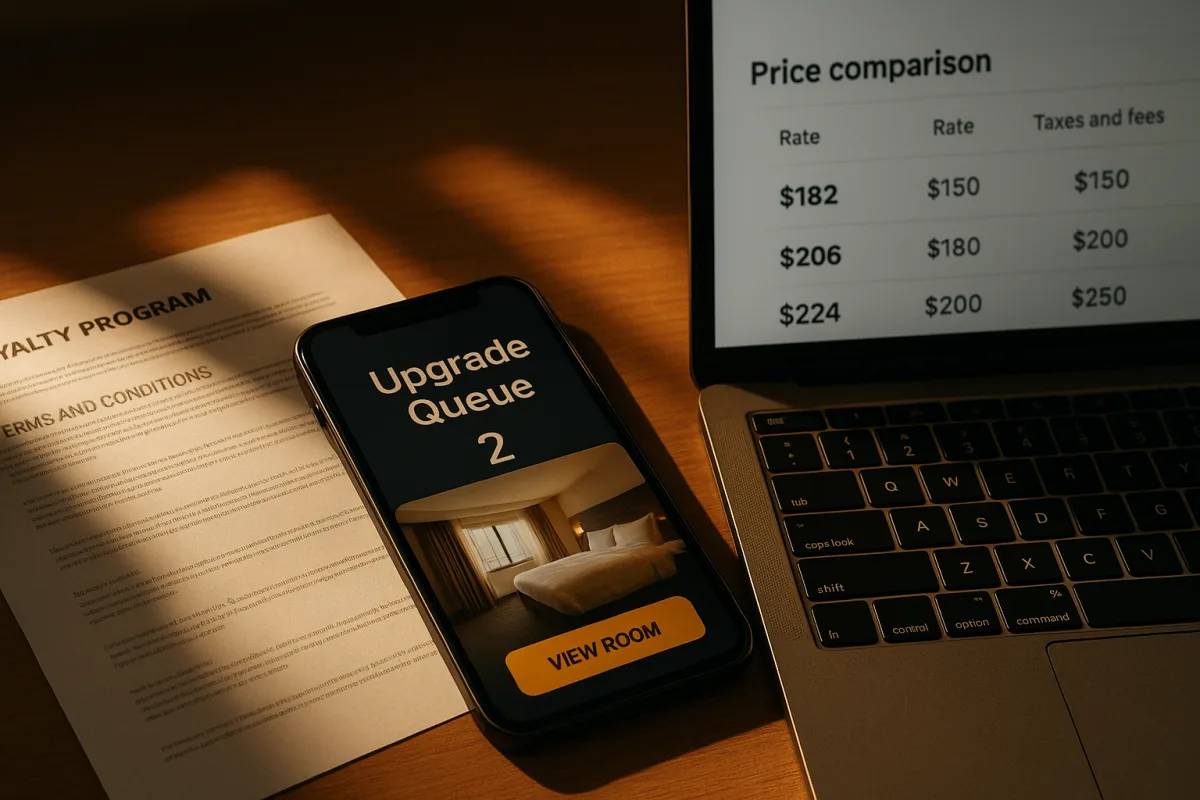
Hotel Booking Is Becoming Less Opaque, but Not Necessarily Cheaper
The shift is from hidden rules to visible queues
Hotel booking has long depended on rules a guest cannot see. A traveller may find several prices for the same room, but not know why they differ. An elite member may be told upgrades are “subject to availability,” without seeing who is ahead.
That is beginning to change, though unevenly. Marriott Bonvoy is testing an app-based Complimentary Upgrade List, while a proposed U.S. class action against Expedia challenges the contracts and algorithms that plaintiffs say keep hotel prices high across booking channels. [1][3]
These are not the same development, and neither proves the other. One is a loyalty-programme feature controlled by a hotel company. The other is unresolved litigation about online distribution. Together, though, they reflect greater pressure for hotel booking systems to explain their decisions.
Several travel-industry outlets independently reported Marriott’s upgrade-list test, including One Mile at a Time, The Points Party and View from the Wing. [1][5][6] The common detail matters more than the commentary: eligible Bonvoy members can see a position in an upgrade queue before arrival.
Likewise, several legal and hotel-trade reports identify the same October 2, 2026 filing, Andrews v. Expedia Group, in the U.S. District Court for the Western District of Washington. [2][3][4] The allegations are serious, but they remain allegations, not findings.
For people arranging their own trips, the useful lesson is practical rather than ideological. Hotel rates and upgrades are becoming a little more legible, but the booking still requires comparison shopping and a clear understanding of what each channel includes.
Marriott’s queue answers one question, not all of them
Marriott’s beta feature borrows the basic logic of an airline upgrade list. Instead of waiting until the front desk, a qualifying Bonvoy member can see where they stand among guests seeking a complimentary room upgrade. [1][5]
The test is limited. Marriott had not published adoption figures, satisfaction data or evidence that the tool leads to more upgrades as of mid-October 2026. Reports describe a beta rollout to selected members and properties, rather than a programme-wide policy. [1][5]
That distinction is important when choosing a hotel. A visible queue can reduce uncertainty, especially on a short city break where a larger room would genuinely change the stay. It does not create inventory in a sold-out hotel.
The list also makes a hierarchy that travellers should already assume, but often do not. Marriott’s Nightly Upgrade Awards are prioritised ahead of complimentary elite upgrades, and rooms tied to those awards are excluded from the app’s estimate of complimentary upgrade availability. [1][5]
In plain terms, a Gold, Platinum, Titanium or Ambassador member might see an apparently favourable queue position without receiving an upgrade. The hotel may have no qualifying rooms left after confirmed reservations, paid upgrades and Nightly Upgrade Award requests are processed.
That does not make the feature useless. It helps a guest decide whether to ask a precise question before arrival, such as whether a paid upgrade is worth considering, rather than relying on vague front-desk language.
There is also an awkward side to transparency. Limited anecdotal reports note that some users have watched their queue position move despite no upgrade rooms appearing available. The briefing found no broad evidence of guest backlash or a measurable service problem.
For now, the sensible way to use the list is as a planning signal. If the larger room matters, book the room type you need. If it is a nice-to-have, book a flexible standard room and regard any complimentary upgrade as an uncertain bonus.
A visible queue may expose the value of status
The upgrade-list experiment arrives when hotel loyalty is increasingly sold through credit cards, qualifying-night promotions and elite benefits. Status can look more valuable in marketing than it feels during a fully booked convention week or a holiday weekend.
Showing the queue may make that gap more obvious. A member can see, rather than merely suspect, that many other elite guests are competing for the same handful of suites or premium rooms. [6]
That transparency could improve trust if members see upgrades clearing regularly at quieter hotels. It could also prompt sharper questions about the value of holding status when a guest repeatedly lands behind award requests or higher-tier members.
Marriott’s decision to test the feature suggests it sees value in answering requests for clarity. Still, there is no published evidence yet that the list improves retention, upgrade satisfaction or hotel-level operations. Those claims would be premature. [1][5]
For trip planning, seasonality remains more useful than app mechanics. A Sunday night in a business district, or a low-demand weekday outside school holidays, is more likely to produce room inventory than a high rank during a peak weekend.
Bookers should also separate an upgrade from an included benefit. Lounge access, breakfast, late checkout, parking and resort fees can affect a stay’s real value more than moving from a standard king room to a slightly larger category.
The Expedia case is a warning, not a refund opportunity
The Expedia lawsuit is about a different kind of opacity: the possibility that hotel distribution rules raise what consumers pay. Plaintiffs allege that restrictive contracts and search practices inflated prices nationwide, violating U.S. antitrust law. [2][3]
The proposed class is unusually broad in one respect and narrow in another. It covers certain U.S. consumers who booked Expedia-listed hotels through hotel websites or competing booking sites from October 2, 2022 onward, but excludes Expedia’s own customers. [2][4]
That exclusion will surprise many people who see headlines about Expedia rates. The lawsuit’s theory is not simply that Expedia customers paid too much. It alleges that Expedia’s practices affected prices available to people booking elsewhere. [2][3]
As of October 13, 2026, the case had no certified class, settlement, claims process or reported public response from Expedia. [2][4] Nobody should make a booking decision on the assumption that reimbursement will follow.
The complaint reportedly points to rate-parity-style restrictions, supplier arrangements and search visibility. Those allegations may eventually be tested through motions, evidence gathering, expert analysis and, potentially, a trial. They are not established facts today. [3][4]
That caution matters because a high online travel agency commission is not, by itself, proof of consumer overcharging. Expedia hotel commissions are commonly reported at roughly 15% to 25%, with an average around 18% to 20%, depending on market and property arrangements. [7][8]
Properties may also pay for added visibility through programmes such as TravelAds or Accelerator, according to the commission guides. [7][8] Those costs create a reason for hotels to prefer direct bookings, but they do not demonstrate that every direct price will be lower.
There is no reliable public dataset showing how Expedia commission rates have changed year by year since 2021. Individual hotel contracts are negotiated and generally undisclosed, so confident claims about a recent commission trend should be treated cautiously. [7][8]
What to compare before clicking book
The most useful response to the lawsuit is not to abandon online travel agencies. They remain useful search tools, particularly for comparing independent hotels across a neighbourhood. The better habit is to use them for discovery, then price the direct channel properly.
Start with the exact same variables: hotel, room category, bed type, number of guests, cancellation deadline and payment timing. A lower price that is non-refundable, excludes breakfast or requires prepayment is not equivalent to a flexible direct member rate.
Then compare the all-in total. Taxes, mandatory resort or destination fees, parking and any local charges can change the arithmetic. If the site displays only a nightly rate until late in the process, continue far enough to see the total.
For chain hotels, log into the loyalty account before comparing. Member rates, points, elite benefits and qualifying-night credit often apply only to direct bookings, while an online agency may offer its own discount or package value.
For an independent hotel, send a short direct message if the difference is small. Ask whether the property can match a publicly available rate, include breakfast or offer a better cancellation policy. A polite request costs nothing and makes the comparison clearer.
Do not assume the hotel website always wins. The reporting around the Expedia case has highlighted examples of lower prices through other channels, and prices can differ because of targeted member offers, packages or inventory allocations. [3][4]
The practical target is not ideological purity about booking direct. It is the best bookable deal for the trip you are actually taking, including the flexibility and benefits you are likely to use.
A more transparent booking process still needs scepticism
Marriott’s upgrade list is a modest but concrete improvement because it replaces a black box with some operational information. The Expedia lawsuit may eventually reveal more about hotel distribution, but it currently offers allegations rather than a proven explanation for hotel pricing.
Both developments reward travellers who look past a single headline number. A queue position is not a suite, a member discount is not automatically the lowest total, and a lawsuit is not evidence that every online rate is inflated.
The strongest booking workflow remains fairly unglamorous: search broadly, compare like for like, join free hotel loyalty programmes when useful, and save screenshots of the terms before paying. The new tools can make that process clearer, but they do not replace it.
Frequently Asked Questions
How are hotel booking systems becoming more transparent?
Hotel booking systems are shifting from hidden rules to visible queues, making some decisions clearer to travelers. For example, Marriott Bonvoy is testing an app feature that shows elite members their position in the upgrade queue, while a U.S. class action lawsuit against Expedia challenges opaque pricing algorithms and contracts. These developments reflect growing pressure for hotel booking processes to be more explainable, though transparency remains uneven.
What is Marriott Bonvoy's upgrade queue and how does it work?
Marriott Bonvoy’s upgrade queue is a beta app feature that lets eligible elite members see their place in line for complimentary room upgrades before arrival. The system prioritizes Nightly Upgrade Awards ahead of complimentary upgrades, and the feature is currently limited to select members and properties. It aims to reduce uncertainty but does not guarantee an upgrade or increase available inventory.
Does seeing an upgrade queue guarantee a hotel room upgrade?
No, seeing your position in Marriott Bonvoy’s upgrade queue does not guarantee an upgrade. The queue provides information about your rank among other guests seeking upgrades but does not create additional available rooms. Upgrades remain subject to availability, and Nightly Upgrade Awards are prioritized over complimentary upgrades.
How can travelers compare hotel booking rates effectively?
Travelers should compare final cancellable rates rather than just headline nightly prices, taking into account taxes, resort fees, breakfast, and loyalty benefits. Checking a hotel’s direct member rate alongside at least one online travel agency is recommended, as pricing differences may exist and lawsuits alleging inflated rates have not been legally confirmed.
What impact does the Expedia lawsuit have on hotel prices?
The Expedia lawsuit, filed in October 2026, alleges that Expedia’s contracts and algorithms inflated hotel prices nationwide, but these remain allegations without court findings. The case is at an early stage with no certified class or claim forms available, so travelers should not delay bookings expecting compensation or price changes related to this lawsuit.
How we researched this
This article was assembled from 2 published articles, 8 cited references.
Nothing here is based on hands-on testing. Where a figure or finding appears, it belongs to the source cited beside it, and the writing says so rather than implying otherwise. Every source is listed below so you can check it.
Sources
Marriott Bonvoy will now let you see where you stand in line for a hotel upgrade — The Points Guy
Expedia Sued For Inflating Hotel Rates By Up To 30%—But You Can Already Book The Same Room For Less — View from the Wing
Marriott Tests Airline-Style Upgrade List That Ranks Bonvoy Elite Members - One Mile at a Time
Expedia class action alleges hotel pricing rules drove up room rates nationwide - Hotel.Report EN
Expedia accused of inflating hotel prices in antitrust class action
Marriott Is Testing an In-App Upgrade List That Shows Your Place in Line — The Points Party
Marriott Tests An Airline-Style Upgrade Waitlist—Showing Where Your Elite Status Really Puts You
Related Articles

Airport Lounge Access Credit Cards
Compare airport lounge access credit cards like Citi Strata Elite and Marriott Bonvoy Brilliant to find the best fit for your travel needs.

Airline Loyalty Program Changes and Updates in 2026
Explore 2026 airline loyalty program changes, status updates, and how fare choices impact upgrades and benefits across major US airlines.
Google AI Travel Booking: How It Works and What to Know
Learn how Google AI travel booking works, its benefits, limitations, and how it affects hotel loyalty and flight price tracking.

Cruise Loyalty Programs
Explore cruise loyalty programs like Norwegian Latitudes and Ponant Yacht Club to see which offers better rewards and benefits for your cruising style.